
Catalogue Search | MBRL


Are you sure you want to remove the book from the shelf?

{{itemTitle}}
1,751,817
result(s) for
"computer science"
Sort by:


Big Data, Little Data, No Data
\"Big Data\" is on the covers ofScience, Nature, theEconomist, andWiredmagazines, on the front pages of theWall Street Journaland theNew York Times.But despite the media hyperbole, as Christine Borgman points out in this examination of data and scholarly research, having the right data is usually better than having more data; little data can be just as valuable as big data. In many cases, there are no data -- because relevant data don't exist, cannot be found, or are not available. Moreover, data sharing is difficult, incentives to do so are minimal, and data practices vary widely across disciplines.Borgman, an often-cited authority on scholarly communication, argues that data have no value or meaning in isolation; they exist within a knowledge infrastructure -- an ecology of people, practices, technologies, institutions, material objects, and relationships. After laying out the premises of her investigation -- six \"provocations\" meant to inspire discussion about the uses of data in scholarship -- Borgman offers case studies of data practices in the sciences, the social sciences, and the humanities, and then considers the implications of her findings for scholarly practice and research policy. To manage and exploit data over the long term, Borgman argues, requires massive investment in knowledge infrastructures; at stake is the future of scholarship.
eBook

The computing universe : a journey through a revolution
\"Computers now impact almost every aspect of our lives, from our social interactions to the safety and performance of our cars. How did this happen in such a short time? And this is just the beginning. In this book, Tony Hey and Gyuri Pâapay lead us on a journey from the early days of computers in the 1930s to the cutting-edge research of the present day that will shape computing in the coming decades. Along the way, they explain the ideas behind hardware, software, algorithms, Moore's Law, the birth of the personal computer, the Internet and the Web, the Turing Test, Jeopardy's Watson, World of Warcraft, spyware, Google, Facebook, and quantum computing. This book also introduces the fascinating cast of dreamers and inventors who brought these great technological developments into every corner of the modern world. This exciting and accessible introduction will open up the universe of computing to anyone who has ever wondered where his or her smartphone came from\"-- Provided by publisher.
Book

Connected Code
Coding, once considered an arcane craft practiced by solitary techies, is now recognized by educators and theorists as a crucial skill, even a new literacy, for all children. Programming is often promoted in K-12 schools as a way to encourage \"computational thinking\" -- which has now become the umbrella term for understanding what computer science has to contribute to reasoning and communicating in an ever-increasingly digital world.InConnected Code,Yasmin Kafai and Quinn Burke argue that although computational thinking represents an excellent starting point, the broader conception of \"computational participation\" better captures the twenty-first-century reality. Computational participation moves beyond the individual to focus on wider social networks and a DIY culture of digital \"making.\" Kafai and Burke describe contemporary examples of computational participation: students who code not for the sake of coding but to create games, stories, and animations to share; the emergence of youth programming communities; the practices and ethical challenges of remixing (rather than starting from scratch); and the move beyond stationary screens to programmable toys, tools, and textiles.
eBook

Careers in computer science
Careers in computer science are among the hottest, most in-demand occupations in the United States today. Comments from people in the industry, current statistics and forecasts, and realistic descriptions provide a useful look at computer science jobs ranging from software developers to information security analysts to database administrators.
Book

Research methods in human-computer interaction
Research Methods in Human-Computer Interaction is a comprehensive guide to performing research and is essential reading for both quantitative and qualitative methods.Since the first edition was published in 2009, the book has been adopted for use at leading universities around the world, including Harvard University, Carnegie-Mellon University.
eBook

The computer : a very short introduction
Computers have changed so much since the room-filling, bulky magnetic tape running monsters of the mid 20th century. They now form a vital part of most people's lives. And they are more ubiquitous than might be thought - you may have more than 30 computers in your home: not just the desktop and laptop but think of the television, the fridge, the microwave. But what is the basic nature of the modern computer? How does it work? How has it been possible to squeeze so much power into increasingly small machines? And what will the next generations of computers look like? In this Very Short Introduction, Darrel Ince looks at the basic concepts behind all computers; the changes in hardware and software that allowed computers to become so small and commonplace; the challenges produced by the computer revolution - especially whole new modes of cybercrime and security issues; the Internet and the advent of 'cloud computing'; and the promise of whole new horizons opening up with quantum computing, and even computing using DNA-- Source other than Library of Congress.
Book

Data Clustering
Research on the problem of clustering tends to be fragmented across the pattern recognition, database, data mining, and machine learning communities. Addressing this problem in a unified way, Data Clustering: Algorithms and Applications provides complete coverage of the entire area of clustering, from basic methods to more refined and complex data clustering approaches. It pays special attention to recent issues in graphs, social networks, and other domains.The book focuses on three primary aspects of data clustering: Methods, describing key techniques commonly used for clustering, such as feature selection, agglomerative clustering, partitional clustering, density-based clustering, probabilistic clustering, grid-based clustering, spectral clustering, and nonnegative matrix factorization Domains, covering methods used for different domains of data, such as categorical data, text data, multimedia data, graph data, biological data, stream data, uncertain data, time series clustering, high-dimensional clustering, and big data Variations and Insights, discussing important variations of the clustering process, such as semisupervised clustering, interactive clustering, multiview clustering, cluster ensembles, and cluster validation In this book, top researchers from around the world explore the characteristics of clustering problems in a variety of application areas. They also explain how to glean detailed insight from the clustering process-including how to verify the quality of the underlying clusters-through supervision, human intervention, or the automated generation of alternative clusters.
eBook

Computing tomorrow : future research directions in computer science
The book's purpose is to show that long-term research in computer science is crucial and that it must not be driven solely by commercial considerations. The authors don't shirk difficult aspects of their topics, but try to expose them in the simplest terms possible, in order that the reader can understand the issues involved.
Book
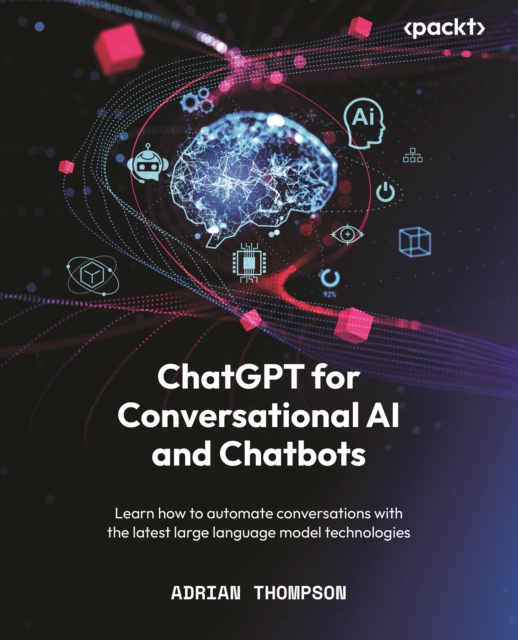
ChatGPT for Conversational AI and Chatbots
Explore ChatGPT technologies to create state-of-the-art chatbots and voice assistants, and prepare to lead the AI revolution
Key Features
Learn how to leverage ChatGPT to create innovative conversational AI solutions for your organizationHarness LangChain and delve into step-by-step LLM application development for conversational AIGain insights into security, privacy, and the future landscape of large language models and conversational AIPurchase of the print or Kindle book includes a free PDF eBook
Book Description
ChatGPT for Conversational AI and Chatbots is a definitive resource for exploring conversational AI, ChatGPT, and large language models. This book introduces the fundamentals of ChatGPT and conversational AI automation. You’ll explore the application of ChatGPT in conversation design, the use of ChatGPT as a tool to create conversational experiences, and a range of other practical applications. As you progress, you’ll delve into LangChain, a dynamic framework for LLMs, covering topics such as prompt engineering, chatbot memory, using vector stores, and validating responses. Additionally, you’ll learn about creating and using LLM-enabling tools, monitoring and fine tuning, LangChain UI tools such as LangFlow, and the LangChain ecosystem. You’ll also cover popular use cases, such as using ChatGPT in conjunction with your own data. Later, the book focuses on creating a ChatGPT-powered chatbot that can comprehend and respond to queries directly from your unique data sources. The book then guides you through building chatbot UIs with ChatGPT API and some of the tools and best practices available. By the end of this book, you’ll be able to confidently leverage ChatGPT technologies to build conversational AI solutions.
What you will learn
Gain a solid understanding of ChatGPT and its capabilities and limitationsUnderstand how to use ChatGPT for conversation designDiscover how to use advanced LangChain techniques, such as prompting, memory, agents, chains, vector stores, and toolsCreate a ChatGPT chatbot that can answer questions about your own dataDevelop a chatbot powered by ChatGPT APIExplore the future of conversational AI, LLMs, and ChatGPT alternatives
Who this book is for
This book is for tech-savvy readers, conversational AI practitioners, engineers, product owners, business analysts, and entrepreneurs wanting to integrate ChatGPT into conversational experiences and explore the possibilities of this game-changing technology. Anyone curious about using internal data with ChatGPT and looking to stay up to date with the developments in large language models will also find this book helpful. Some expertise in coding and standard web design concepts would be useful, along with familiarity with conversational AI terminology, though not essential.
eBook