
Catalogue Search | MBRL


Are you sure you want to remove the book from the shelf?

{{itemTitle}}
76,508
result(s) for
"consumer debt"
Sort by:


Policy Intervention in Debt Renegotiation
We evaluate the effects of the 2009 Home Affordable Modification Program (HAMP) that provided intermediaries with sizable financial incentives to renegotiate mortgages. HAMP increased intensity of re-negotiations and prevented a substantial number of foreclosures but reached just one-third of its targeted indebted households. This short-fall was in large part due to low renegotiation intensity of a few large intermediaries and was driven by intermediary-specific factors. Exploiting regional variation in the intensity of program implementation by intermediaries suggests that the program was associated with a lower rate of foreclosures, consumer debt delinquencies, house price declines, and an increase in durable spending.
Journal Article

What to do when your family is in debt
A guide to debt, what it is, what it may mean for your family, and how you can help.
Book
Debtor nation
Before the twentieth century, personal debt resided on the fringes of the American economy, the province of small-time criminals and struggling merchants. By the end of the century, however, the most profitable corporations and banks in the country lent money to millions of American debtors. How did this happen? The first book to follow the history of personal debt in modern America,Debtor Nationtraces the evolution of debt over the course of the twentieth century, following its transformation from fringe to mainstream--thanks to federal policy, financial innovation, and retail competition.
How did banks begin making personal loans to consumers during the Great Depression? Why did the government invent mortgage-backed securities? Why was all consumer credit, not just mortgages, tax deductible until 1986? Who invented the credit card? Examining the intersection of government and business in everyday life, Louis Hyman takes the reader behind the scenes of the institutions that made modern lending possible: the halls of Congress, the boardrooms of multinationals, and the back rooms of loan sharks. America's newfound indebtedness resulted not from a culture in decline, but from changes in the larger structure of American capitalism that were created, in part, by the choices of the powerful--choices that made lending money to facilitate consumption more profitable than lending to invest in expanded production.
From the origins of car financing to the creation of subprime lending,Debtor Nationpresents a nuanced history of consumer credit practices in the United States and shows how little loans became big business.
eBook

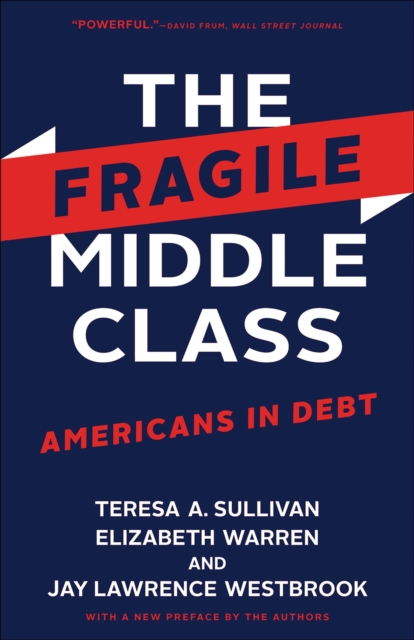
The Fragile Middle Class
Why have so many middle-class Americans encountered so much financial trouble? In this classic analysis of hard-pressed families, the authors discover that financial stability for many middle-class Americans is all too fragile. The authors consider the changing cultural and economic factors that threaten financial security and what they imply for the future vitality of the middle class. A new preface examines the persistent and new threats that have emerged since the original publication. \"[A] fascinating, alarming study. . . . [This] chilling diagnosis of middle-class affliction demonstrates that we all may be only a job loss, medical problem or credit card indulgence away from the downward spiral leading to bankruptcy.\"-Publishers Weekly \"A well-designed and carefully executed study.\"-Andrew Greeley, University of Chicago \"The Fragile Middle Class, a well-written work of social science that is about as gripping as the genre gets, forces us to reevaluate notions about consumerism.\"-American Prospect
eBook


Household Need for Liquidity and the Credit Card Debt Puzzle
In the 2001 U.S. Survey of Consumer Finances, 27% of households report simultaneously revolving significant credit card debt and holding sizeable amounts of low-return liquid assets; this is known as the \"credit card debt puzzle\". In this article, I quantitatively evaluate the role of liquidity demand in accounting for this puzzle: households that accumulate credit card debt may not pay it off using their money in the bank, because they anticipate needing that money in situations where credit cards cannot be used. I characterize the puzzle in survey data, and calibrate a dynamic stochastic heterogeneous-agent model of household portfolio choice, where consumer credit and liquidity coexist as means of consumption and saving, where households consume a cash good and a credit good, and where cash consumption is subject to uncertainty. The model accounts for between 44% and 56% of the households in the data who hold consumer debt and liquidity simultaneously, and for 100% of the liquidity held by a median such household. Under reasonable calibration alternatives, the model can capture the entire puzzle group size as well. One-half of money demand in the model is precautionary.
Journal Article


Consumer debt holding, income and happiness: evidence from China
PurposeThe relationship between debt and happiness is an emerging research topic with significant implications for both theory and practice in economics and business. In China, where the consumer credit market is at an early stage of development, the topic remains under-investigated and the evidence on the debt–well-being link is scarce. The purpose of this study is to examine the association between debt holding and happiness and the moderating role of income in it.Design/methodology/approachData used in the study were from three waves (2013, 2015 and 2017) of the China Household Finance Survey. Fixed-effect regressions on panel data were used for data analyses.FindingsThe results show that any type of debt holding is negatively associated with happiness. Among seven specific types of debts, four types show negative associations with happiness, which in the order from higher to lower associations, are medical, education, other and housing debt. In addition, negative associations between debt holding and happiness vary among income groups. The results suggest that any debt holding potentially decreases happiness for low- and middle-income consumers only. In addition, holdings of three specific types of debts (medical, education and housing debt) may decrease happiness for both low- and middle-income consumers, and holding two types of debts (business and other debt) may decrease happiness for middle-income consumers only.Research limitations/implicationsData used in this study originate from one country only. It limits the generalizability of findings to other countries with different institutional backgrounds and different socio-economic characteristics of populations. The results have implications for researchers who study consumer debt behavior and business practitioners who do businesses with Chinese companies and consumers.Practical implicationsChina is an emerging economy that is at the early stage of credit market development. The results of this study provide helpful information and insights for business practitioners to explore credit markets and serve credit product clients with various income levels in China.Social implicationsThe results of this study are informative for public policies. When introducing credit market-related policies, policymakers should pay attention to people's happiness and to differential welfare effects of holdings of different types of debts and among consumers with various levels of incomes.Originality/valueUnique contributions of this study include using data from the most recently available waves of the China Household Finance Survey (2013, 2015 and 2017) to study the associations between debt holding and happiness. In addition, the findings of this study enrich the literature of debt and happiness by adding evidence from China, the largest emerging economy in the world, which is helpful for future theory building and business practice on the relationship between debt holding and happiness.
Journal Article