
Catalogue Search | MBRL


Are you sure you want to remove the book from the shelf?

{{itemTitle}}
6,013
result(s) for
"corporate political power"
Sort by:

What democracy is for : on freedom and moral government
Stein Ringen argues that the world's democracies are failing to live up to their ideals - the United States and Great Britain most especially. The issues that concern him include education, poverty, the social and economic roles of families, and the lack of democracy in our economic lives.
Book
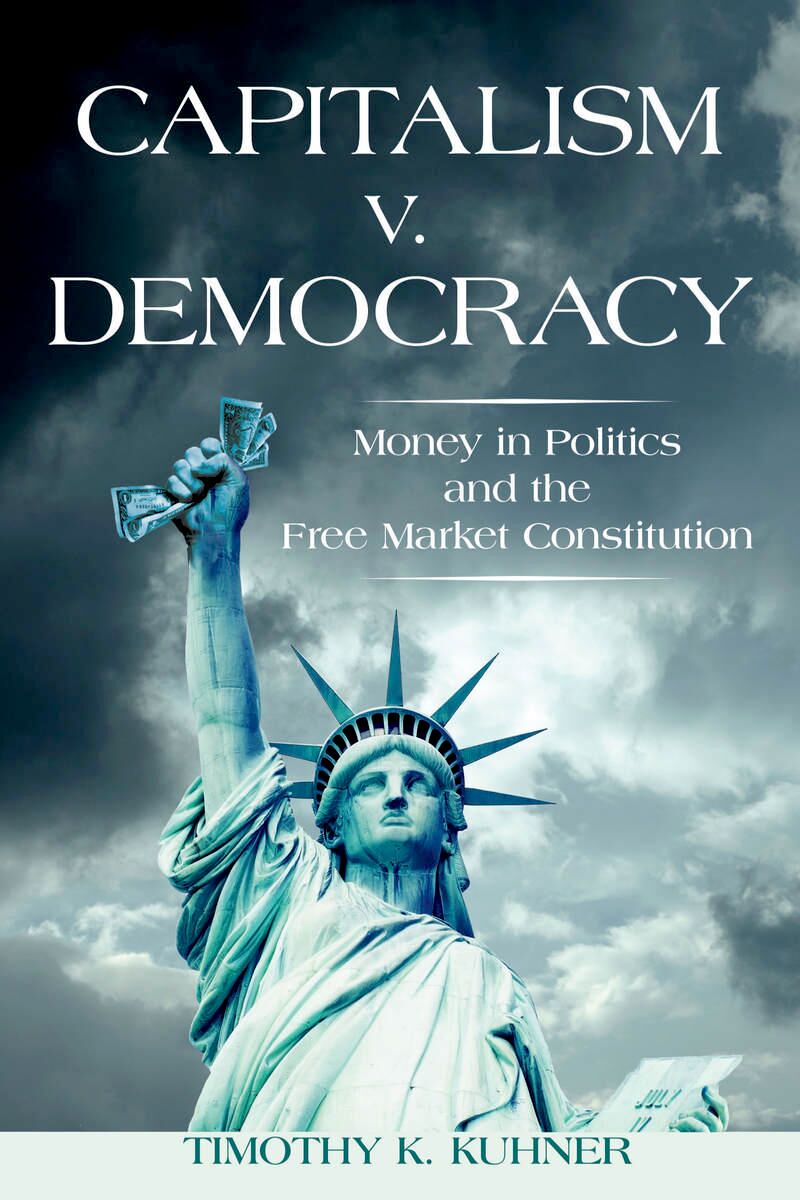
Capitalism v. democracy : money in politics and the free market constitution
As of the latest national elections, it costs approximately $1 billion to become president, $10 million to become a Senator, and $1 million to become a Member of the House. High-priced campaigns, an elite class of donors and spenders, superPACs, and increasing corporate political power have become the new normal in American politics. In Capitalism v. Democracy, Timothy Kuhner explains how these conditions have corrupted American democracy, turning it into a system of rule that favors the wealthy and marginalizes ordinary citizens. Kuhner maintains that these conditions have corrupted capitalism as well, routing economic competition through political channels and allowing politically powerful companies to evade market forces. The Supreme Court has brought about both forms of corruption by striking down campaign finance reforms that limited the role of money in politics. Exposing the extreme economic worldview that pollutes constitutional interpretation, Kuhner shows how the Court became the architect of American plutocracy.
Capitalism v. Democracy offers the key to understanding why corporations are now citizens, money is political speech, limits on corporate spending are a form of censorship, democracy is a free market, and political equality and democratic integrity are unconstitutional constraints on money in politics. Supreme Court opinions have dictated these conditions in the name of the Constitution, as though the Constitution itself required the privatization of democracy. Kuhner explores the reasons behind these opinions, reveals that they form a blueprint for free market democracy, and demonstrates that this design corrupts both politics and markets. He argues that nothing short of a constitutional amendment can set the necessary boundaries between capitalism and democracy.
eBook


The making of a transnational capitalist class
Throughout the world, there has been a growing wave of interest in global corporate power and the rise of a transnational capitalist class, triggered by economic and political transformations that have blurred national borders and disembedded corporate business from national domiciles. With an indepth analysis that spans three decades, The Making of a Transnational Capitalist Class maps the changing field of power generated by elite relations among the world's largest corporations and related political organizations. Using social network analysis, William Carroll charts the making of a capitalist class which reaches beyond national forms of organization into a global field, but which faces spirited opposition from below in an ongoing struggle over alternative global futures.
eBook


Political Ideologies of CEOs: The Influence of Executives' Values on Corporate Social Responsibility
This article examines the influence on organizational outcomes of CEOs' political ideology, specifically political conservatism vs. liberalism. We propose that CEOs' political ideologies will influence their firms' corporate social responsibility (CSR) practices, hypothesizing that (1) liberal CEOs will emphasize CSR more than will conservative CEOs; (2) the association between a CEO's political ideology and CSR will be amplified by a CEO's relative power; and (3) liberal CEOs will emphasize CSR even when recent financial performance is low, whereas conservative CEOs will pursue CSR initiatives only as performance allows. We test our ideas with a sample of 249 CEOs, measuring their ideologies by coding their political donations over the ten years prior to their becoming CEOs. Results indicate that the political ideologies of CEOs are manifested in their firms' CSR profiles. Compared with conservative CEOs, liberal CEOs exhibit greater advances in CSR; the influence of CEOs' political liberalism on CSR is amplified when they have more power; and liberal CEOs' CSR initiatives are less contingent on recent performance than are those of conservative CEOs. In a corroborative exploration, we find that CEOs' political ideologies are significantly related to their corporate political action committee allocations, indicating that this largely unexplored executive attribute might be more widely consequential.
Journal Article

Corporations and American democracy
\"The Supreme Court's decision in Citizens United v. Federal Election Commission has provoked passionate debate about the proper role of corporations in American democracy, among academics and also among the wider community of concerned citizens. As the essays in this volume demonstrate, there is absolutely no justification for basing present-day decisions on originalist interpretations of the Constitution. Not only did the framers themselves hold conflicting views of corporations but the relationship between corporations and American democracy has shifted and evolved over the course of American history. The changes that underpin recent debates over Citizens United and the role of corporations in American society are of relatively recent origin. This volume makes it possible to understand them in the context of the complex ways in which America's multi-layered, federated polity wrestled with the problem of corporate power and possibility in the past\"-- Provided by publisher.
Book

Lobbying America
Lobbying Americatells the story of the political mobilization of American business in the 1970s and 1980s. Benjamin Waterhouse traces the rise and ultimate fragmentation of a broad-based effort to unify the business community and promote a fiscally conservative, antiregulatory, and market-oriented policy agenda to Congress and the country at large. Arguing that business's political involvement was historically distinctive during this period, Waterhouse illustrates the changing power and goals of America's top corporate leaders.
Examining the rise of the Business Roundtable and the revitalization of older business associations such as the National Association of Manufacturers and the U.S. Chamber of Commerce, Waterhouse takes readers inside the mind-set of the powerful CEOs who responded to the crises of inflation, recession, and declining industrial productivity by organizing an effective and disciplined lobbying force. By the mid-1970s, that coalition transformed the economic power of the capitalist class into a broad-reaching political movement with real policy consequences. Ironically, the cohesion that characterized organized business failed to survive the ascent of conservative politics during the 1980s, and many of the coalition's top goals on regulatory and fiscal policies remained unfulfilled. The industrial CEOs who fancied themselves the \"voice of business\" found themselves one voice among many vying for influence in an increasingly turbulent and unsettled economic landscape.
Complicating assumptions that wealthy business leaders naturally get their way in Washington,Lobbying Americashows how economic and political powers interact in the American democratic system.
eBook

The Political Mobilization of Firms and Industries
Corporate political activity is both a long-standing preoccupation and an area of innovation for sociologists. We examine the limitations of investigating business unity without focusing directly on processes and outcomes and then review studies of five types of business political action that offer lenses into corporate power in the United States: engagement in electoral politics, direct corporate lobbying, collective action through associations and coalitions, business campaigns in civil society, and political aspects of corporate responsibility. Through these avenues, we highlight four shifts since the 1970s: (a) increasing fragmentation of capitalist interests, (b) closer attention to links between business lobbying and firms' social embeddedness, (c) a turn away from the assumption that money buys political victories, and (d) new avenues of covert corporate influence. This body of research has reinvigorated the classic elitist/pluralist debate while also raising novel questions about how business actors are adapting to (and generating changes within) their sociopolitical environments.
Journal Article

Towards a Political Theory of the Firm
The revenues of large companies often rival those of national governments, and some companies have annual revenues higher than many national governments. Among the largest corporations in 2015, some had private security forces that rivaled the best secret services, public relations offices that dwarfed a US presidential campaign headquarters, more lawyers than the US Justice Department, and enough money to capture (through campaign donations, lobbying, and even explicit bribes) a majority of the elected representatives. The only powers these large corporations missed were the power to wage war and the legal power of detaining people, although their political influence was sufficiently large that many would argue that, at least in certain settings, large corporations can exercise those powers by proxy. Yet in economics, the commonly prevailing view of the firm ignores all these elements of politics and power. We must recognize that large firms have considerable power to influence the rules of the game. I call attention to the risk of a “Medici vicious circle,” in which economic and political power reinforce each other. The possibility and extent of a “Medici vicious circle” depends upon several nonmarket factors. I discuss how they should be incorporated in a broader “Political Theory” of the firm.
Journal Article