
Catalogue Search | MBRL


Are you sure you want to remove the book from the shelf?

{{itemTitle}}
148
result(s) for
"counterespionage"
Sort by:
A Communist for the RCMP
In 1941, the RCMP recruited Frank Hadesbeck, a Spanish Civil War veteran, as a paid informant to infiltrate the Communist Party. For decades, he informed not only upon communists, but also upon hundreds of other people who held progressive views. Hadesbeck's \"Watch Out\" lists on behalf of the Security Service included labour activists, medical doctors, lawyers, university professors and students, journalists, Indigenous and progressive farm leaders, members of the clergy, and anyone involved in the peace and human rights movements.
Defying every warning given to him by his handlers, Hadesbeck kept secret notes. Using these notes, author Dennis Gruending recounts how the RCMP spied upon thousands of Canadians. Hadesbeck's life and career are in the past, but RCMP surveillance continues in new guises. As Canada's petroleum industry doubles down on its extraction plans in the oil sands and elsewhere, the RCMP and other state agencies provide support, routinely branding Indigenous land defenders and their allies in the environmental movement as potential terrorists. They share information and tactics with petroleum industry \"stakeholders\" in what has been described as a \"surveillance web\" intended to suppress dissent. A Communist for the RCMP provides an inside account of Hadesbeck's career and illustrates how the RCMP uses surveillance of activists to enforce the status quo.
eBook
Military counterespionage against Romania executed by the directorate of the independent gendarme corps from Bessarabia
The Russian Empire, with centuries-old imperial traditions, was based on military force, in which a significant role was played by the accumulation of information about opponents and the fight against foreign espionage inside the country. Based on a substantial collection of original historiographical material amassed through research in the National Archive of the Republic of Moldova, the author provides an analysis of the activity and results achieved by the Russian counterintelligence services. This work was conducted by the Independent Corps of Gendarmes, specifically represented by the Directorate of the Independent Corps of Gendarmes from Bessarabia, against the alleged activities of Romanian military espionage in the Russian Empire. The study is part of a larger work, devoted to the activity of the Independent Corps of Gendarmes from Bessarabia, whose activity, from a military point of view, was mostly directed against Romania.
Journal Article

Spy Ships
Almost from the first days of seafaring, men have used ships for
\"spying\" and intelligence collection. Since early in the twentieth
century, with the technological advancements of radio and radar,
the U.S. Navy and other government agencies and many other navies
have used increasingly specialized ships and submarines to ferret
out the secrets of other nations. The United States and the Soviet
Union/Russia have been the leaders in those efforts, especially
during the forty-five years of the Cold War. But, as Norman Polmar
and Lee J. Mathers reveal, so has China, which has become a major
maritime power in the twenty-first century, with special interests
in the South China Sea and with increasing hostility toward the
United States. Through extensive, meticulous research and through
the lens of such notorious spy ship events as the Israeli attack on
the USS Liberty , the North Korean capture of the USS
Pueblo , and the U.S. Central Intelligence Agency's success
in clandestinely salvaging part of a Soviet submarine with the
Hughes Glomar Explorer , Spy Ships is a
fascinating and valuable resource for understanding maritime
intelligence collection and what we have learned from it.
eBook

Marianne Is Watching
Polly Corrigan Book Prize shortlist Professional intelligence
became a permanent feature of the French state as a result of the
army's June 8, 1871, reorganization following France's defeat in
the Franco-Prussian War. Intelligence practices developed at the
end of the nineteenth century without direction or oversight from
elected officials, and yet the information gathered had a profound
influence on the French population and on pre-World War I Europe
more broadly. In Marianne Is Watching Deborah Bauer
examines the history of French espionage and counterespionage
services in the era of their professionalization, arguing that the
expansion of surveillance practices reflects a change in
understandings of how best to protect the nation. By leading
readers through the processes and outcomes of professionalizing
intelligence in three parts-covering the creation of permanent
intelligence organizations within the state; the practice of
intelligence; and the place of intelligence in the public
sphere-Bauer fuses traditional state-focused history with social
and cultural analysis to provide a modern understanding of
intelligence and its role in both state formation and cultural
change. With this first English-language book-length treatment of
the history of French intelligence services in the era of their
inception, Bauer provides a penetrating study not just of the
security establishment in pre-World War I France but of the diverse
social climate it nurtured and on which it fed.
eBook

Enemy Archives
Soviet counterinsurgency officers assembled a comprehensive archive documenting the ideological worldview, operational structures, and activities of the Ukrainian nationalist movement. Viatrovych and Luciuk have curated a selection of these documents that challenges prejudices about who these Ukrainian nationalists were, whom they fought, and why.
eBook
Stress Tested
The emergence of COVID-19 has raised urgent and important questions about the role of Canadian intelligence and national security within a global health crisis. Some argue that the effects of COVID-19 on Canada represent an intelligence failure, or a failure of early warning. Others argue that the role of intelligence and national security in matters of health is—and should remain—limited. At the same time, traditional security threats have rapidly evolved, themselves impacted and influenced by the global pandemic.
Stress Tested brings together leading experts to examine the role of Canada's national security and intelligence community in anticipating, responding to, and managing a global public welfare emergency. This interdisciplinary collection offers a clear-eyed view of successes, failures, and lessons learned in Canada's pandemic response.
Addressing topics including supply chain disruptions, infrastructure security, the ethics of surveillance within the context of pandemic response, the threats and potential threats of digital misinformation and fringe beliefs, and the challenges of maintaining security and intelligence operations during an ongoing pandemic, Stress Tested is essential reading for anyone interested in the lasting impacts of the COVID-19 pandemic.
eBook

Gestructureerde Inlichtingenanalyse Voor Opsporing en Ordehandhaving
'Gestructureerde inlichtingenanalyse voor opsporing en ordehandhaving' legt aan de hand van concrete voorbeelden uit de Nederlandse praktijk van opsporing en openbare-ordehandhaving de veelgebruikte technieken voor gestructureerde inlichtingenanalyse uit.
eBook

Geospatial intelligence : origins and evolution
A riveting introduction to the complex and evolving field of geospatial intelligence.Although geospatial intelligence is a term of recent origin, its underpinnings have a long and interesting history. Geospatial Intelligence: Origins and Evolution shows how the current age of geospatial knowledge evolved from its ancient origins to become ubiquitous in daily life across the globe. Within that framework, the book weaves a tapestry of stories about the people, events, ideas, and technologies that affected the trajectory of what has become known as GEOINT. Author Robert M. Clark explores the historical background and subsequent influence of fields such as geography, cartography, remote sensing, photogrammetry, geopolitics, geophysics, and geographic information systems on GEOINT. Although its modern use began in national security communities, Clark shows how GEOINT has rapidly extended its reach to other government agencies, NGOs, and corporations. This global explosion in the use of geospatial intelligence has far-reaching implications not only for the scientific, academic, and commercial communities but for a society increasingly reliant upon emerging technologies. Drones, the Internet of things, and cellular devices transform how we gather information and how others can collect that information, to our benefit or detriment.
eBook
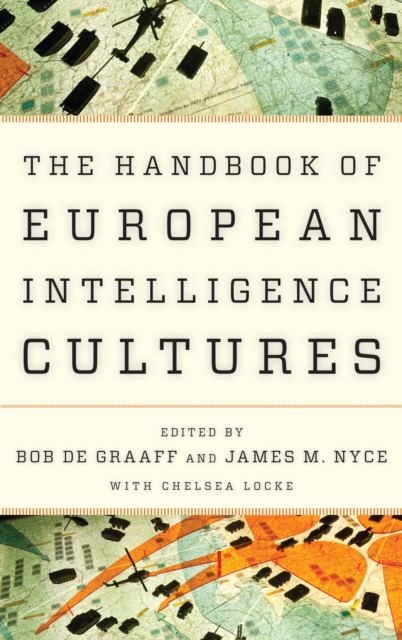
Handbook of European Intelligence Cultures
As experts from the countries discussed, the contributors address the intelligence community rather than focusing on a single agency. Each entry looks at the environment in which an organization works, its actors, and cultural and ideological climate, to cover both the external and internal factors that influence a nation's intelligence community.
eBook

Intelligence Leadership and Governance
This book explores the challenges leaders in intelligence communities face in an increasingly complex security environment and how to develop future leaders to deal with these issues.
As the security and policy making environment becomes increasingly complicated for decision-makers, the focus on intelligence agencies 'to deliver' more value will increase. This book is the first extensive exploration of contemporary leadership in the context of intelligence agencies, principally in the 'Five Eyes' nations (i.e. Australia, United States, United Kingdom, Canada, and New Zealand). It provides a grounded theoretical approach to building practitioner and researcher understanding of what individual and organisational factors result in better leadership. Using interviews from former senior intelligence leaders and a survey of 208 current and former intelligence leaders, the work explores the key challenges that leaders will likely face in the twenty-first century and how to address these. It also explores what principles are most likely to be important in developing future leaders of intelligence agencies in the future.
This book will be of much interest to students of intelligence studies, strategic studies, leadership studies, security studies, and international relations.
eBook