
Catalogue Search | MBRL


Are you sure you want to remove the book from the shelf?

{{itemTitle}}
68
result(s) for
"crown of Aragon"
Sort by:

A METHODOLOGICAL PUZZLE: THE REPRESENTATIVENESS OF AFTER-DEATH INVENTORIES WITHOUT MONETARY VALUATIONS. THE CASE OF VIC (1400-1460)
[...]the study will assess the possibilities that alternative wealth indicators may offer to socially classify after-death inventories without monetary valuations in order to establish a solid methodological foundation essential for conducting a rigorous historical analysis of pre-industrial consumption patterns in Catalonia and, by extension, all the Crown of Aragon. Consumer demand is in itself a dynamic concept as it is constantly being reshaped according to the owner's wealth and ideas. [...]it cannot be studied using after-death inventories.5 In order to explore the dynamic perspective of consumption, one must turn to other historical sources, such as household budgets. [...]the findings based on the analysis of after-death inventories cannot be valid because they do not cover the same social groups across time.10 The recent studies of Jane Humphries, Jacob Weisdorf, and Benjamin Schneider on the annual earnings of English workers seem to have put an end to this debate. [...]their annual earnings were also much higher than previous studies had estimated on the basis of daily wages.11 Following Jan de Vries' argument, these authors have claimed that eighteenth-century households reallocated more time into their work, thus increasing their modest incomes and allowing them to gain the necessary cash with which to buy the new commodities listed in the probate inventories.12 Regardless of its outcome, this debate emphasizes the importance of understanding the socio-economic composition inherent in any inventory sample used for statistical purposes.
Journal Article

Solidarity or Fiscal Rapacity?
This paper examines the interplay between tax policy and food supply regulation in Valencia during the 1350s–1360s, a decade marked by fiscal restructuring and war. It argues that the city’s grain subsidy program—ostensibly aimed at ensuring affordable access to food and preserving social peace—was primarily designed to expand the city council’s fiscal capacity. Drawing on archival sources, the study highlights how indirect taxation and provisioning policies were interwoven into a coherent yet contradictory system. The findings reveal how war, debt, and governance shaped a framework that would endure for centuries, benefitting urban elites under the guise of public welfare.
Journal Article

James I of Aragon (1213–1276)
James I, King of Aragon (1213–1276). He was the third king of the Crown of Aragon, which had come into existence through the union between Queen Petronila of Aragon (1157–1164) and the Count of Barcelona Ramon Berenguer IV (1137–1162). James I represents a milestone in the iconography of the Kings of Aragon, although this is due more to his successors’ promotion of him rather than to his own efforts. In order to organise and unify his dominions after the conquests of Mallorca and Valencia, he immersed himself in legal work that consolidated his legislative power whilst still allowing his territories to retain a certain degree of autonomy. He carried out an essential monetary reorganisation in which his coinage retained its obverse but altered its reverse according to the place of issue. He never succeeded in being crowned, although he featured the crown prominently in his stamps and seals and, on some coins, he added the term rex gratia Dei. In addition, he revived the sword as a royal insignia, having proclaimed the right of conquest as the basis of his sovereignty.
Journal Article
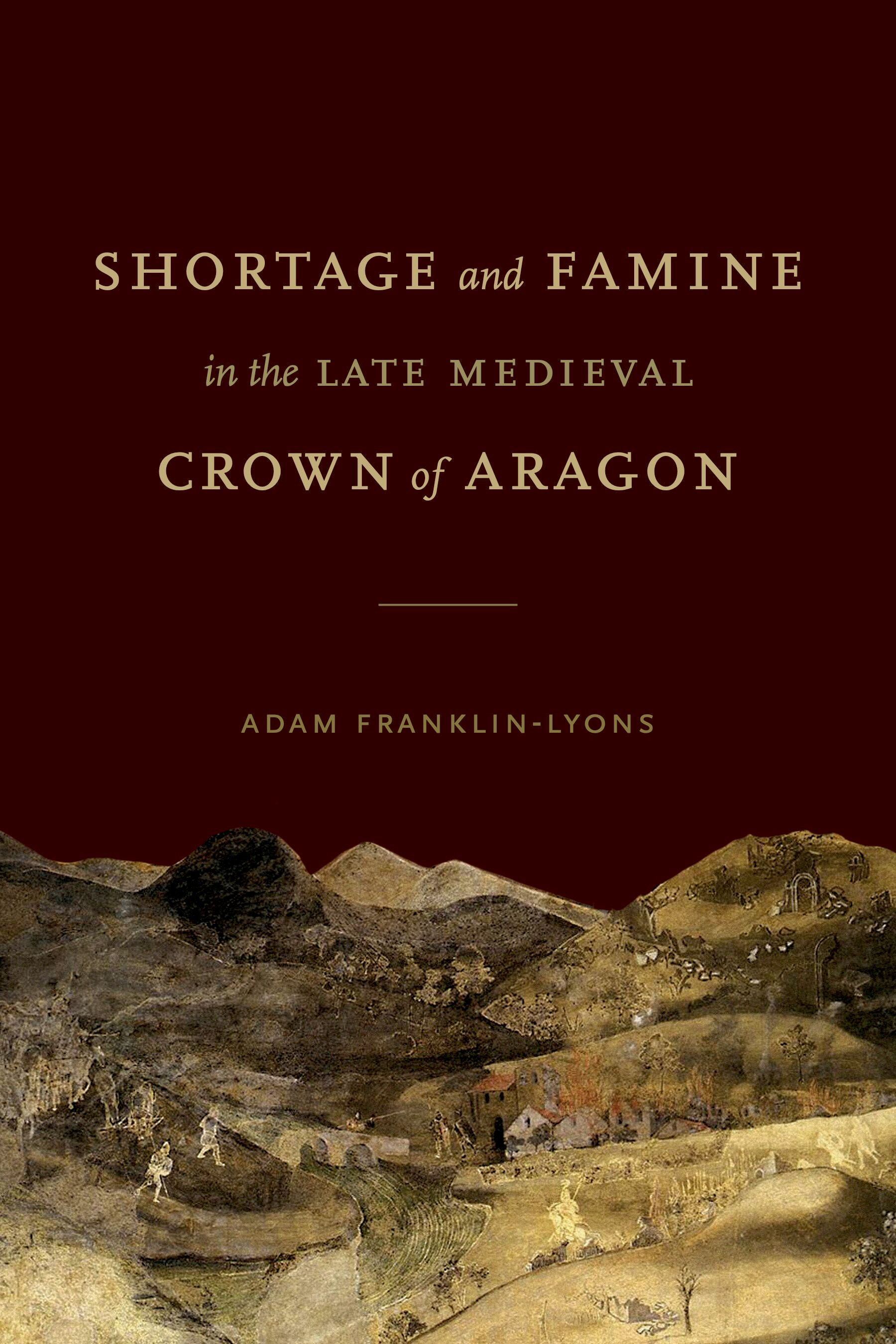
Shortage and Famine in the Late Medieval Crown of Aragon
In the late fourteenth century, the medieval Crown of Aragon experienced a series of food crises that created conflict and led to widespread starvation. Adam Franklin-Lyons applies contemporary understandings of complex human disasters, vulnerability, and resilience to explain how these famines occurred and to describe more accurately who suffered and why.Shortage and Famine in the Late Medieval Crown of Aragon details the social causes and responses to three events of varying magnitude that struck the western Mediterranean: the minor food shortage of 1372, the serious but short-lived crisis of 1384–85, and the major famine of 1374–76, the worst famine of the century in the region. Shifts in military action, international competition, and violent attempts to control trade routes created systemic panic and widespread starvation—which in turn influenced decades of economic policy, social practices, and even the course of geopolitical conflicts, such as the War of the Two Pedros and the papal schism in Italy.Providing new insights into the intersecting factors that led to famine in the fourteenth-century Mediterranean, this deeply researched, convincingly argued book presents tools and models that are broadly applicable to any historical study of vulnerabilities in the human food supply. It will be of interest to scholars of medieval Iberia and the medieval Mediterranean as well as to historians of food and of economics.
eBook

Communities of Non-violence? Justice and Social Integration among Conversos and Old Christians in Fifteenth-Century Valencia: A Preliminary Examination
This article examines non-violent conflicts between Conversos and Old Christians in fifteenth-century Valencia, challenging the historiographical emphasis on violence and structural discrimination in interfaith relations. Drawing on judicial records, notarial protocols, and arbitration agreements, it explores the mechanisms of conflict resolution and their role in the gradual integration of conversos into Christian society following the mass conversions of 1391. The study highlights how disputes —rooted in familial, economic, and social interactions— were managed through civil courts and private arbitration, revealing a nuanced interplay between coexistence and inequality. By analyzing the socio-professional networks and endogamous tendencies of the converso community, the article argues that peaceful conflict management served as a vital tool for fostering social cohesion and enabling conversos' participation in economic and institutional frameworks. This integrative process, while paradoxically born of violence, demonstrates the complexities of rebuilding coexistence in late medieval Iberia.
Journal Article
Alphonse II of Aragon (1164–1196)
Alphonse II King of Aragon (1164–1196). He was the first king of the Crown of Aragon and son of the Queen Petronila of Aragon (1157–1164) and the count of Barcelona, Ramon Berenguer IV (1137–1162). Aware of the new political reality that he embodied as King of Aragon and Count of Barcelona, Alphonse II made significant changes to his iconography. Among the most important of these is the binomial that he incorporated to his pendent seals; that is, a portrayal of Alphonse enthroned as king on the obverse and Alphonse as count and mounted on a horse on the reverse. As a known bibliophile and as a result of his desire to reorganise his chancellery following the union of various political entities, he ordered the compilation of the Liber Feudorum Maior, the folios of which demonstrate his potestas regia through their lavish iconography. He was no less innovative in his coinage, on which he included, for the first time, the image of his head wearing the crown.
Journal Article
Peter IV of Aragon (1336–1387)
Peter IV king of Aragón (1336–1387). He was the seventh king of the Crown of Aragon, and father of Juan I (1387–1396) and Martín I (1396–1410), the last members of the dynasty to take the throne. When Martín died, the Trastámara branch occupied the throne of the kingdom. Peter IV was dazzling in his ability to use art as a tool of authority and sovereignty. With the aim of exalting the dynasty, he patronised various enterprises, among the most important of which was the abbey of Santa Maria de Poblet, which he intended to be a burial place for himself and his successors, a wish that was fulfilled, without exception, down to Juan II, the predecessor of the Catholic Monarchs. A perfectionist and zealot, he endowed important religious events with profound political significance, and promoted works of great symbolism such as the genealogy of the new saló del tinell, or the ordinacions de la casa i cort, to which he added an appendix establishing how the kings of Aragon were to be crowned.
Journal Article
The patrons of the Kingdom. Shipowners, shipmasters, foreign merchants and the control of Sicily’s fiscal system at the beginning of the Trastamara age (1414-22)
In 1420, Alfonso V of Aragon (1416–1458), known as the Magnanimous, signed a legal contract with a group of patrons (i.e., shipowners and shipmasters) to secure ships for the royal fleet and military support to complete the conquest of Sardinia and launch an offensive against Corsica, then under Genoese rule. According to this agreement, the sovereign temporarily granted these patrons control over the kingdom’s most significant fiscal resources, namely, the revenues generated from grain and foodstuff exports through the sale of export licenses (tratte). The agreement also resulted in the transfer of extensive public authority from the Crown to the patrons, who gained direct administrative control over the ports, their personnel, and the castles located in the same port towns. After examining the reconstruction of the royal patrimony following Alfonso’s ascension to the Crown of Aragon in 1412, this essay explores Sicily’s role in financing the political and military agenda of Alfonso the Magnanimous, focusing on the agreement between the monarch and the consortium of shipowners and shipmasters. In this regard, it provides a detailed analysis of the contract’s contents, the distribution of fiscal resources among the patrons, and their social origins. Finally, the essay discusses Sicily’s increasing strategic and financial significance in supporting the Crown of Aragon’s subsequent campaigns in Naples and the Italian Mezzogiorno.
Journal Article
Ferdinand II of Aragon (1479–1516)
Ferdinand II king of Aragon (1479–1516). He was the fourth king of the Trastámara dynasty, which had first come to power after the Compromise of Caspe, reached after Martin I died with no living descendants in 1410. Although in terms of artistic patronage Ferdinand II was not as active as his wife Elisabeth I, he was still aware that the wise use of artistic commissions in reinforcing ideas and concepts favourable to the institution of the monarchy. He is a highly important figure in the history of Spain because, along with Elisabeth, he was one of the Catholic Monarchs and thus represents a new conception of power based on their joint governance, a fact that is reflected in the iconography found in his artistic commissions across all genres. All of the images are evidence of how King Ferdinand, at the end of the Middle Ages, wanted to be recognised by his subjects, who also used his image for legitimising and propagandistic purposes. Nobody else in the history of the Hispanic kingdoms had their image represented so many times and on such diverse occasions as did the Catholic Monarchs.
Journal Article

The Transit of Mary Magdalene’s Soul in Catalan Artistic Production in the 15th Century
There are a great many studies on the figure of Mary Magdalene in different areas of knowledge. Nevertheless, there is a gap as regards the image of this character in Catalonia, and specifically regarding the visual representation of her soul at the moment when she died. This text aims to analyze this matter based on two Catalan altarpieces: the Altarpiece of Saint Mary Magdalene from Perella (Bernat Martorell, 1437–1453) and The Death of Mary Magdalene (Jaume Huguet, 1465–1480). The analysis has been carried out based on the postulates from the tradition of studies on iconography and iconology: the relationships between image and text, the history of the iconographic types and the magnetic power of images. The basic hypothesis is that the representation of Mary Magdalene’s soul in the 15th Century in Catalonia is visually borrowed from the iconographic type of the Dormition of the Mother of God. To test this, comparative analyses have been made of the visual representation of the two women and also of the textual sources, such as the canonical and extracanonical gospels, a variety of medieval legends and different hagiographies or vitas and sermons from the period.
Journal Article