
Catalogue Search | MBRL


Are you sure you want to remove the book from the shelf?

{{itemTitle}}
116,289
result(s) for
"cruelty"
Sort by:


Mother Cow, Mother India
India imposes stringent criminal penalties, including life imprisonment in some states, for cow slaughter, based on a Hindu ethic of revering the cow as sacred. And yet India is among the world's leading producers of beef, leather, and milk, industries sustained by the mass slaughter of bovines. What is behind this seeming contradiction? What do bovines, deemed holy in Hinduism, experience in the Indian milk and beef industries? Yamini Narayanan asks and answers these questions, introducing cows and buffaloes as key subjects in India's cow protectionism, rather than their treatment hitherto as mere objects of political analysis.
Emphasizing human–animal hierarchical relations, Narayanan argues that the Hindu framing of the cow as \"mother\" is one of human domination, wherein bovine motherhood is simultaneously capitalized for dairy production and weaponized by right-wing Hindu nationalists to violently oppress Muslims and Dalits. Using ethnographic and empirical data gathered across India, this book reveals the harms caused to buffaloes, cows, bulls, and calves in dairying, and the exploitation required of the diverse, racialized labor throughout India's dairy production continuum to obscure such violence. Ultimately, Narayanan traces how the unraveling of human domination and exploitation of farmed animals is integral to progressive multispecies democratic politics, speculating on the real possibility of a post-dairy society, based on vegan agricultural policies for livelihoods and food security.
eBook

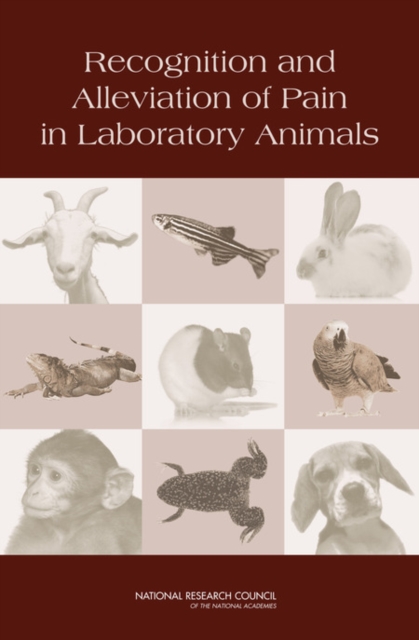
Recognition and alleviation of pain in laboratory animals
The use of animals in research adheres to scientific and ethical principles that promote humane care and practice. Scientific advances in our understanding of animal physiology and behavior often require theories to be revised and standards of practice to be updated to improve laboratory animal welfare.
Recognition and Alleviation of Pain in Laboratory Animals , the second of two reports revising the 1992 publication Recognition and Alleviation of Pain and Distress in Laboratory Animals from the Institute for Laboratory Animal Research (ILAR), focuses on pain experienced by animals used in research. This book aims to educate laboratory animal veterinarians; students, researchers and investigators; Institutional Animal Care and Use Committee members; and animal care staff and animal welfare officers on the current scientific and ethical issues associated with pain in laboratory animals. It evaluates pertinent scientific literature to generate practical and pragmatic guidelines for recognizing and alleviating pain in laboratory animals, focusing specifically on the following areas: physiology of pain in commonly used laboratory species; pharmacologic and non-pharmacologic principles to control pain; identification of humane endpoints; and principles for minimizing pain associated with experimental procedures. Finally, the report identifies areas in which further scientific investigation is needed to improve laboratory animal welfare.
eBook

A very private school : a memoir
\"A Very Private School offers a clear-eyed, first-hand account of a culture of cruelty at the school Charles Spencer attended in his youth and provides important insights into an antiquated boarding system. Drawing on the memories of many of his schoolboy contemporaries, as well as his own letters and diaries from the time, he reflects on the hopelessness and abandonment he felt at aged eight, viscerally describing the intense pain of homesickness and the appalling inescapability of it all. Exploring the long-lasting impact of his experiences, Spencer presents a candid reckoning with his past and a reclamation of his childhood\"-- Provided by publisher.
Book

Beyond Purity: Moral Disgust Toward Bad Character
Previous studies support a link between moral disgust and impurity, whereas anger is linked to harm. We challenged these strict correspondences by showing that disgust is activated in response to information about moral character, even for harm violations. By contrast, anger is activated in response to information about actions, including their moral wrongness and consequences. Study 1 examined disgust and anger in response to an action that suggests bad moral character (animal cruelty) versus an action that is seen as inherently more wrong (domestic abuse). Animal cruelty was associated with more disgust than domestic abuse was, whereas domestic abuse was associated with more anger. Studies 2 and 3 manipulated character by varying the agent's desire to cause harm and also varied the action's harmful consequences. Desire to harm predicted only disgust (controlling for anger), whereas consequences were more closely related to anger (controlling for disgust). Taken together, these results indicate that disgust arises in response to evidence of bad moral character, not just to impurity.
Journal Article

Zooicide : seeing cruelty, demanding abolition
\"In 'Zooicide,' Sue Coe employs her bold artistic style to confront the institution of zoos, showing that they are inherently cruel and that the solution is not to reform them, but to abolish them. Coe's visual journalism investigates the mental anguish inflicted upon animals--including instances where they have killed themselves to end their torture. She depicts famous tragedies like the killing of the gorilla Harambe at the Cincinnati Zoo in 2016 alongside lesser known but equally heart-wrenching incidents like the beating death of hippo Gustavito at a zoo in El Salvador. Zoos may pay lip service to education, enrichment, and conservation, but their depravity is systemic and ubiquitous. As long as animals are considered property, they will be treated as things, with no rights--things that can be caged, bred, abused, or killed for profit and entertainment. It's time to end this cruelty. A powerful companion to Coe's images, and written specifically for them, Stephen F. Eisenman's essay, 'The Capitalist Zoo,' is a musing on a future where zoos have been abolished, a history of where they came from, and an appreciation of Coe's work and its place in art history\"--Page 4 of cover.
Book

Brighton v RSPCA NSW: Appeals and Lessons Four Years On
Animal law has the potential to initiate improvements for animal wellbeing. However, this largely depends on how effectively the law bridges the legal chasm between animal welfare and animal suffering, a chasm the authors refer to as the welfare gap. When the law does not adequately address this gap, where regulation subordinates animal interests to human interests, it results in weak animal protection that does little more than regulate to a standard that avoids a life not worth living. The authors analyse a series of cases involving the RSPCA and Brighton, in which Brighton was charged with serious animal cruelty pursuant to s 530 of the Crimes Act 1900 (NSW). He stabbed a dog with a pitchfork; after failing to kill the dog, he suspended it from a tree branch by a leash attached to its collar and struck the dog several times on the head with a mallet, finally killing him. Brighton was found guilty in the NSW Local Court and appealed to the NSW Supreme Court, where Rothman J allowed the appeal, holding that Brighton had exterminated a pest animal. This led to protracted litigation, including to the NSW Court of Appeal, a second hearing in the Local Court and a further appeal to the Supreme Court. In August 2020, Sophie Riley published a case note and commentary on the litigation up to the Rothman J appeal. This paper evaluates the litigation that followed, identifying how regulatory failures have entrenched the welfare gap. Regulatory failures include inadequate and aged legislative protections for a confined subset of animals. In NSW, animal sentience is not enshrined in legislation; the law limits the types of animals protected by anti-cruelty law; fundamental statutory language remains undefined, for example terms such as “pest animal” and “exterminate”; and challenges abound for adducing sufficient evidence to prove subjective criminal intent. These deficiencies pose significant challenges for practitioners and judicial officers, particularly when complex statutory interpretation is required in the busy and fast-paced summary jurisdiction. This paper concludes that legislators should consider modernising the law, removing ambiguity, and settling minimum standards for a good life for animals, taking into account the welfare aspects described in Mellor’s Five Domains model.
Journal Article


Animal Behavior for Shelter Veterinarians and Staff
A comprehensive resource to understand the behavioral considerations for intake, management, and rehoming of dogs and cats Animal Behavior for Shelter Veterinarians and Staff provides readers with comprehensive information addressing the behavior of both animals and humans associated with the intake, management, and rehoming of dogs and cats.
eBook