
Catalogue Search | MBRL


Are you sure you want to remove the book from the shelf?

{{itemTitle}}
111
result(s) for
"cultivated meat"
Sort by:

Companies: share cultivated meat breakthroughs publicly—here is how
Cultivated meat could satisfy soaring global protein demand while dramatically reducing greenhouse gas emissions and the spread of zoonotic diseases such as avian flu. One challenge is that, instead of sharing relevant scientific discoveries, too many companies keep them under lock and key, which imperils the entire sector.
Cultivated meat could satisfy soaring global protein demand while dramatically reducing greenhouse gas emissions and the spread of zoonotic diseases such as avian flu. One challenge is that, instead of sharing relevant scientific discoveries, too many companies keep them under lock and key, which imperils the entire sector.
Journal Article
Cultivated ingredients: a strategic pivot for cultivated meat?
Cultivated meat is a promising solution to global food security challenges, but cultivated ingredients offer an equally compelling and potentially more economically stable path forward. Components such as flavour enhancers, cultivated fat, and proteins present scalable opportunities for improving alternative proteins, highlighting the untapped potential of cultivated ingredient-focused strategies.
Cultivated meat is a promising solution to global food security challenges, but cultivated ingredients offer an equally compelling and potentially more economically stable path forward. Components such as flavour enhancers, cultivated fat, and proteins present scalable opportunities for improving alternative proteins, highlighting the untapped potential of cultivated ingredient-focused strategies.
Journal Article
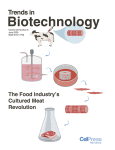
The Business of Cultured Meat
Cultured meats (CMs) are produced by in vitro culture of animal cells. Since the first CM burger patty was created in 2013, many companies have been founded to commercialize CM products. We discuss the meat focus and geographical spread of CM companies, the funding landscape, and challenges for commercialization.
Journal Article

Scaffolding Biomaterials for 3D Cultivated Meat: Prospects and Challenges
Cultivating meat from stem cells rather than by raising animals is a promising solution to concerns about the negative externalities of meat production. For cultivated meat to fully mimic conventional meat's organoleptic and nutritional properties, innovations in scaffolding technology are required. Many scaffolding technologies are already developed for use in biomedical tissue engineering. However, cultivated meat production comes with a unique set of constraints related to the scale and cost of production as well as the necessary attributes of the final product, such as texture and food safety. This review discusses the properties of vertebrate skeletal muscle that will need to be replicated in a successful product and the current state of scaffolding innovation within the cultivated meat industry, highlighting promising scaffold materials and techniques that can be applied to cultivated meat development. Recommendations are provided for future research into scaffolds capable of supporting the growth of high‐quality meat while minimizing production costs. Although the development of appropriate scaffolds for cultivated meat is challenging, it is also tractable and provides novel opportunities to customize meat properties. Cultivating meat from cells is a promising solution to the environmental, ethical, health, and food‐security challenges associated with conventional meat production. Cultivated meat will require the development of scalable, low‐cost, and edible or biodegradable scaffolds to support cell growth. This review discusses the unique challenges of cultivated meat scaffolding and highlights promising materials and processing methods worthy of further investigation.
Journal Article

Cell Sources for Cultivated Meat: Applications and Considerations throughout the Production Workflow
Cellular agriculture is an emerging scientific discipline that leverages the existing principles behind stem cell biology, tissue engineering, and animal sciences to create agricultural products from cells in vitro. Cultivated meat, also known as clean meat or cultured meat, is a prominent subfield of cellular agriculture that possesses promising potential to alleviate the negative externalities associated with conventional meat production by producing meat in vitro instead of from slaughter. A core consideration when producing cultivated meat is cell sourcing. Specifically, developing livestock cell sources that possess the necessary proliferative capacity and differentiation potential for cultivated meat production is a key technical component that must be optimized to enable scale-up for commercial production of cultivated meat. There are several possible approaches to develop cell sources for cultivated meat production, each possessing certain advantages and disadvantages. This review will discuss the current cell sources used for cultivated meat production and remaining challenges that need to be overcome to achieve scale-up of cultivated meat for commercial production. We will also discuss cell-focused considerations in other components of the cultivated meat production workflow, namely, culture medium composition, bioreactor expansion, and biomaterial tissue scaffolding.
Journal Article

Ex-ante life cycle assessment of commercial-scale cultivated meat production in 2030
PurposeCultivated meat (CM) is attracting increased attention as an environmentally sustainable and animal-friendly alternative to conventional meat. As the technology matures, more data are becoming available and uncertainties decline. The goal of this ex-ante life cycle assessment (LCA) was to provide an outlook of the environmental performance of commercial-scale CM production in 2030 and to compare this to conventional animal production in 2030, using recent and often primary data, combined with scenario analysis.MethodsThis comparative attributional ex-ante LCA used the ReCiPe Midpoint impact assessment method. System boundaries were cradle-to-gate, and the functional unit was 1 kg of meat. Data were collected from over 15 companies active in CM production and its supply chain. Source data include lab-scale primary data from five CM producers, full-scale primary data from processes in comparable manufacturing fields, data from computational models, and data from published literature. Important data have been cross-checked with additional experts. Scenarios were used to represent the variation in data and to assess the influence of important choices such as energy mix. Ambitious benchmarks were made for conventional beef, pork, and chicken production systems, which include efficient intensive European animal agriculture and incorporate potential improvements for 2030.Results and discussionCM is almost three times more efficient in turning crops into meat than chicken, the most efficient animal, and therefore agricultural land use is low. Nitrogen-related and air pollution emissions of CM are also lower because of this efficiency and because CM is produced in a contained system without manure. CM production is energy-intensive, and therefore the energy mix used for production and in its supply chain is important. Using renewable energy, the carbon footprint is lower than beef and pork and comparable to the ambitious benchmark of chicken. Greenhouse gas profiles are different, being mostly CO2 for CM and more CH4 and N2O for conventional meats. Climate hotspots are energy used for maintaining temperature in reactors and for biotechnological production of culture medium ingredients.ConclusionsCM has the potential to have a lower environmental impact than ambitious conventional meat benchmarks, for most environmental indicators, most clearly agricultural land use, air pollution, and nitrogen-related emissions. The carbon footprint is substantially lower than that of beef. How it compares to chicken and pork depends on energy mixes. While CM production and its upstream supply chain are energy-intensive, using renewable energy can ensure that it is a sustainable alternative to all conventional meats.RecommendationsCM producers should optimize energy efficiency and source additional renewable energy, leverage supply chain collaborations to ensure sustainable feedstocks, and search for the environmental optimum of culture medium through combining low-impact ingredients and high-performance medium formulation. Governments should consider this emerging industry’s increased renewable energy demand and the sustainability potential of freed-up agricultural land. Consumers should consider CM not as an extra option on the menu, but as a substitute to higher-impact products.
Journal Article

Enhancing the palatability of cultivated meat
Select cultivated meat (CM) products have been approved for sale and consumption in Singapore, the USA, and Israel.Palatability, a term encompassing the taste, texture, and aroma of foods, plays a central role in the appeal of foods.Currently, the consumer appeal of CM is relatively low, including low perceptions of palatability and a variable willingness to try.The palatability of meat arises from the unique chemistry and structure of its cellular constituents: muscle, fat, and stroma.Natural post-mortem processes, deliberate post-processing modifications, and various cooking methods are crucial in determining the palatability of agricultural meat (AM); replicating these processes could improve the palatability of CM.
Cultivated meat (CM) has transitioned from a futuristic concept to a present reality, with select products approved for consumption and sale in Singapore, Israel, and the USA. This evolution has emphasized scalable, cost-effective, and sustainable production, as well as navigation of regulatory pathways. As CM develops, a crucial challenge lies in delivering products that are highly appealing to consumers. Central to this will be refining CM palatability, a term encompassing food’s taste, aroma, texture, tenderness, juiciness, and color. We explore the scientific and engineering approaches to producing palatable CM, including cell-line selection, cell differentiation, and post-processing techniques. This includes a discussion of the structural and compositional properties of meat that are intrinsically coupled to palatability.
Cultivated meat (CM) has transitioned from a futuristic concept to a present reality, with select products approved for consumption and sale in Singapore, Israel, and the USA. This evolution has emphasized scalable, cost-effective, and sustainable production, as well as navigation of regulatory pathways. As CM develops, a crucial challenge lies in delivering products that are highly appealing to consumers. Central to this will be refining CM palatability, a term encompassing food’s taste, aroma, texture, tenderness, juiciness, and color. We explore the scientific and engineering approaches to producing palatable CM, including cell-line selection, cell differentiation, and post-processing techniques. This includes a discussion of the structural and compositional properties of meat that are intrinsically coupled to palatability.
Journal Article
Probiotic cultivated meat: bacterial-based scaffolds and products to improve cultivated meat
Cultured meat production requires microcarriers, hydrogels, and scaffolds for 3D growth and support.Co-culturing techniques of probiotic bacteria and cell cultures are available.Probiotic bacteria efficiently produce antimicrobial substances, hydrogels, and fibril scaffolds.Probiotic bacteria can be genetically manipulated to grow only when it serves the cell culture.Probiotic bacteria can be genetically manipulated to serve as biosensors for lactate production and to remove lactate waste.Introducing probiotic bacteria into cultured meat can improve the design, function, and cost production and should be further explored.
Cultivated meat is emerging to replace traditional livestock industries, which have ecological costs, including land and water overuse and considerable carbon emissions. During cultivated meat production, mammalian cells can increase their numbers dramatically through self-renewal/proliferation and transform into mature cells, such as muscle or fat cells, through maturation/differentiation. Here, we address opportunities for introducing probiotic bacteria into the cultivated meat industry, including using them to produce renewable antimicrobials and scaffolding materials. We also offer solutions to challenges, including the growth of bacteria and mammalian cells, the effect of probiotic bacteria on production costs, and the effect of bacteria and their products on texture and taste. Our summary provides a promising framework for applying microbial composites in the cultivated meat industry.
Cultivated meat is emerging to replace traditional livestock industries, which have ecological costs, including land and water overuse and considerable carbon emissions. During cultivated meat production, mammalian cells can increase their numbers dramatically through self-renewal/proliferation and transform into mature cells, such as muscle or fat cells, through maturation/differentiation. Here, we address opportunities for introducing probiotic bacteria into the cultivated meat industry, including using them to produce renewable antimicrobials and scaffolding materials. We also offer solutions to challenges, including the growth of bacteria and mammalian cells, the effect of probiotic bacteria on production costs, and the effect of bacteria and their products on texture and taste. Our summary provides a promising framework for applying microbial composites in the cultivated meat industry.
Journal Article

Aggregating in vitro-grown adipocytes to produce macroscale cell-cultured fat tissue with tunable lipid compositions for food applications
We present a method of producing bulk cell-cultured fat tissue for food applications. Mass transport limitations (nutrients, oxygen, waste diffusion) of macroscale 3D tissue culture are circumvented by initially culturing murine or porcine adipocytes in 2D, after which bulk fat tissue is produced by mechanically harvesting and aggregating the lipid-filled adipocytes into 3D constructs using alginate or transglutaminase binders. The 3D fat tissues were visually similar to fat tissue harvested from animals, with matching textures based on uniaxial compression tests. The mechanical properties of cultured fat tissues were based on binder choice and concentration, and changes in the fatty acid compositions of cellular triacylglyceride and phospholipids were observed after lipid supplementation (soybean oil) during in vitro culture. This approach of aggregating individual adipocytes into a bulk 3D tissue provides a scalable and versatile strategy to produce cultured fat tissue for food-related applications, thereby addressing a key obstacle in cultivated meat production.
Journal Article

Towards more realistic cultivated meat by rethinking bioengineering approaches
Cultivated meat (CM) is considered to be a sustainable alternative to meet the increasing demand for animal-based proteins while minimizing the negative impacts of conventional livestock farming.Although it does not fully resemble the complexity of mammalian skeletal muscle tissue, CM aims to recreate several features in terms of nutrition, taste, and texture.Integration of taste and texture analyses into recent CM studies enables the measurement of properties for obtaining high-quality CM.The cellular compounds, organization, differentiation stages, and metabolic activities, which are the keys of skeletal muscle tissue meat integrity, have not yet been fully explored in current CM models.
Cultivated meat (CM) refers to edible lab-grown meat that incorporates cultivated animal cells. It has the potential to address some issues associated with real meat (RM) production, including the ethical and environmental impact of animal farming, and health concerns. Recently, various biomanufacturing methods have been developed to attempt to recreate realistic meat in the laboratory. We therefore overview recent achievements and challenges in the production of CM. We also discuss the issues that need to be addressed and suggest additional recommendations and potential criteria to help to bridge the gap between CM and RM from an engineering standpoint.
Cultivated meat (CM) refers to edible lab-grown meat that incorporates cultivated animal cells. It has the potential to address some issues associated with real meat (RM) production, including the ethical and environmental impact of animal farming, and health concerns. Recently, various biomanufacturing methods have been developed to attempt to recreate realistic meat in the laboratory. We therefore overview recent achievements and challenges in the production of CM. We also discuss the issues that need to be addressed and suggest additional recommendations and potential criteria to help to bridge the gap between CM and RM from an engineering standpoint.
Journal Article