
Catalogue Search | MBRL


Are you sure you want to remove the book from the shelf?

{{itemTitle}}
109,027
result(s) for
"cultural change"
Sort by:

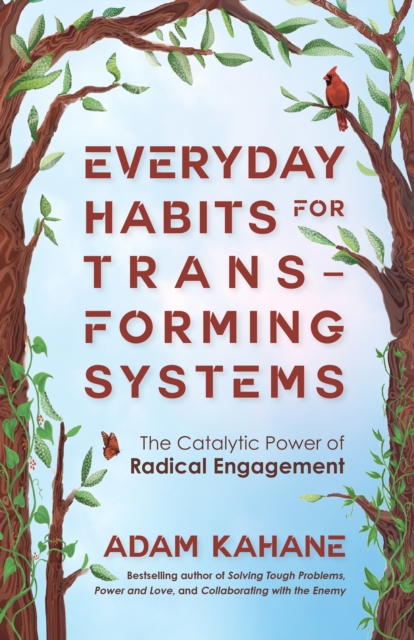
Everyday Habits for Transforming Systems
Seven practical habits for people ready to stop observing broken systems and start changing them, whether at the neighborhood level or the global stage. Adam Kahane, bestselling author of Collaborating with the Enemy and a veteran facilitator who has worked with presidents, executives, and community organizers across dozens of countries, distills decades of real-world experience into a clear, actionable framework for everyday changemakers. This book is built for people working on problems that feel too big or too entrenched to move, including climate advocates, healthcare reformers, nonprofit leaders, local activists, and organizational managers who want their work to have lasting impact. Inside, you will find * the 7 habits that help ordinary people become effective agents of systemic change, * strategies for collaborating across deep political and organizational divides, * methods for identifying leverage points that others overlook, * real examples from peacebuilding and community transformation, and * guidance for sustaining momentum through setbacks. Rather than offering inspiration without instruction, Kahane gives readers concrete behaviors they can practice in their existing roles and communities. If you work within systems that feel resistant to change, this is a grounded, experience-backed guide to making progress anyway.
eBook


The Eastern Archaic, historicized
The Eastern Archaic, Historicized offers an alternative perspective on the genesis and transformation of cultural diversity over eight millennia of hunter-gatherer dwelling in eastern North America. For many decades, archaeological understanding of Archaic diversity has been dominated by perspectives that emphasize localized relationships between humans and environment. The evidence, shows, however that Archaic people routinely associated with other groups throughout eastern North America and expressed themselves materially in ways that reveal historical links to other places and times. Starting with the colonization of eastern North America by two distinct ancestral lines, the Eastern Archaic was an era of migrations, ethnogenesis, and coalescence—an 8,200-year era of making histories through interactions and expressing them culturally in ritual and performance.
eBook


The Age of Em
Robots may one day rule the world, but what is a robot-ruled Earth like? Many think that the first truly smart robots will be brain emulations or \"ems.\" Robin Hanson draws on decades of expertise in economics, physics, and computer science to paint a detailed picture of this next great era in human (and machine) evolution - the age of em.
eBook


The Hadza
InThe Hadza, Frank Marlowe provides a quantitative ethnography of one of the last remaining societies of hunter-gatherers in the world. The Hadza, who inhabit an area of East Africa near the Serengeti and Olduvai Gorge, have long drawn the attention of anthropologists and archaeologists for maintaining a foraging lifestyle in a region that is key to understanding human origins. Marlowe ably applies his years of research with the Hadza to cover the traditional topics in ethnography-subsistence, material culture, religion, and social structure. But the book's unique contribution is to introduce readers to the more contemporary field of behavioral ecology, which attempts to understand human behavior from an evolutionary perspective. To that end,The Hadzaalso articulates the necessary background for readers whose exposure to human evolutionary theory is minimal.
eBook


Flourishing in the Age of Climate Change
Flourishing in the Age of Climate
Change explores skills we need to
successfully navigate the distinctive environmental, social, and
economic challenges of the twenty-first century. Our
inability to address increasing resource constraints, social
conflict, and ecological decline lead many toward a deep pessimism
that saps motivation for change.
Drawing on research from environmental science, ethics,
psychology, sociology and educational theory, William M. Throop
shows why cultivating underdeveloped skills involved in
collaboration, humility, frugality and systems thinking can enable
flourishing within our context. He also illustrates how we can
strengthen such skills individually and how education can scale up
their cultivation, which will be essential for achieving
sustainability.
Flourishing in the Age of Climate Change is a hopeful,
practical resource for readers passionate about creating a world
where we can thrive, and where flourishing is widespread.
eBook