
Catalogue Search | MBRL


Are you sure you want to remove the book from the shelf?

{{itemTitle}}
1,421,729
result(s) for
"data analysis"
Sort by:

Price-based investment strategies : how research discoveries reinvented technical analysis
This compelling book examines the price-based revolution in investing, showing how research over recent decades has reinvented technical analysis. The authors discuss the major groups of price-based strategies, considering their theoretical motivation, individual and combined implementation, and back-tested results when applied to investment across country stock markets. Containing a comprehensive sample of performance data, taken from 24 major developed markets around the world and ranging over the last 25 years, the authors construct practical portfolios and display their performance - ensuring the book is not only academically rigorous, but practically applicable too.
Book

Statistical analysis of high-dimensional biomedical data: a gentle introduction to analytical goals, common approaches and challenges
Background
In high-dimensional data (HDD) settings, the number of variables associated with each observation is very large. Prominent examples of HDD in biomedical research include omics data with a large number of variables such as many measurements across the genome, proteome, or metabolome, as well as electronic health records data that have large numbers of variables recorded for each patient. The statistical analysis of such data requires knowledge and experience, sometimes of complex methods adapted to the respective research questions.
Methods
Advances in statistical methodology and machine learning methods offer new opportunities for innovative analyses of HDD, but at the same time require a deeper understanding of some fundamental statistical concepts. Topic group TG9 “High-dimensional data” of the STRATOS (STRengthening Analytical Thinking for Observational Studies) initiative provides guidance for the analysis of observational studies, addressing particular statistical challenges and opportunities for the analysis of studies involving HDD. In this overview, we discuss key aspects of HDD analysis to provide a gentle introduction for non-statisticians and for classically trained statisticians with little experience specific to HDD.
Results
The paper is organized with respect to subtopics that are most relevant for the analysis of HDD, in particular initial data analysis, exploratory data analysis, multiple testing, and prediction. For each subtopic, main analytical goals in HDD settings are outlined. For each of these goals, basic explanations for some commonly used analysis methods are provided. Situations are identified where traditional statistical methods cannot, or should not, be used in the HDD setting, or where adequate analytic tools are still lacking. Many key references are provided.
Conclusions
This review aims to provide a solid statistical foundation for researchers, including statisticians and non-statisticians, who are new to research with HDD or simply want to better evaluate and understand the results of HDD analyses.
Journal Article

Data mining approaches for big data and sentiment analysis in social media
\"This book explores the key concepts of data mining and utilizing them on online social media platforms, offering valuable insight into data mining approaches for big data and sentiment analysis in online social media and covering many important security and other aspects and current trends\"-- Provided by publisher.
Book

From Data Management to Actionable Findings: A Five-Phase Process of Qualitative Data Analysis
This article outlines a five-phase process of qualitative analysis that draws on deductive (codes developed a priori) and inductive (codes developed in the course of the analysis) coding strategies, as well as guided memoing and analytic questioning, to support trustworthy qualitative studies. The five-phase process presented here can be used as a whole or in part to support researchers in planning, articulating, and executing systematic and transparent qualitative data analysis; developing an audit trail to ensure study dependability and trustworthiness; and/or fleshing out aspects of analysis processes associated with specific methodologies.
Journal Article

Data-driven science and engineering : machine learning, dynamical systems, and control
\"Data-driven discovery is revolutionizing the modelling, prediction, and control of complex systems. This textbook brings together machine learning, engineering mathematics, and mathematical physics to integrate modelling and control of dynamical systems with modern methods in data science. It highlights many of the recent advances in scientific computing that enable data-driven methods to be applied to a diverse range of complex systems, such as turbulence, the brain, climate, epidemiology, finance, robotics, and autonomy. Aimed at advanced undergraduate and beginning graduate students in the engineering and physical sciences, the text presents a range of topics and methods from introductory to state of the art\"-- Provided by publisher.
Book
Exploring the Use of Artificial Intelligence for Qualitative Data Analysis: The Case of ChatGPT
The potential use of artificial intelligence programs such as a ChatGPT to analyze qualitative data raises any number of questions, most notably whether it is possible to produce similar results without the demanding process of manual coding. In addition, there are questions about both the simplicity of using ChatGPT for qualitative data analysis and the potential time savings that it might provide This article addresses these questions by using ChatGPT to reinvestigate two qualitative datasets that were previously analyzed by more traditional methods. In particular, it examines the extent to which the responses from ChatGPT can recreate the themes that were originally chosen to summarize the two previous analyses. The results show that ChatGPT performed reasonably well, but in both cases it was less successful at locating subtle, interpretive themes, and more successful at reproducing concrete, descriptive themes. In doing so, the program was quite easy to use and required very little effort in comparison to approaches that rely on manual coding. It is important to recognize, however, that both coding and approaches based on artificial intelligence are simply tools that must be applied within a larger analytic process. Overall, this exploration suggests that artificial intelligence may well have the power to disrupt the coding of data segments as a dominant paradigm for qualitative data analysis.
Journal Article

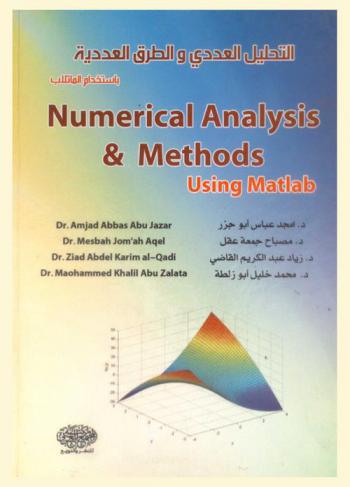
Advanced numerical methods with Matlab 1 : function approximation and system resolution
Most physical problems can be written in the form of mathematical equations (differential, integral, etc.). Mathematicians have always sought to find analytical solutions to the equations encountered in the different sciences of the engineer (mechanics, physics, biology, etc.). These equations are sometimes complicated and much effort is required to simplify them. In the middle of the 20th century, the arrival of the first computers gave birth to new methods of resolution that will be described by numerical methods. They allow solving numerically as precisely as possible the equations encountered (resulting from the modeling of course) and to approach the solution of the problems posed. The approximate solution is usually computed on a computer by means of a suitable algorithm. The objective of this book is to introduce and study the basic numerical methods and those advanced to be able to do scientific computation. The latter refers to the implementation of approaches adapted to the treatment of a scientific problem arising from physics (meteorology, pollution, etc.) or engineering (structural mechanics, fluid mechanics, signal processing, etc.).-- Provided by Publisher.
Book

Fully Automated Reduction of Longslit Spectroscopy with the Low Resolution Imaging Spectrometer at the Keck Observatory
This paper presents and summarizes a software package (\"LPipe\") for completely automated, end-to-end reduction of both bright and faint sources with the Low Resolution Imaging Spectrometer (LRIS) at Keck Observatory. It supports all gratings, grisms, and dichroics, and also reduces imaging observations, although it does not include multislit or polarimetric reduction capabilities at present. It is suitable for on-the-fly quicklook reductions at the telescope, for large-scale reductions of archival data sets, and (in many cases) for science-quality post-run reductions of PI data. To demonstrate its capabilities the pipeline is run in fully automated mode on all LRIS longslit data in the Keck Observatory Archive acquired during the 12-month period between 2016 August and 2017 July. The reduced spectra (of 675 single-object targets, totaling ∼200 hours of on-source integration time in each camera), and the pipeline itself, are made publicly available to the community.
Journal Article

Visualization in Bayesian workflow
Bayesian data analysis is about more than just computing a posterior distribution, and Bayesian visualization is about more than trace plots of Markov chains. Practical Bayesian data analysis, like all data analysis, is an iterative process of model building, inference, model checking and evaluation, and model expansion. Visualization is helpful in each of these stages of the Bayesian workflow and it is indispensable when drawing inferences from the types of modern, high dimensional models that are used by applied researchers.
Journal Article