
Catalogue Search | MBRL


Are you sure you want to remove the book from the shelf?

{{itemTitle}}
9,284
result(s) for
"development ethnography"
Sort by:

Developers and farmers intertwining interventions: the case of rainwater harvesting and food-for-work in Degua Temben, Tigray, Ethiopia
Understanding the objectives, strategies and actions of the different actors that play a role in the implementation of rural development programmes is a key to explaining the latter's success and sustainability. Based on in-depth anthropological fieldwork and from an actor perspective this paper shows how the Rainwater Harvesting Pond Programme (RHPP) and the public work component of the Productive Safety Net Programme (PSNP) work out in practice in one district of the Tigray region in Ethiopia. Developers and farmers turn the two essentially unrelated rural development programmes into practically intertwined interventions, which leads to an undesirable set of outcomes. The RHPP's participants, who are conceived of as willing to improve, are favoured above other candidates for employment in the PSNP, which farmers compete for. Developers' and farmers' moves and countermoves result in targeting errors in the PSNP and in farmers massively constructing rainwater harvesting ponds, the large majority of which fail because farmers do not aspire to make them succeed, but merely see them as a stepping stone to employment in the PSNP. In addition both groups' perception of each other is affected. Our observations challenge prevailing interpretations of the effects of development interventions on Tigrayan people's livelihoods.
Journal Article

Tourism in Fishing Communities in Peru
By combining critical discourse analysis and multi-sited ethnography, this article looks at the discursive spheres where ideologies of race and development intersect in tourism contexts outside the Andean highlands. It illustrates how dominant discourses construct and situate social subjects within the structure of Peruvian society, while ideologically justifying the expansion of the tourism industry. Based on the case of Máncora, Piura, it explores the tensions and negotiations that emerge from implementing tourism within fishing communities in Northern Peru. The author argues that the tourism industry has advanced into a contemporary platform where old discourses and racialized practices are reproduced, creating the conditions for the processes of social exclusion to occur.
Este artículo combina el análisis crítico del discurso y la etnografía multi-lugar para analizar las esferas discursivas donde las ideologías de raza y de desarrollo se intersectan en contextos turísticos costeros. Ilustra cómo los discursos dominantes construyen y sitúan sujetos sociales dentro de la estructura de la sociedad peruana, al mismo tiempo que justifican ideológicamente la expansión de la industria turística. Utilizando el caso de Máncora, en el departamento de Piura, este artículo explora las tensiones y negociaciones que surgen a partir de la implementación del turismo entre comunidades de pescadores artesanales del Norte del Perú. El autor argumenta que el turismo en el Perú se ha convertido en una plataforma contemporánea a través de la cual antiguos discursos y prácticas racializadas se reproducen, creando a su vez condiciones que fomentan procesos de exclusión social.
Journal Article
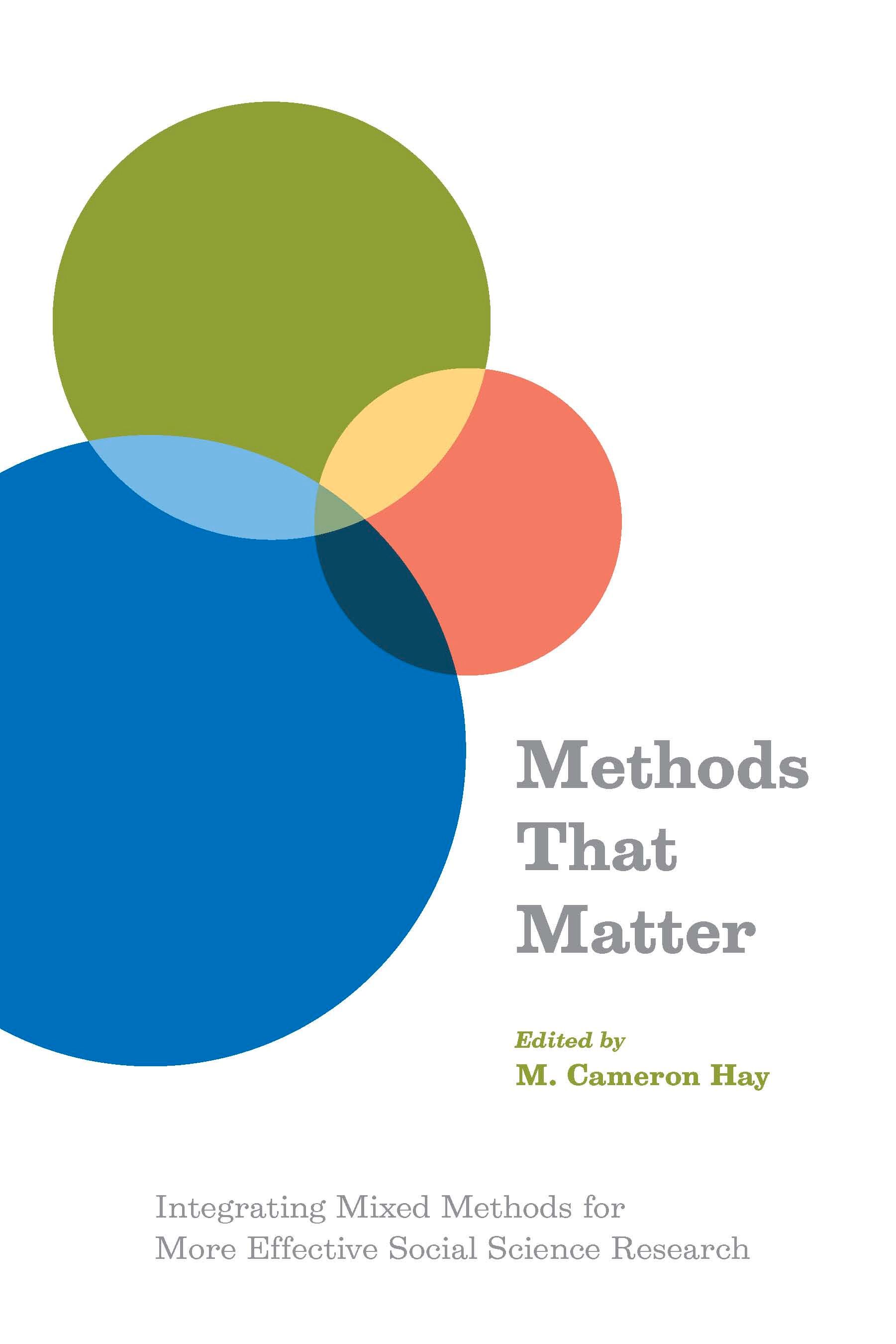
Methods That Matter
To do research that really makes a difference—the authors of this book argue—social scientists need questions and methods that reflect the complexity of the world. Bringing together a consortium of voices across a variety of fields, Methods that Matter offers compelling and successful examples of mixed methods research that do just that. In case after case, the researchers here break out of the traditional methodological silos that have long separated social science disciplines in order to better describe the intricacies of our personal and social worlds. Historically, the largest division between social science methods has been that between quantitative and qualitative measures. For people trained in psychology or sociology, the bias has been toward the former, using surveys and experiments that yield readily comparable numerical results. For people trained in anthropology, it has been toward the latter, using ethnographic observations and interviews that offer richer nuances of meaning but are difficult to compare across societies. Discussing their own endeavors to combine the quantitative with the qualitative, the authors invite readers into a conversation about the best designs and practices of mixed methodologies to stimulate creative ideas and find new pathways of insight. The result is an engaging exploration of a promising new approach to the social sciences.
eBook

Generating Customer Insights in Mid-sized B2B Companies: Integrative Review and Future Research Directions
Mid-sized businesses (MSB) and mid-sized B2B businesses (MSB2B) in particular are often ignored in the research on innovation management. Yet, MSBs are very important for the growth of economies worldwide and it is of utmost importance for their future performance to develop new products. For the successful development of new differentiated products in MSBs, the early identification and consideration of customers’ hidden needs is crucial. Techniques that can be used to generate customer insights are often referred to by the term voice of the customer (VOC). However, extant research has treated this term very inconsistently. This is why, it is difficult for MSBs to decide which techniques are most useful to them. For MSBs, that have limited resources, this is a particular issue and best practices of how MSBs identify their customers’ needs for different types and different phases of innovation projects are lacking.This review aims at clarifying the aforementioned issues for MSB2Bs. Based on an analysis of the limited research on using hidden needs techniques in MSB2Bs, actionable recommendations are derived as to which hidden needs techniques are most useful for MSB2Bs and which best practices should be considered when developing new products in MSB2Bs. Opportunities for academia and practitioners are identified and managerial implications for industrial product innovation in MSB2Bs are discussed.
Journal Article

Hacia una etnografía de la acción pública: desafíos teórico-metodológicos de la antropología para el estudio de las políticas públicas contemporáneas
El artículo presenta fragmentos etnográficos que establecen los lineamientos para una antropología de la acción pública a través del examen de la intervención del Estado y otros agentes luego de un desastre natural en Chiapas (México). En esta propuesta, la labor de la antropología es examinar la producción de símbolos y significados que orientan el comportamiento de una multiplicidad de agentes de diversas esferas (del Estado, el sector privado, los organismos civiles, los organismos multilaterales, etc.) en escalas desiguales (local, municipal, regional, estatal, nacional, internacional). Tales agentes se mueven en espacios sociales policéntricos, pero se expresan y tienen impactos en espacios localizados y sobre factores culturales (conocimientos e información, sentimientos y emociones, normas y valores, ilusiones y utopías) que marcan buena parte del imaginario social y el comportamiento político de los agentes en torno al desarrollo social.
Journal Article
\Somos indios, somos empresarios, somos pastos\: una etnografía del desarrollo empresarial indígena en Colombia
El artículo recoge algunas de las experiencias del proyecto de los indígenas pastos del departamento de Nariño, Colombia, para transformarse en empresarios a través de la creación de una cooperativa lechera. Este proceso tuvo lugar en el contexto de un programa de desarrollo empresarial ejecutado por la Red de Solidaridad Social, el Programa Mundial de Alimentos (PMA) y el Programa de Naciones Unidas para el Desarrollo (PNUD) entre los años 1994 y 1998. A diferencia de otros programas impulsados por el Estado, por las ong o por organismos multilaterales, este puso en marcha, de manera paralela, el reconocimiento etnográfico de sus diferentes fases. El ejercicio etnográfico buscaba identificar la visión que los indígenas tenían del programa y, desde su punto de vista, determinar los logros y las limitaciones del mismo, con el fin de coordinar permanentemente, con todos los actores involucrados, los ajustes y retos que se fueran presentando a lo largo de la ejecución del proyecto. El ejercicio etnográfico destacó los diversos dilemas políticos y étnicos que enfrentó la empresa indígena y, al mismo tiempo, cuestionó varios de los presupuestos del programa de desarrollo empresarial de indígenas.
Journal Article
