
Catalogue Search | MBRL


Are you sure you want to remove the book from the shelf?

{{itemTitle}}
36
result(s) for
"device local controller"
Sort by:

New real-time demand-side management approach for energy management systems
This study proposes a new demand-side management (DSM) technique, which is characterised by low computational requirements. The proposed technique relies on developing an operational matrix by the device local controller based on the device characteristics and the customer preferences. This matrix is sent to the energy management system (EMS) without the need to send any further information about the device or the customer preferences; then, the EMS chooses the optimal schedule for the device. To demonstrate the effectiveness of the proposed DSM technique, it is incorporated in an EMS that consists of three units controlled by a centralised microgrid controller (MGC). The three units managed by the MGC are the data collection and storage engine, the forecasting engine, and the optimisation engine. The EMS utilises the rolling horizon concept to manage real-time information and to provide the plug-and-play option for all controllable devices. Simulation results on a typical microgrid system show that the proposed DSM technique outperforms conventional DSM approaches in terms of the computational time.
Journal Article

Robust terminal sliding mode power flow controller using unified power flow controller with adaptive observer and local measurement
Unified power flow controller (UPFC) is one of the multipurpose flexible AC transmission system devices which controls the transmission line parameters independently and simultaneously. This study presents a novel power flow controlling method based on terminal sliding mode control (TSMC) method using UPFC. The proposed controller has the advantages of finite-time convergence and chattering-free properties. A chattering-free state variable controller is designed and employed to address the problems of reference tracking, robustness against uncertainties and disturbances performance of the proposed controller is compared with an existing sliding mode controller (SMC) and a PI controller. Chattering phenomena and discontinuity of the sliding mode controller are also eliminated. Another objective of the proposed control scheme is to use only locally-measurable states, and to avoid remote long distance measurements. An adaptive observer is used to estimate the receiving end bus voltage, to avoid the data transfer problems over long distances, and to fulfil advantages such as fault detection and isolation. The presented observer could also be used to estimate the measurable states of the system. Simulation results demonstrate the efficiency of the proposed controllers. It is shown that the convergence time of the proposed TSMC is lower than those of the SMC and PID controllers’. Stability of the proposed controllers is mathematically proved. The performance of the presented adaptive observer, in the noisy environment, is also evaluated by simulation. Finally, simulation results of the suggested controllers under transient states and faulty conditions are presented.
Journal Article

Programmable Logic Controllers (4th Edition)
This is the introduction to PLCs for which baffled students, technicians and managers have been waiting. In this straightforward, easy-to-read guide, Bill Bolton has kept the jargon to a minimum, considered all the programming methods in the standard IEC 1131-3 - in particular ladder programming, and presented the subject in a way that is not device specific to ensure maximum applicability to courses in electronics and control systems. Now in its fourth edition, this best-selling text has been expanded with increased coverage of industrial systems and PLCs and more consideration has been given to IEC 1131-3 and all the programming methods in the standard. The new edition brings the book fully up to date with the current developments in PLCs, describing new and important applications such as PLC use in communications (e.g. Ethernet - an extremely popular system), and safety - in particular proprietary emergency stop relays (now appearing in practically every PLC based system).
eBook

Interconnecting smart objects with IP : the next Internet
Interconnecting Smart Objects with IP: The Next Internet explains why the Internet Protocol (IP) has become the protocol of choice for smart object networks.IP has successfully demonstrated the ability to interconnect billions of digital systems on the global Internet and in private IP networks.
eBook
Implementation Optimal Location and Sizing of UPFC on Iraqi Power System Grid (132 kV) Using Genetic Algorithm
Electric power systems required efficient processors and intelligent methods for sustainability therefore, in this paper used Flexible AC Transmission System (FACTS) device specifically Unified Power Flow Controller (UPFC) because of its useful properties on series and shunt devices and used Genetic Algorithm (GA) to determine the optimal location and values of UPFC to achieve the following objectives: improve voltages profile, reduce power losses, treatment of power flow in overloaded transmission lines and reduce power generation. Consequently, all of these goals led to a reduction in the total cost of the power system. GA was applied to an Iraqi local power grid system (Diyala 132 kV) to find the optimal values and locations of UPFC for the purpose of achieving the objectives mentioned above using the MATLAB program. The simulation results showed the effectiveness of GA to calculate the optimum values and locations of UPFC and promising results were obtained for the Diyala power network (132 kV) with regard to the desired objectives.
Journal Article
Conservation voltage reduction (CVR) via two-timescale control in unbalanced power distribution systems
Voltage control devices are employed in power distribution systems to reduce the power consumption by operating the system closer to the lower acceptable voltage limits; this technique is called conservation voltage reduction (CVR). The different modes of operation for system's legacy devices (with binary control) and new devices (e.g. smart inverters with continuous control) coupled with variable photovoltaic (PV) generation results in voltage fluctuations which makes it challenging to achieve CVR objective. This study presents a two-timescale control of feeder's voltage control devices to achieve CVR that includes: (i) a centralised controller operating in a slower time-scale to coordinate voltage control devices across the feeder; and (ii) local controllers operating in a faster timescale to mitigate voltage fluctuations due to PV variability. The centralised controller utilises a three-phase optimal power flow model to obtain the decision variables for both legacy devices and smart inverters. The local controllers operate smart inverters to minimise voltage fluctuations and restore nodal voltages to their reference values by adjusting the reactive power support. The proposed approach is validated using the IEEE-123 bus (medium-size) and R3-12.47-2 (large-size) feeders. It is demonstrated that the proposed approach is effective in achieving the CVR objective for unbalanced distribution systems.
Journal Article

UAV communication system integrated into network traversal with mobility
In this paper, a secured unmanned aerial vehicle (UAV)-assisted heterogeneous network environment, and seamless IP prototype is proposed. UAV is controlled over the Internet to resolve a long-range communication barrier and to improve remote sensing. In the new technology, a pilot can control UAV via an end device (ED)-secured communication without any information about the network architectures, network address translation types, Internet protocol version. Network traversal with mobility (NTMobile) offers a secured communication for UAV through a public network infrastructure. NTMobile enhances the security and maintain mobility by generating keys and building tunnel using virtual IPs for two nodes inside the network. In the prototype the UAV flight controller can install a ground control station application on the UAV board. An ED can be any smart device connected to the Internet with the ability to run the remote protocols, which allows the pilot to send commands and receives data from UAV. Moreover, the pilot transmits commands through the remote desktop protocol or secure shell protocol. Experimentally, an autopilot mission is designed and uploaded to the flight controller where UAV and ED are forced to switch access network between cellular network LTE and 802.11a IEEE wireless local area network in specific waypoints. The novelty of this study is proposing secure continuous connectivity of the UAV communication and control system even during the occurrence of a network switch, which is one of the important factor in the heterogeneous network environment. The results revealed that NTMobile maintains continuous communication by re-establishing the created tunnel between UAV and ED in the proposed prototype while both are travelling in a heterogeneous network.
Journal Article

Modified Grey Wolf Optimization for Maximum Power Point Tracking in Photovoltaic System under Partial Shading Conditions
Maximum power point tracking (MPPT) is a method often used to maximize photovoltaic (PV) power output. In this paper, a modified gray wolf optimization (MGWO) is proposed to improve MPPT capability for PV in partial shade conditions. In the gray wolf optimization standard (GWO), it cannot maintain a balance between exploration of global optimization parameters and exploitation of local optimization parameters, which results in inaccurate optimal results. Therefore, the GWO is modified by updating alpha every iteration to increase the convergence speed and avoid local optima trapped by partial shading conditions. The proposed algorithm is implemented by an interleaved boost converter and a low-cost microcontroller. Simulation and experimental results show that the proposed algorithm can improve tracking performance speed and accuracy. The contribution of this invention can be applied to intelligent electronic devices (IEDs) as maximum power tracking based on embedded controllers.
Journal Article

A force threshold-based position controller for legged locomotion
Taking inspiration from local leg feedback control loops present in animal legs, a force threshold-based position (FTP) controller is presented to aid with legged locomotion over irregular terrain. The algorithm uses pre-planned position trajectories and force feedback to either elevate or depress the foot. The FTP controller isolates the control of each leg to use only localized feedback, which can result in greater responsiveness to the terrain when compared to a centralized controller arbitrating all of the joint positions in a high degree of freedom system. The controller is robust to terrain elevations without using visual sensors, a priori terrain information, inertial sensing or inter-leg communication. Results of the FTP controller applied to a hexapod system in simulation and on an experimental system are shown in this paper. The algorithm also has the potential for expansion to bipeds, quadrupeds and other biologically-inspired forms.
Journal Article
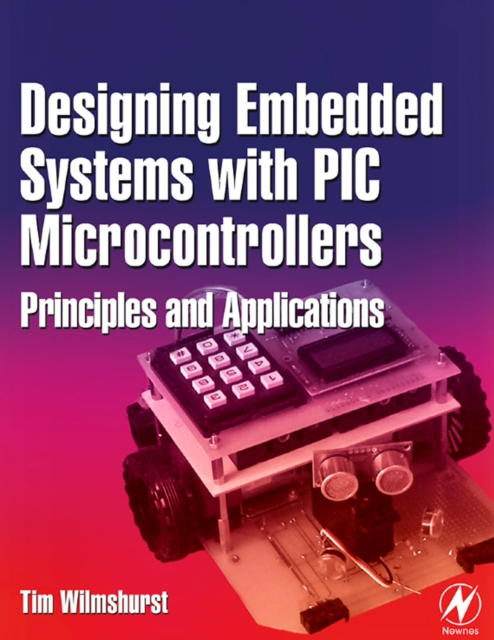
Designing embedded systems with PIC microcontrollers : principles and applications
Embedded Systems with PIC Microcontrollers: Principles and Applications is a hands-on introduction to the principles and practice of embedded system design using the PIC microcontroller. Packed with helpful examples and illustrations, the book provides an in-depth treatment of microcontroller design as well as programming in both assembly language and C, along with advanced topics such as techniques of connectivity and networking and real-time operating systems. In this one book students get all they need to know to be highly proficient at embedded systems design. This text combines embedded systems principles with applications, using the16F84A, 16F873A and the 18F242 PIC microcontrollers. Students learn how to apply the principles using a multitude of sample designs and design ideas, including a robot in the form of an autonomous guide vehicle. Coverage between software and hardware is fully balanced, with full presentation given to microcontroller design and software programming, using both assembler and C. The book is accompanied by a companion website containing copies of all programs and software tools used in the text and a 'student' version of the C compiler. This textbook will be ideal for introductory courses and lab-based courses on embedded systems, microprocessors using the PIC microcontroller, as well as more advanced courses which use the 18F series and teach C programming in an embedded environment. Engineers in industry and informed hobbyists will also find this book a valuable resource when designing and implementing both simple and sophisticated embedded systems using the PIC microcontroller.
eBook