
Catalogue Search | MBRL


Are you sure you want to remove the book from the shelf?

{{itemTitle}}
1,043
result(s) for
"digital jukebox"
Sort by:

Selling digital music, formatting culture
\"Selling Digital Music documents the transition of recorded music on CDs to music as digital files on computers. More than two decades after the first digital music files began circulating in online archives and playing through new software media players, we have yet to fully internalize the cultural and aesthetic consequences of these shifts. Exploring the emergence of what Morris calls the digital music commodity, Selling Digital Music considers how a conflicted assemblage of technologies, users, and industries helped reformat popular music's meanings and uses. Through case studies of five key technologies--Winamp, metadata, Napster, iTunes, and cloud computing--Morris questions how music listeners gradually came to understand computers and digital files as suitable replacements for their stereos and CDs. The digitization of the music commodity connects industrial production, popular culture, technology, and commerce in a narrative involving the aesthetics of music and computers, and the labor of producers and everyday users, as well as the value that listeners make and take from digital objects and cultural goods. Above all, Selling Digital Music is a sounding out of music's encounters with the interfaces, metadata, and algorithms of digital culture.\"--Provided by publisher.
Book

Selling digital music, formatting culture
Selling Digital Music, Formatting Culturedocuments the transition of recorded music on CDs to music as digital files on computers. More than two decades after the first digital music files began circulating in online archives and playing through new software media players, we have yet to fully internalize the cultural and aesthetic consequences of these shifts. Tracing the emergence of what Jeremy Wade Morris calls the \"digital music commodity,\"Selling Digital Music, Formatting Cultureconsiders how a conflicted assemblage of technologies, users, and industries helped reformat popular music's meanings and uses. Through case studies of five key technologies-Winamp, metadata, Napster, iTunes, and cloud computing-this book explores how music listeners gradually came to understand computers and digital files as suitable replacements for their stereos and CD. Morris connects industrial production, popular culture, technology, and commerce in a narrative involving the aesthetics of music and computers, and the labor of producers and everyday users, as well as the value that listeners make and take from digital objects and cultural goods. Above all,Selling Digital Music, Formatting Cultureis a sounding out of music's encounters with the interfaces, metadata, and algorithms of digital culture and of why the shifting form of the music commodity matters for the music and other media we love.
eBook

Spotify
Un guide pratique et accessible pour tout savoir sur Spotify et ses créateurs passionnés Avec plus de 60 millions d'utilisateurs actifs à travers le monde en fin d'année 2014, Spotify est de loin l'acteur incontournable de l'écoute de musique en streaming. Mais que sait-on réellement de l'entreprise et des moyens qu'elle met en œuvre pour proposer à l'auditeur ses morceaux préférés ? Quelles sont les clés de la réussite de cet acteur qui a révolutionné la manière de consommer la musique ? D'ailleurs, l'entreprise est-elle véritablement rentable ? Ce livre vous aidera à : Comprendre la révolution que se joue dans le secteur musical Connaître les dessous de la création de l'entreprise Vous faire une idée précise des développements et des ambitions de Spotify Et bien plus encore ! Le mot de l'éditeur : « Avec l'auteur, Charlotte Bouillot, nous avons voulu dresser un tableau des réalités de l'industrie musicale au travers de l'analyse de l'acteur colossal qu'est Spotify et, ainsi, retracer le passionnant parcours des entrepreneurs, Daniel Ek et Martin Lorentzon, pour que le lecteur apprécie la complexité et l'ingéniosité de ce service révolutionnaire. » Juliette Nève À PROPOS DE LA SÉRIE 50MINUTES | Business Stories La série « Business Stories » de la collection 50MINUTES propose des documents qui invitent tous les curieux à réfléchir et à s'inspirer des plus grandes entreprises qui ont marqué notre histoire ou qui participent au paysage économique actuel. Nous avons conçu la collection Business & Economics en pensant aux nombreux professionnels obligés de se former en permanence en économie, en management, en stratégie ou en marketing. Nos auteurs combinent des éléments de théorie, des pistes de réflexion, et, pour certains sujets, des études de cas et de nombreux exemples pratiques pour permettre aux lecteurs de
eBook

Selling digital music, formatting culture
\"Selling Digital Music documents the transition of recorded music on CDs to music as digital files on computers. More than two decades after the first digital music files began circulating in online archives and playing through new software media players, we have yet to fully internalize the cultural and aesthetic consequences of these shifts. Exploring the emergence of what Morris calls the digital music commodity, Selling Digital Music considers how a conflicted assemblage of technologies, users, and industries helped reformat popular music's meanings and uses. Through case studies of five key technologies--Winamp, metadata, Napster, iTunes, and cloud computing--Morris questions how music listeners gradually came to understand computers and digital files as suitable replacements for their stereos and CDs. The digitization of the music commodity connects industrial production, popular culture, technology, and commerce in a narrative involving the aesthetics of music and computers, and the labor of producers and everyday users, as well as the value that listeners make and take from digital objects and cultural goods. Above all, Selling Digital Music is a sounding out of music's encounters with the interfaces, metadata, and algorithms of digital culture.\"--Provided by publisher
Book

Selling Digital Music, Formatting Culture
Selling Digital Music, Formatting Culture documents the transition of recorded music on CDs to music as digital files on computers. More than two decades after the first digital music files began circulating in online archives and playing through new software media players, we have yet to fully internalize the cultural and aesthetic consequences of these shifts. Tracing the emergence of what Jeremy Wade Morris calls the \"digital music commodity,\" Selling Digital Music, Formatting Culture considers how a conflicted assemblage of technologies, users, and industries helped reformat popular music'
Book
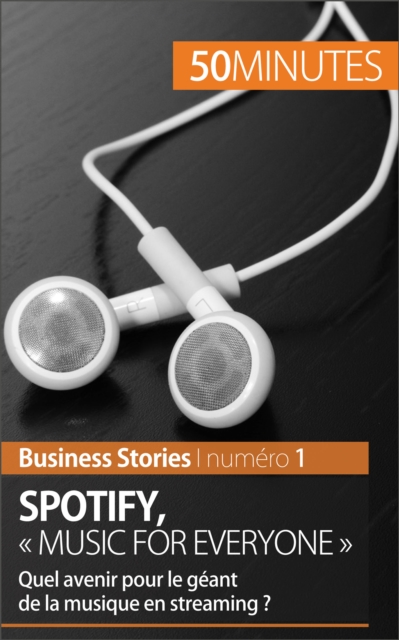
Spotify : \Music for everyone\
Un guide pratique et accessible pour tout savoir sur Spotify et ses créateurs passionnés
Avec plus de 60 millions d'utilisateurs actifs à travers le monde en fin d'année 2014, Spotify est de loin l'acteur incontournable de l'écoute de musique en streaming. Mais que sait-on réellement de l'entreprise et des moyens qu'elle met en œuvre pour proposer à l'auditeur ses morceaux préférés? Quelles sont les clés de la réussite de cet acteur qui a révolutionné la manière de consommer la musique? D'ailleurs, l'entreprise est-elle véritablement rentable? Ce livre vous aidera à:
• Comprendre la révolution que se joue dans le secteur musical
• Connaître les dessous de la création de l'entreprise
• Vous faire une idée précise des développements et des ambitions de Spotify
• Et bien plus encore! Le mot de l'éditeur:
« Avec l'auteur, Charlotte Bouillot, nous avons voulu dresser un tableau des réalités de l'industrie musicale au travers de l'analyse de l'acteur colossal qu'est Spotify et, ainsi, retracer le passionnant parcours des entrepreneurs, Daniel Ek etMartin Lorentzon, pour que le lecteur apprécie la complexité et l'ingéniosité de ce service révolutionnaire.» Juliette Nève À PROPOS DE LA SÉRIE 50MINUTES | Business Stories
La série « Business Stories » de la collection 50MINUTES propose des documents qui invitent tous les curieux à réfléchir et à s'inspirer des plus grandes entreprises qui ont marqué notre histoire ou qui participent au paysage économique actuel. Nous avons conçu la collection Business & Economics en pensant aux nombreux professionnels obligés de se former en permanence en économie, en management, en stratégie ou en marketing. Nos auteurs combinent des éléments de théorie, des pistes de réflexion, et, pour certains sujets, des études de cas et de nombreux exemples pratiques pour permettre aux lecteurs de développer leurs compétences et leur expertise.
eBook

Looping, turning and mixing
Writes of his experiences learning to DJ and performing at the Brooklyn studio of Serato (a New Zealand company responsible for the 'Scratch Live' software which revolutionsed the DJing industry) then club Le Bain in New York City. Source: National Library of New Zealand Te Puna Matauranga o Aotearoa, licensed by the Department of Internal Affairs for re-use under the Creative Commons Attribution 3.0 New Zealand Licence.
Newspaper Article

ECOGEN : Bird sounds generation using deep learning
Large‐scale acoustic projects generate vast amounts of data that can now be efficiently processed using deep learning tools. However, these tools often face limitations due to sound labeling and imbalanced sampling. Data augmentation can help overcome such challenges, particularly through the generation of synthetic and lifelike sounds. Synthetic samples can be valuable not only for deep learning but also for species with limited available data. Despite advancements in computer power, sound generation remains a time‐consuming process, even requiring a substantial number of samples. We present ECOGEN, a novel deep learning approach designed to generate realistic bird songs for biologists and ecologists. The primary objective of ECOGEN is to enhance the number of samples in under‐represented bird song classes, thereby improving the performance and robustness of classifiers in ecological research.The ECOGEN framework employs spectrograms as a representation of bird songs and leverages proven image generation techniques to create new spectrograms, subsequently converted back to digital audio signals. As a class‐agnostic tool, ECOGEN is applicable to a wide range of biophonic sounds, including mammal and insect calls. We show that adding samples generated by ECOGEN to a bird song classifier improved the classification accuracy by 12% on average and improved results compared with classic data augmentation techniques 80% of the time. Our approach is both fast and efficient, enabling the generation of synthetic bird songs on standard computing resources. By facilitating the creation of synthetic bird songs, ECOGEN can contribute to the conservation of endangered bird species, while providing valuable insights into their vocalizations, behaviours and habitat preferences. Future development of ECOGEN can be easily implemented and could focus on incorporating additional configurable parameters during the generation phase for increased control over the output, catering to the specific needs of biologists.
Journal Article