
Catalogue Search | MBRL


Are you sure you want to remove the book from the shelf?

{{itemTitle}}
556
result(s) for
"divisions of race"
Sort by:

The managed hand
Two women, virtual strangers, sit hand-in-hand across a narrow table, both intent on the same thing-achieving the perfect manicure. Encounters like this occur thousands of times across the United States in nail salons increasingly owned and operated by Asian immigrants. This study looks closely for the first time at these intimate encounters, focusing on New York City, where such nail salons have become ubiquitous. Drawing from rich and compelling interviews, Miliann Kang takes us inside the nail industry, asking such questions as: Why have nail salons become so popular? Why do so many Asian women, and Korean women in particular, provide these services? Kang discovers multiple motivations for the manicure-from the pampering of white middle class women to the artistic self-expression of working class African American women to the mass consumption of body-related services. Contrary to notions of beauty service establishments as spaces for building community among women, The Managed Hand finds that while tentative and fragile solidarities can emerge across the manicure table, they generally give way to even more powerful divisions of race, class, and immigration.
eBook


Racial/Ethnic Variation in the Relationship Between Educational Assortative Mating and Wives' Income Trajectories
Prior work has examined the relationship between educational assortative mating and wives' labor market participation but has not assessed how this relationship varies by race/ethnicity. Using data from the National Longitudinal Survey of Youth 1979, we estimate group-based developmental trajectories to investigate whether the association between educational assortative mating and wives' income trajectories varies by race/ethnicity. The presence, prevalence, and shapes of prototypical long-term income trajectories vary markedly across racial/ethnic groups. Whites are more likely than Blacks and Hispanics to follow income trajectories consistent with a traditional gender division of labor. The association between educational assortative mating is also stronger for Whites than for Blacks and Hispanics. White wives in educationally hypogamous unions make the greatest contribution to the couple's total income, followed by those in homogamous and hypergamous unions. Black and Hispanic wives in hypogamous unions are less likely than their peers in other unions to be secondary earners. These findings underscore the need for studies of the consequences of educational assortative mating to pay closer attention to heterogeneity across and within racial/ethnic groups.
Journal Article
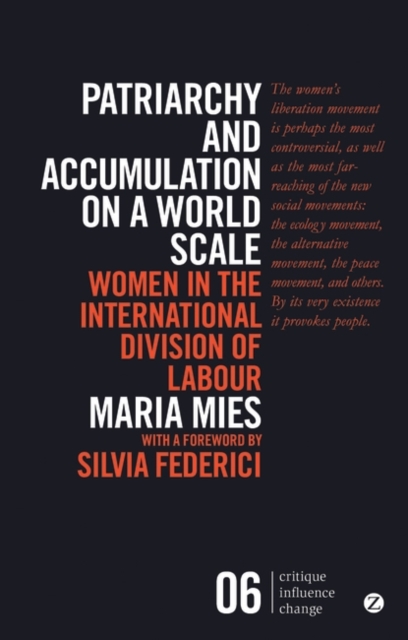
Patriarchy and Accumulation on a World Scale
First published in 1986, Maria Mies’s progressive book was hailed as a major paradigm shift for feminist theory, and it remains a major contribution to development theory and practice today. Tracing the social origins of the sexual division of labour, it offers a history of the related processes of colonization and 'housewifization' and extends this analysis to the contemporary new international division of labour. Mies's theory of capitalist patriarchy has become even more relevant today.
eBook

Making Care Count
There are fundamental tasks common to every society: children have to be raised, homes need to be cleaned, meals need to be prepared, and people who are elderly, ill, or disabled need care. Day in, day out, these responsibilities can involve both monotonous drudgery and untold rewards for those performing them, whether they are family members, friends, or paid workers. These are jobs that cannot be outsourced, because they involve the most intimate spaces of our everyday lives--our homes, our bodies, and our families.
Mignon Duffy uses a historical and comparative approach to examine and critique the entire twentieth-century history of paid care work--including health care, education and child care, and social services--drawing on an in-depth analysis of U.S. Census data as well as a range of occupational histories. Making Care Count focuses on change and continuity in the social organization along with cultural construction of the labor of care and its relationship to gender, racial-ethnic, and class inequalities. Debunking popular understandings of how we came to be in a \"care crisis,\" this book stands apart as an historical quantitative study in a literature crowded with contemporary, qualitative studies, proposing well-developed policy approaches that grow out of the theoretical and empirical arguments.
eBook

Critical Race Theory: How Policy Language Differentially Engages Symbolic Racism and Partisanship
Recent years have seen a marked shift in the salience and politicization of any incorporation of race into teaching at the elementary and secondary levels. “Critical race theory” (CRT) has become a prominent feature of the current debate, even as there is a good deal of misunderstanding about what CRT actually is. Drawing on a pre-registered survey experiment, we consider the impact of the phrase “critical race theory” in activating both racial biases and partisan identity. Our expectation was that CRT would tend to activate partisanship independent of symbolic racism. Results suggest otherwise: where support for culturally relevant pedagogy is concerned, CRT appears to engage partisanship particularly amongst those who exhibit high levels of symbolic racism.
Journal Article

“I Hesitate but I Do Have Hope”: Youth Speculative Civic Literacies for Troubled Times
In this essay, Nicole Mirra and Antero Garcia explore how young people from six demographically distinct communities across the United States understand the social and political issues affecting their lives, engage in storytelling and dialogue across differences, and collaboratively imagine humanizing and hopeful civic futures. Drawing from critical race perspectives on democracy and civic education, and with an expansive vision of the nature and purpose of literacy, Mirra and Garcia develop a speculative approach to civic literacy research and practice that centers the voices and concerns of young people, honors differences of identity and expression, and manifests ideological commitments to equity, empathy, and collective struggle to ward off civic disintegration. Findings from their social design-based experiment foreground counterstories in which youth challenge their positioning as not-yet-citizens, create opportunities to engage in civic life on their own terms, and leverage their repertoire of literacy practices to invent new possibilities for inclusive democratic community life.
Journal Article

Intergenerational effects of maternal lifetime stressor exposure on offspring telomere length in Black and White women
Although maternal stressor exposure has been associated with shorter telomere length (TL) in offspring, this literature is based largely on White samples. Furthermore, timing of maternal stressors has rarely been examined. Here, we examined how maternal stressors occurring during adolescence, pregnancy, and across the lifespan related to child TL in Black and White mothers.
Mothers (112 Black; 110 White;
= 39) and their youngest offspring (
= 222;
= 8) were part of a larger prospective cohort study, wherein mothers reported their stressors during adolescence (assessed twice during adolescence for the past year), pregnancy (assessed in midlife for most recent pregnancy), and across their lifespan (assessed in midlife). Mother and child provided saliva for TL measurement. Multiple linear regression models examined the interaction of maternal stressor exposure and race in relation to child TL, controlling for maternal TL and child gender and age. Race-stratified analyses were also conducted.
Neither maternal adolescence nor lifespan stressors interacted with race in relation to child TL. In contrast, greater maternal pregnancy stressors were associated with shorter child TL, but this effect was present for children of White but not Black mothers. Moreover, this effect was significant for financial but not social pregnancy stressors. Race-stratified models revealed that greater financial pregnancy stressors predicted shorter telomeres in offspring of White, but not Black mothers.
Race and maternal stressors interact and are related to biological aging across generations, but these effects are specific to certain races, stressors, and exposure time periods.
Journal Article

Transnational gentrification, tourism and the formation of ‘foreign only’ enclaves in Barcelona
In a context of global-scale inequalities and increased middle-class transnational mobility, this paper explores how the arrival of Western European and North American migrants in Barcelona drives a process of gentrification that coexists and overlaps with the development of tourism in the city. Research has focused increasingly on the role of visitors and Airbnb in driving gentrification. However, our aim is to add another layer to the complexity of neighbourhood change in tourist cities by considering the role of migrants from advanced economies as gentrifiers in these neighbourhoods. We combined socio-demographic analysis with in-depth interviews and, from this, we found that: (1) lifestyle opportunities, rather than work, explain why transnational migrants are attracted to Barcelona, resulting in privileged consumers of housing that then displace long-term residents; (2) migrants have become spatially concentrated in tourist enclaves and interact predominantly with other transnational mobile populations; (3) the result is that centrally located neighbourhoods are appropriated by foreigners – both visitors and migrants – who are better positioned in the unequal division of labour, causing locals to feel increasingly excluded from the place. We illustrate that tourism and transnational gentrification spatially coexist and, accordingly, we provide an analysis that integrates both processes to understand how neighbourhood change occurs in areas impacted by tourism. By doing so, the paper offers a fresh reading of how gentrification takes place in a Southern European destination and, furthermore, it provides new insights into the conceptualisation of tourism and lifestyle migration as drivers of gentrification.
在全球范围内不平等和中产阶级跨国流动增加的背景下,本文探讨了在巴塞罗那,西欧和北美移民的到来如何推动了一个与城市旅游业发展共存和重叠的绅士化进程。研究越来越关注游客和爱彼迎在推动绅士化方面的作用。然而,我们的目标是通过考察来自发达经济体的移民作为这些街区的绅士化推动者角色,为旅游城市的街区变化增加另一层复杂性。我们将社会人口分析与深入访谈相结合,从中我们发现:(1)生活方式的机会,而不是工作,解释了为什么跨国移民被吸引到巴塞罗那,导致住房的特权消费者,然后驱逐长期居民;(2)移民在空间上集中在旅游飞地,主要与其他跨国流动人口互动;(3)结果是位于中心的街区被外国人(包括游客和移民)占据,他们在不平等的劳动分工中处于更有利的地位,导致当地人越来越感到被排斥在这个地方之外。我们证明旅游业和跨国绅士化在空间上是共存的,因此,我们提供了一个综合这两个过程的分析,以了解在受旅游业影响的地区街区关系是如何发生变化的。藉此,本文对一个南欧旅游胜地的绅士化进行了全新的解读,此外,本文还对旅游业和生活方式迁移的概念化作为绅士化的驱动因素提供了新的见解。
Journal Article

THE GENDER REVOLUTION: Uneven and Stalled
In this article, the author describes sweeping changes in the gender system and offers explanations for why change has been uneven. Because the devaluation of activities done by women has changed little, women have had strong incentive to enter male jobs, but men have had little incentive to take on female activities or jobs. The gender egalitarianism that gained traction was the notion that women should have access to upward mobility and to all areas of schooling and jobs. But persistent gender essentialism means that most people follow gender-typical paths except when upward mobility is impossible otherwise. Middle-class women entered managerial and professional jobs more than working-class women integrated blue-collar jobs because the latter were able to move up while choosing a \"female\" occupation; many mothers of middle-class women were already in the highest-status female occupations. The author also notes a number of gender-egalitarian trends that have stalled.
Journal Article