
Catalogue Search | MBRL


Are you sure you want to remove the book from the shelf?

{{itemTitle}}
119
result(s) for
"emerging church"
Sort by:


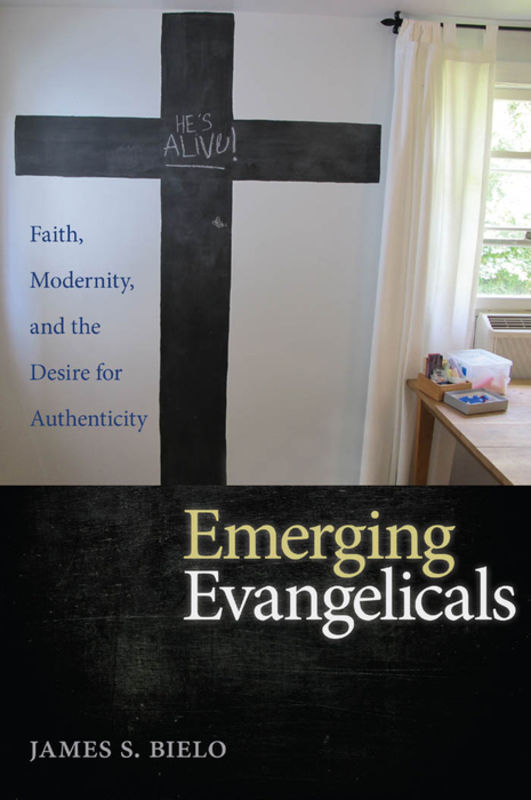
Emerging Evangelicals
The Emerging Church movement developed in the mid-1990s among
primarily white, urban, middle-class pastors and laity who were
disenchanted with America's conservative Evangelical sub-culture.
It is a response to the increasing divide between conservative
Evangelicals and concerned critics who strongly oppose what they
consider overly slick, corporate, and consumerist versions of
faith. A core feature of their response is a challenge to
traditional congregational models, often focusing on new church
plants and creating networks of related house churches. Drawing on
three years of ethnographic fieldwork, James S. Bielo explores the
impact of the Emerging Church movement on American Evangelicals. He
combines ethnographic analysis with discussions of the movement's
history, discursive contours, defining practices, cultural logics,
and contentious interactions with conservative Evangelical critics
to rethink the boundaries of \"Evangelical\" as a category.
Ultimately, Bielo makes a novel contribution to our understanding
of the important changes at work among American Protestants, and
illuminates how Emerging Evangelicals interact with the cultural
conditions of modernity, late modernity, and visions of
\"postmodern\" Christianity.
eBook

New Concepts for New Dynamics: Generating Theory for the Study of Religious Innovation and Social Change
The Emerging Church movement (ECM) is sociologically interesting—not due to the size of its membership or the centrality of its congregations. Rather, the ECM is significant because it provides an opportunity to generate new concepts for the study religious innovation and social change. Using theoretical language, the ECM consists of institutional entrepreneurs who drive their religiously concerned movement by continually deconstructing and reframing beliefs, practices, and identities from \"mainstream\" Christianity while at the same time promoting newly formulated and broadly resonant religious imperatives. As Emerging Christians cultivate new or altered religious practices, these must be continually legitimized. Furthermore, their renegotiated beliefs (heterodoxies) require new forms of organization (alternative congregations). Such action is not the work of isolated individuals, nor is it independent of societal conditions. Ultimately, the ECM consists of Emerging Christians who creatively operate through diffuse network structures across wide geographic spaces and among disparate social groups to enact a collective institutional entrepreneurship that seeks to reimagine the assumptions of conventional Christian congregational life.
Journal Article
An Emergent Threat: Christian Clergy Perceptions of the Emerging Church Movement
Although there have been several attempts to study the dimensions of the Emerging Church movement (ECM) through close observation and survey data, we know little about its diffusion into American religious cultures. We undertook this project by attempting to capture whether Christian clergy thought about the movement and how consistently they considered it. Our analysis of survey data from several denominations suggests that the ECM is less well known among the clergy they are reacting against (evangelicals). Opinions turn not on partisan identity, but on religious authority, which is precisely the ground on which the ECM presents its challenge to evangelicalism. In this way, the ECM appears to be following a path paved by the decline of denominationalism.
Journal Article
Emerging Christianity and Religious Identity
The issue of religious identity is important for understanding the Emerging Church movement (ECM), which is in our view a religious orientation adopted by individuals and groups with a variety of religious identities. ECM participants are often resistant to religious identity labels, even to the point of being reluctant to identify as part of the ECM itself. Coupling this resistance with the growing millennial embrace of the category \"religious none,\" we use identity theory to argue that the kind of religious change we see with millennials and the Emerging Church is the product of identity change. Using the results of focus groups with millennials in the southern United States, we argue that the potential for religious change around Emerging Church identities lies in a process of shifting. We also identify the potential for religious change among different Emerging Christian identities, taking Peter Rollins as an example of someone who proposes a concept of Christian identity more radical than those espoused by other Emerging Church figures.
Journal Article

Emergent Church Practices in America: Inclusion and Deliberation in American Congregations
In the last 15 years a small but growing movement organized under the label \"emergent church\" has begun to help push the church through what many of them believe to be the first careful steps that will usher in a new understanding of Christianity for the twenty-first century. An emergent church model is quite a radical one that prioritizes the agency of those in attendance to determine the beliefs and direction of the church. In this way, emergent churches, at least in theory, are radical deliberative democrats in orientation, which may have profound effects on how the church is run and how members view the church, each other, and society as a result. Using the first dataset known to acquire this identity of Protestant clergy, we assess whether emergent Christian clergy adhere to a different set of religious beliefs, values, and deliberative norms than those in the modern church.
Journal Article
The Emerging Church in Transatlantic Perspective
Is the Emerging Church movement (ECM) a single transnational movement? Or is it a series of parallel religious orientations framed by nationally specific contexts? Cross-national comparisons of the many manifestations of the ECM remain scarce, especially as the development of the ECM across the globe (e.g., in the United States, the United Kingdom, Australia, and New Zealand) is most certainly affected by divergent histories and socioreligious landscapes. Focusing on a comparative analysis of the United Kingdom and the United States, I trace how these different cultural contexts determine variant patterns of ECM identity formation. Overall, a global perspective on the ECM calls for a theorization of the national development of religious movements and takes seriously the cultural and historical experiences that shape both its emergence in particular nations and the differentiated development of distinctive manifestations of ECM identity.
Journal Article
The Question of Cultural Change in the Social Scientific Study of Religion: Notes from the Emerging Church
This article explores how anthropological models of cultural change bolster the social scientific study of the Emerging Church movement. A distinction is drawn between market-oriented approaches to change that measure institutional growth and decline and cultural-oriented approaches that address broader effects on sociocultural systems. Emphasis is placed on models that emphasize change occurring internal to cultural systems and that recognize the co-occurrence of cultural durability and transformation. This theoretical exploration is grounded in more than three years of ethnographic fieldwork conducted among Emerging evangelical communities in the midwestern United States.
Journal Article

n
A theology of hope for the Dutch Reformed Church. A forgotten yearning? During prof. Piet Meiring’s discussion of the Dutch Reformed Church’s ‘Year of Hope’ in 2001, he argued that the societal issues of reconciliation, poverty and moral regeneration on which the church focused that year, necessitated a theology of hope towards which theologians of different disciplines should contribute. In this article is explored whether to pursue such an endeavour more than two decades since the Year of Hope. Therefore, from a church historiographic viewpoint, aspects of Jürgen Moltmann’s ideas on a theology of hope within a context of injustices are revisited to assert their current relevance. In addition, more recent theological developments concerning the horizontal dimension of Christological hope within society are considered as well. In this regard reference is made to relevant ideas of the Emergent Church movement and its historical continuance. Reflecting on the current South African context and its socio-political, economic and environmental challenges, the need for a theology of hope is considered relevant to the church in order to establish credible relationships and engage strategically with society in need of hope itself.Interdisciplinary implicationsThis article contains reviewed material of historical relevance and is, therefore, conducted within the field of Church Historiography. In further consideration of a Theology of Hope the opportunity arises for interdisciplinary collaboration of theological disciplines such as Systematic Theology and Practical Theology.
Journal Article