
Catalogue Search | MBRL


Are you sure you want to remove the book from the shelf?

{{itemTitle}}
482,987
result(s) for
"energy development"
Sort by:

Design and performance of policy instruments to promote the development of renewable energy
This report summarizes the results of a recent review of the emerging experience with the design and implementation of policy instruments to promote the development of renewable energy (RE) in a sample of six representative developing countries and transition economies ('developing countries') (World Bank 2010). The review focused mainly on price- and quantity-setting policies, but it also covered fiscal and financial incentives, as well as relevant market facilitation measures. The lessons learned were taken from the rapidly growing literature and reports that analyze and discuss RE policy instruments in the context of different types of power market structures. The analysis considered all types of grid-connected RE options except large hydropower: wind (on-shore and off-shore), solar (photovoltaic and concentrated solar power), small hydropower (SHP) (with capacities below 30 megawatts), biomass, bioelectricity (cogeneration), landfill gas, and geothermal. The six countries selected for the review included Brazil, India, Indonesia, Nicaragua, Sri Lanka, and Turkey.
eBook

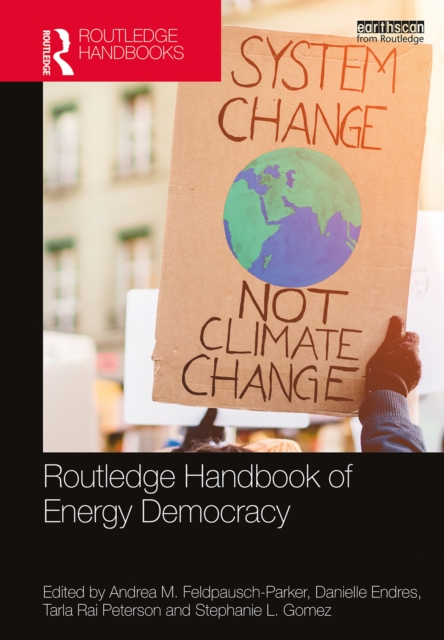
Routledge Handbook of Energy Democracy
This handbook offers a comprehensive transdisciplinary examination of the research and practices that constitute the emerging research agenda in energy democracy.
With protests over fossil fuels and controversies over nuclear and renewable energy technologies, democratic ideals have contributed to an emerging social movement. Energy democracy captures this movement and addresses the issues of energy access, ownership, and participation at a time when there are expanding social, political, environmental, and economic demands on energy systems. This volume defines energy democracy as both a social movement and an academic area of study and examines it through a social science and humanities lens, explaining key concepts and reflecting state-of-the-art research. The collection is comprised of six parts:
Scalar Dimensions of Power and Governance in Energy Democracy
Discourses of Energy Democracy
Grassroots and Critical Modes of Action
Democratic and Participatory Principles
Energy Resource Tensions
Energy Democracies in Practice
The vision of this handbook is explicitly transdisciplinary and global, including contributions from interdisciplinary international scholars and practitioners. The Routledge Handbook of Energy Democracy will be the premier source for all students and researchers interested in the field of energy, including policy, politics, transitions, access, justice, and public participation.
eBook

Assessing the role of sustainable strategies in alleviating energy poverty: an environmental sustainability paradigm
The rapid urbanization and industrialization of India have caused a demand–supply gap in the electrical sector, leading to higher electric bills. Lower-income households face the worst energy poverty in the country. Sustainable strategies like corporate social responsibility are the most effective way to combat the energy crisis. This study aims to assess the contribution of corporate social responsibility (CSR) to energy poverty alleviation (EPA) by developing the role of mediating variables such as assessment of renewable energy resource (RER), feasibility of sustainable energy supply (SES), and sustainable energy development (SED). We used hybrid research methodology such as partial least squares structural equation modeling (PLS-SEM) to analyze the collected data from professionals, economic experts, and directors in the country in 2022. The study proved that CSR directly affects energy poverty alleviation. Besides, the findings suggest RER, SES, and SED significantly lead the energy poverty alleviation. The findings of this study will divert the attention of policymakers, stakeholders, and economists toward the corporate social responsibility to mitigate the energy crisis in Indian context. A mediating role of a renewable energy resource (RER) as a value-added contribution to this study can be strengthened more in future research. Based on the results, the study illustrates that CSR acts as a catalyst to alleviate energy poverty.
Journal Article


Assessing the Level of Renewable Energy Development in the European Union Member States. A 10-Year Perspective
The global economic development is, to a great extent, dependent on access to large amounts of cheap energy sources. The growing social awareness of ecology and the enormous damage to the Earth’s ecosystem due to the production of energy from conventional sources have forced fundamental changes in the energy sector. Renewable energy is considered to be an opportunity for such changes. The current state of the art allows such changes to be made without restricting economic development. Therefore, activities related to the energy transition are being taken all over the world. The European Union has definitely managed to achieve the most tangible effects in this regard. This article presents the findings of the research aimed at presenting the current state of renewable energy in the European Union and analyzing the changes reported in this sector in the last decade. The research was carried out using a selected set of 11 indicators characterizing renewable energy in individual countries. These indicators were selected on the basis of literature review and own studies of the state of renewable energy and its development prospects. Based on these indicators, changes in the energy structure of individual European Union countries between 2008–2018 were determined. The study is divided into two main stages. The principal components analysis (PCA) was used for the first analysis. In turn, the Technique for Order Preference by Similarity to Ideal Solution (TOPSIS) was adopted to assess the level of renewable energy development in the European Union countries. Both these methods and the extended statistical analysis were applied to determine the state of renewable energy development in the European Union countries in the studied period and to divide the Member States into classes with different levels of development. The results of the study showed that the EU countries are characterized by significant differences in the development of RES during the period in question. The unquestionable leaders in this respect are Sweden, Austria, Finland, and Latvia. Based on the findings, it is possible to evaluate the effects of activities related to renewable energy development and to prepare assumptions for future activities. Additionally, both the research and its findings broaden the knowledge of the directions of renewable energy development in individual European Union countries. This is particularly important in the context of changes related to the need to reduce harmful substance emissions and the implementation of the European Green Deal idea.
Journal Article


Renewable Energy and the Public
Throughout the world, the threat of climate change is pressing governments to accelerate the deployment of technologies to generate low carbon electricity or heat. But this is frequently leading to controversy, as energy and planning policies are revised to support new energy sources or technologies (e.g. offshore wind, tidal, bioenergy or hydrogen energy) and communities face the prospect of unfamiliar, often large-scale energy technologies being sited near to their homes. Policy makers in many countries face tensions between 'streamlining' planning procedures, engaging with diverse publics to address what is commonly conceived as 'NIMBY' (not in my back yard) opposition, and the need to maintain democratic, participatory values in planning systems.
This volume provides a timely, international review of research on public engagement, in contexts of diverse, innovative energy technologies. Public engagement is conceived broadly - as the interaction between how developers and other key actors engage with publics about energy technologies (including assumptions held about the methods used, such as the provision of financial benefits or the holding of deliberative events), and how individuals and groups engage with energy policies and projects (including indirectly through the media and directly through emotional and behavioural responses).
The book's contributors are leading experts in the UK, Europe, North and South America and Australia drawn from a variety of relevant social science disciplinary perspectives. The book makes a significant contribution to our existing knowledge, as well as providing interested professionals, policymakers and members of the public with a timely overview of the critical issues involved in public engagement with low carbon energy technologies.
eBook