
Catalogue Search | MBRL


Are you sure you want to remove the book from the shelf?

{{itemTitle}}
1,793,392
result(s) for
"enforcement"
Sort by:

They Championed D.E.I. Now They’re Divided
In “Divided,” four former D.E.I. leaders come together to examine the system they once built — and question what it’s really doing.
Streaming Video

Suspect citizens : what 20 million traffic stops tell us about policing and race
\"Suspect Citizens offers the most comprehensive look to date at the most common form of police-citizen interactions, the routine traffic stop. Throughout the war on crime, police agencies have used traffic stops to search drivers suspected of carrying contraband. From the beginning, police agencies made it clear that very large numbers of police stops would have to occur before an officer might interdict a significant drug shipment. Unstated in that calculation was that many Americans would be subjected to police investigations so that a small number of high-level offenders might be found. The key element in this strategy, which kept it hidden from widespread public scrutiny, was that middle-class white Americans were largely exempt from its consequences. Tracking these police practices down to the officer level, Suspect Citizens documents the extreme rarity of drug busts and reveals sustained and troubling disparities in how racial groups are treated\"-- Provided by publisher.
Book

Stop and Frisk
No policing tactic has been more controversial than \"stop and frisk,\" whereby police officers stop, question and frisk ordinary citizens, who they may view as potential suspects, on the streets. As Michael White and Hank Fradella show inStop and Frisk, the first authoritative history and analysis of this tactic, there is a disconnect between our everyday understanding and the historical and legal foundations for this policing strategy. First ruled constitutional in 1968, stop and frisk would go on to become a central tactic of modern day policing, particularly by the New York City Police Department. By 2011 the NYPD recorded 685,000 'stop-question-and-frisk' interactions with citizens; yet, in 2013, a landmark decision ruled that the police had over- and mis-used this tactic.Stop and Frisktells the story of how and why this happened, and offers ways that police departments can better serve their citizens. They also offer a convincing argument that stop and frisk did not contribute as greatly to the drop in New York's crime rates as many proponents, like former NYPD Police Commissioner Ray Kelly and Mayor Michael Bloomberg, have argued.
While much of the book focuses on the NYPD's use of stop and frisk, examples are also shown from police departments around the country, including Philadelphia, Baltimore, Chicago, Newark and Detroit. White and Fradella argue that not only does stop and frisk have a legal place in 21st-century policing but also that it can be judiciously used to help deter crime in a way that respects the rights and needs of citizens. They also offer insight into the history of racial injustice that has all too often been a feature of American policing's history and propose concrete strategies that every police department can follow to improve the way they police. A hard-hitting yet nuanced analysis,Stop and Friskshows how the tactic can be a just act of policing and, in turn, shows how to police in the best interest of citizens.
eBook
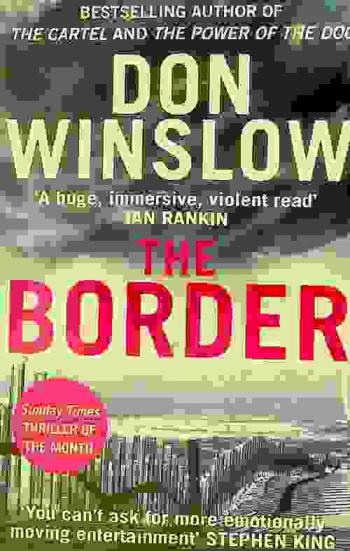
The border
\"The explosive, highly anticipated conclusion to the epic Cartel trilogy from the New York Times bestselling author of The Force. What do you do when there are no borders? When the lines you thought existed simply vanish? How do you plant your feet to make a stand when you no longer know what side you're on? The war has come home. For over forty years, Art Keller has been on the front lines of America's longest conflict: The War On Drugs. His obsession to defeat the world's most powerful, wealthy, and lethal kingpin--the godfather of the Sinaloa Cartel, Adan Barrera--has left him bloody and scarred, cost him people he loves, even taken a piece of his soul. Now Keller is elevated to the highest ranks of the DEA, only to find that in destroying one monster he has created thirty more that are wreaking even more chaos and suffering in his beloved Mexico. But not just there. Barrera's final legacy is the heroin epidemic scourging America. Throwing himself into the gap to stem the deadly flow, Keller finds himself surrounded by enemies--men that want to kill him, politicians that want to destroy him, and worse, the unimaginable--an incoming administration that's in bed with the very drug traffickers that Keller is trying to bring down. Art Keller is at war with not only the cartels, but with his own government. And the long fight has taught him more than he ever imagined. Now, he learns the final lesson--there are no borders. In a story that moves from deserts south of the border to Wall Street, from the slums of Guatemala to the marbled corridors of Washington, D.C., Winslow follows a new generation ofnarcos, the cops that fight them, the street traffickers, the addicts, the politicians, money-launderers, real-estate moguls and mere children fleeing the violence for the chance of a life in a new country. A shattering tale of vengeance, violence, corruption and justice, this last novel in Don Winslow's magnificent, award-winning, internationally bestselling trilogy is packed with unforgettable, drawn-from-the-headlines scenes. Shocking in its brutality, raw in its humanity, The Border is an unflinching portrait of modern America, a story of--and for--our time\"-- Provided by publisher

Rights of Rivers: Learning from the River Whanganui Case
Generally, laws meant to protect nature usually suffer setbacks with respect to either their provisions or their mechanisms of enforcement. While certain laws have no enforceable right to a clean environment, others lack sufficient deterrence or require strict proof of causation to ground action. Consequently, suggested reforms include addressing the constitutional challenge of justiciability, improving sanctions, creating compensation guidelines, and amending laws on proof of causation. The enforcement mechanisms of the laws can benefit from strengthening good governance, building the capacity of the judiciary to be able to effectively adjudicate on conservation-related matters, and generally encouraging hybrid enforcement mechanisms.
Journal Article

The history of policing America : from militias and military to the law enforcement of today
\"America's first known system of law enforcement was established more than 350 years ago. Today law enforcement faces issues such as racial discrimination, use of force, and Body Worn Camera (BWC) scrutiny. But the birth and development of the American police can be traced to a multitude of historical, legal and political-economic conditions. [This book] traces how and why law enforcement agencies evolved and became permanent agencies; looking logically through history and offering potential steps forward that could make a difference without triggering unconstructive backlash\"--Back cover.
Book

CONSIDERAȚII CRITICE CU PRIVIRE LA DECIZIA NR. 27/2021 PRONUNȚATĂ DE ÎNALTA CURTE DE CASAȚIE ȘI JUSTIȚIE – COMPLETUL PENTRU SOLUȚIONAREA RECURSULUI ÎN INTERESUL LEGII, ÎN MATERIA SUSPENDĂRII PROVIZORII A EXECUTĂRII SILITE
The present study analyzes the Decision of the High Court of Cassation and Justice No 27/2021 - the Panel for the settlement of the appeal in the interest of the law, in the matter of the provisional suspension of the enforcement. The authors offer a critical, different perspective on this, analyzing and fighting in detail the arguments offered by the supreme court which led to the admission of the appeal in the interest of the law. Moreover, the present study analyzes the consequences of the solution pronounced by the High Court of Cassation and Justice regarding the obligation of the court vested with a request for provisional suspension of the enforcement to verify its competence according to the general provisions, respectively whether the character of special emergency of the procedure is still complied with, in the end, being able to even question the usefulness of the institution.
Journal Article

The force of law
Discusses the role of police, police work, and the law and how it affects people and society.
Book

Border Policing
An extensive history examining how North American nations have tried (and often failed) to police their borders, Border Policing presents diverse scholarly perspectives on attempts to regulate people and goods at borders, as well as on the ways that individuals and communities have navigated, contested, and evaded such regulation. The contributors explore these power dynamics though a series of case studies on subjects ranging from competing allegiances at the northeastern border during the War of 1812 to struggles over Indian sovereignty and from the effects of the Mexican Revolution to the experiences of smugglers along the Rio Grande during Prohibition. Later chapters stretch into the twenty-first century and consider immigration enforcement, drug trafficking, and representations of border policing in reality television. Together, the contributors explore the powerful ways in which federal authorities impose political agendas on borderlands and how local border residents and regions interact with, and push back against, such agendas. With its rich mix of political, legal, social, and cultural history, this collection provides new insights into the distinct realities that have shaped the international borders of North America.
eBook