
Catalogue Search | MBRL


Are you sure you want to remove the book from the shelf?

{{itemTitle}}
78,538
result(s) for
"environmental communication"
Sort by:


Black boxes, not green: Mythologizing artificial intelligence and omitting the environment
We are repeatedly told that AI will help us to solve some of the world's biggest challenges, from treating chronic diseases and reducing fatality rates in traffic accidents to fighting climate change and anticipating cybersecurity threats. However, the article contends that public discourse on AI systematically avoids considering AI’s environmental costs.
Artificial Intelligence- Brevini argues- runs on technology, machines, and infrastructures that deplete scarce resources in their production, consumption, and disposal, thus increasing the amounts of energy in their use, and exacerbate problems of waste and pollution. It also relies on data centers, that demands impressive amounts of energy to compute, analyse, categorize. If we want to stand a chance at tackling the Climate Emergency, then we have to stop avoiding addressing the environmental problems generated by AI.
Journal Article

Environmental risk communication : principles and practices for industry
\"Modern industry faces many communication challenges, including social media. This second edition is thoroughly updated, expanded, and reorganized to help industry communicators remain effective in addressing these new challenges. At the core of the book are foundational building blocks that address the human factors responsible for driving success or failure when communicating about environmental risk. Coupled with tools and best practices from decades of research, this insider's guide provides CEOs, plant managers, environmental compliance and health and safety officers, etc., with the direction and the confidence needed to prepare for difficult dialogue and high-pressure encounters\"-- Provided by publisher.
Book

Examining communication strategy and implementation of the social forestry program of the Ministry of Environment and Forestry Indonesia in Bandung West Java
This article examines the communication strategies of the Ministry of Environment and Forestry in promoting the Environmental Partnership program within Social Forestry. Using a qualitative case study approach, the research focuses on the Forest Village Community Institutions (LMDH) Manglayang Lestari and Manglayang Hijau in Cileunyi Sub-district, Bandung Regency, West Java. Data were collected through field observations, in-depth interviews, and focus group discussions. The findings reveal communication barriers in the program's dissemination, particularly by the Directorate of Environmental Partnerships. The communication strategy aims to raise stakeholder awareness of their rights and responsibilities in social forestry and to foster understanding of partnership-based forest management. Key elements include optimizing internal and external communication resources, strengthening public awareness, aligning socialization efforts, and employing persuasive communication within the Social Forestry Working Group. However, inconsistencies and unclear messaging persist, leaving some community groups underserved. Moreover, the implementation of the program by LMDH Manglayang Hijau has been suboptimal due to weak communication between program facilitators, forest administrators, and local farmers. The study highlights the need for more coherent and inclusive communication strategies to ensure broader and more effective participation in the Social Forestry program.
Journal Article

Communicating the environment to save the planet : a journey into eco-communication
\"This book, based on authoritative sources and reports, links environmental communication to different fields of competence: environment, sustainability, journalism, mass media, architecture, design, art, green and circular economy, public administration, big event management and legal language. The manual offers a new, scientifically based perspective, and adopts a theoretical-practical approach, providing readers with qualified best practices, case studies and 22 exclusive interviews with professionals. A fluent style of writing leads the readers through specific details, enriching their knowledge without being boring. As such it is an excellent preparatory and interdisciplinary academic tool intended for university students, scholars, professionals, and anyone who would like to know more on the matter.\"--Publisher.
Book
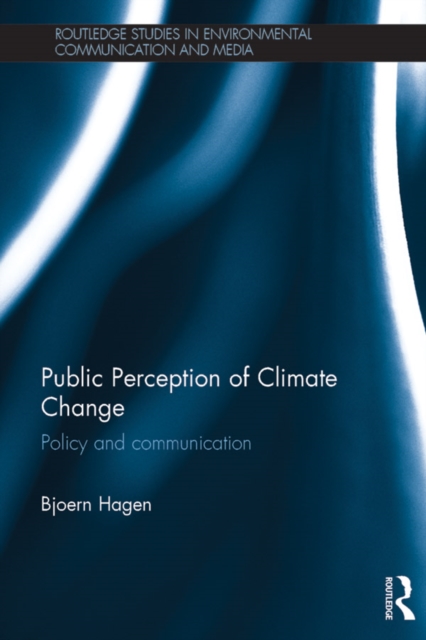
Public perception of climate change : policy and communication
Despite the findings on global climate change presented by the scientific community, there remains a significant gap between its recommendations and the actions of the public and policy makers. So far scientists and the media have failed to successfully communicate the urgency of the climate change situation in such a way that long-term, comprehensive, and legally binding policy commitments are being made on the national and international level. This book examines the way the public processes information, how they perceive threats and other perceptual factors that have a significant effect on how and to what degree climate change mitigation and adaptation strategies are supported. Understanding public risk perception plays a vital role in communicating the challenges of global climate change. Using a diverse range of international case studies, this book explores the nature of public perceptions of climate change and identifies the perception factors which have a significant impact on the public's willingness to support global climate change policies or commit to behavioral changes to reduce greenhouse gas emissions and improve urban resiliency. The comparative study of social and cultural factors, beliefs, attitudes and trust provides an international overview of best practices regarding the design, implementation and generation of public support for climate change policies at a global level. Offering valuable insight into climate change and risk communication, the book should be of interest to students and scholars of environment studies, politics, urban planning, and media and cultural studies.
eBook

Citizen voices
Citizen Voices explores the ways in which citizen voices on science and environmental issues are articulated, heard, marginalized, and silenced in mass media, policymaking, and other public venues. In a range of case studies from countries across Europe and North America, contributors offer empirical insights about the articulation of citizen voices, as well as citizens' scope for action in different national, cultural, and institutional contexts. Drawing on science and technology, environmental studies, and media and communication studies, they also present methods for foregrounding the role of communication in scientific and environmental governance.
eBook


THE THEORETICAL DIALOGUE BETWEEN ENVIRONMENTAL COMMUNICATION AND SOCIAL SCIENCES IN THE LOGIC OF SCIENCE IN ACTION
Abstract This article examines how the theoretical repertoires of the social sciences are managed by the researchers in environmental communication/journalism and how the theoretical arguments are appropriated in the applied studies. The corpus of analysis comprises 492 scientific communications presented by researchers of the Brazilian Society of Interdisciplinary Communication Studies (Intercom) in the period of 2001-2016, in addition to 36 interviews. The conclusions highlight: the historical contribution of the social sciences to the formation of the academic field of communication; the epistemic proximity between the social sciences and communication/journalism; the valorization of the use of this repertoire by environmental communication/journalism researchers. The interviews reinforce the interdisciplinary nature of environmental communication, the epistemic and methodological proximity to the social sciences, the plurality of actors involved and the consolidation of an already established way of doing research by Intercom scholars in its 40 years of operation. Resumen El artículo examina cómo son agenciados los repertorios teóricos de las ciencias sociales por los investigadores en comunicación/periodismo ambiental y cómo se da la apropiación de los argumentos teóricos en estudios aplicados. El corpus de análisis comprende 492 comunicaciones científicas presentadas por investigadores de la Sociedad Brasileña de Estudios Interdisciplinares de la Comunicación (Intercom) en el período 2001-2016, además de 36 entrevistas. Las conclusiones resaltan: la contribución histórica de las ciencias sociales para la formación del campo académico de la comunicación; la proximidad epistémica entre las ciencias sociales y la comunicación/periodismo; la valorización del uso de ese repertorio por los investigadores de comunicación/periodismo ambiental. Las entrevistas refuerzan la naturaleza interdisciplinaria de la comunicación ambiental, la proximidad epistémica y metodológica con las ciencias sociales, la pluralidad de actores involucrados y la consolidación de un modo ya consagrado de hacer investigación por los estudiosos de Intercom en sus 40 años de actuación. Resumo O artigo examina como são agenciados os repertórios teóricos das ciências sociais pelos pesquisadores em comunicação/jornalismo ambiental e como se dá a apropriação dos argumentos teóricos nos estudos aplicados. O corpus de análise compreende 492 comunicações científicas apresentadas por pesquisadores da Sociedade Brasileira de Estudos Interdisciplinares da Comunicação (Intercom) no período de 2001-2016, além de 36 entrevistas. As conclusões ressaltam: a contribuição histórica das ciências sociais para a formação do campo acadêmico da comunicação; a proximidade epistêmica entre as ciências sociais e a comunicação/jornalismo; a valorização do uso desse repertório pelos pesquisadores de comunicação/jornalismo ambiental. As entrevistas reforçam a natureza interdisciplinar da comunicação ambiental, a proximidade epistêmica e metodológica com as ciências sociais, a pluralidade de atores envolvidos e a consolidação de um modo já consagrado de fazer pesquisa pelos estudiosos da Intercom em seus 40 anos de atuação.
Journal Article