
Catalogue Search | MBRL


Are you sure you want to remove the book from the shelf?

{{itemTitle}}
7
result(s) for
"exclusionary dynamics"
Sort by:

“You are One of Them”: Performing Inclusion and Practicing Marginalization in Academia
This article critically examines how diversity initiatives in higher education can paradoxically reinforce exclusionary practices, particularly within academic systems that frame inclusion as both an ethical commitment and institutional achievement. Through an autoethnographic approach grounded in everyday academic encounters, I analyze how power is reinforced through routine interactions and how individual actors actively sustain racialized hierarchies under the banner of inclusion. Scholars of color are frequently perceived through reductive racialized or migrant identities, regardless of credentials or scholarly contributions, revealing how institutional whiteness is reproduced not only structurally but through interpersonal practices. Rather than presenting these dynamics as abstract or unintentional, the article interrogates how specific actions—such as symbolic inclusion, exceptionalization, and performative allyship— uphold the “neutral” norms of white, middle‐class academic culture. Drawing on García Peña’s (2022) critique of “The One,” I argue that diversity discourse often masks deeper power asymmetries by isolating and instrumentalizing minoritized scholars, positioning them as representatives rather than colleagues. By shifting attention from representational inclusion to the micro‐politics of complicity, this article calls for greater accountability in how inclusion is practiced and performed within academic communities. By naming these practices, it aims to open space for more critical institutional analysis and the possibility of transformative change.
Journal Article
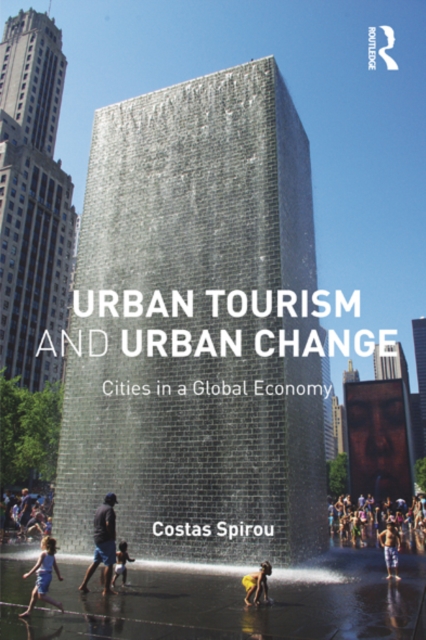
Urban Tourism and Urban Change
Urban Tourism and Urban Change: Cities in a Global Economy provides both a sociological / cultural analysis of change that has taken place in many of the world's cities. This focused treatment of urban tourism examines the implications of these changes for urban management and planning sense, for success and failure in metropolitan change. Uniquely suited for teaching purposes, Costas Spirou integrates numerous case studies of cities to illuminate the significant impact and promise of tourism on urban image and economic development.
'Accessible to a diverse audience including undergraduate students and the general public, this is also an impressive work of original scholarship. No previous book has offered such a sweeping account of the history and recent development of urban tourism, or placed it so thoroughly within large-scale social and economic processes of change.' – Dennis Judd, Political Science, University of Illinois, Chicago
'As a practicing urban planner with a Ph.D. in tourism, I will assign this book to help my students understand the profound social, economic, and demographic changes that will determine the future of cities and – by extension – urban tourism in the coming years.' – Rich Harrill, Hotel, Restaurant, and Tourism Management, University of South Carolina
'A powerful new framework for interpreting cities. Leisure, consumption, and tourism have been rising for decades, but no previous book has put these pieces together as Costas Spirou has done. Spirou points a spotlight at our urban past and present to illuminate a dramatic new view on the current reality of urban tourism. A perfect book to use for advanced undergraduate courses on cities and social change.' – Terry Clark, Sociology, University of Chicago
\"Urban Tourism and Urban Change…serves as an excellent introduction for students unacquainted with the ways in which tourism has been reshaping the urban built environment and influencing the character of neighborhoods.\" —Susan S. Fainstein, Harvard University
\"The past two decades have witnessed growing literature on tourism and cities, but Urban Tourism and Urban Change ...is an important addition to the limited literature available for use as textbooks for students...Indeed, this book fills a gap in terms of scope and perspective, and its publication, a decade or two later than previous urban tourism textbooks, is overdue.\" —Noam Shoval, The Hebrew University of Jerusalem, Jerusalem, Israel
1. Changing Cities and the Commodification of Leisure 2. Globalization, Urban Competition, and Tourism 3. Tourism Policies and Urban Growth 4. The Infrastructure and Finance of Urban Tourism 5. Urban Tourism, Amenities and Human Capital 6. Residential Development and the New Face of Downtowns 7. Implications and Debates
Costas Spirou is Professor in the Department of Social and Behavioral Sciences at National-Louis University in Chicago and a visiting fellow at the University of Notre Dame. His research interests include culture policy, urban redevelopment, tourism, and sports in society. He is co-author of It’s Hardly Sportin’: Stadiums, Neighborhoods and the New Chicago , a book about politics and community development, and author of St. Charles: Culture and Leisure in an All-American Town .
eBook
Urban Austerity
What started as a mortgage crisis in 2007 and became a global financial and economic crisis in 2008, has transformed into a sovereign debt crisis since 2010. Throughout, cities all over Europe have been at the heart of the turmoil in multiple ways: indebted homeowners have been evicted, masses impoverished, public budgets tightened, municipal infrastructures privatized, and public services downsized. In short, austerity measures have been implemented.In view of the above, this book focuses on an issue that affects most people living in urban regions across Europe: the idea that fiscal austerity is a necessity that politics cannot avoid, no matter how harsh the consequences might be. To bring the effects of austerity politics to the forefront, the authors of this book expose actual urban problems in their spatiotemporal dimensions, discuss regulatory restructurings under a new regime of austerity urbanism, and reflect on the role of urban social movements struggling for progressive alternatives.Barbara Schönig is Professor for Urban Planning and Director of the Institute for European Urban Studies at the Bauhaus-Universität Weimar, Germany.Sebastian Schipper, PhD, is a researcher at the Department for Human Geography, Goethe-University Frankfurt am Main, Germany.
eBook

Cities in Contemporary Africa
This book explains how and why cities on the African continent have grown at such a rapid pace, how municipal authorities have tried to cope with this massive influx of people, and how long-time urban residents and new-comers interact, negotiate, and struggle over access to limited resources. Summary reprinted by permission of Palgrave Macmillan
eBook
Reducing inequality for shared growth in China : strategy and policy options for Guangdong province
This overview summarizes the key findings of the eight chapters and one policy note. It is organized as follows. The first section provides a background of Guangdong, while the second describes the current situation of inequality in the province. Next is a discussion of the potential impacts of the transfer of industrial activities ('industrial transfer') in mitigating regional disparity, followed by the recommendation of a three pillar strategy for Guangdong. The fifth section focuses on the elimination of absolute poverty through the minimum living allowance (Dibao) system, and the sixth turns to policy actions needed to increase opportunities for the rural population by moving them to jobs, increasing their access to finance, and ensuring that their land rights are better protected. The seventh section further assesses Guangdong's options for investing in people through more equitable service delivery in compulsory education, skill development, and health care, with the aim of enhancing the capacity of the poor to seize and utilize opportunities. The last section concludes this overview.
eBook

Keeping up the Neighborhood: Estimating Net Effects of Zoning
A political dimension is added to a framework of urban ecology by examining the impact of zoning on housing and population growth within the Chicago metropolitan area. Looking at the social and demographic changes within a sample of 395 central city and suburban tracts, the analyses model the effects of zoning on growth from 1960 to 1970. Findings show that by regulating the types of housing that may be included within local areas, zoning affects local housing availability and hence the socioeconomic composition of sub-areas in the Chicago SMSA. Such findings suggest that the urban ecology framework requires modification to account for the influence of political processes.
Journal Article
