
Catalogue Search | MBRL


Are you sure you want to remove the book from the shelf?

{{itemTitle}}
68,586
result(s) for
"film production"
Sort by:

The language of film
\"Becoming an effective filmmaker involves being deliberately mindful of the structures and conventions that allow film to communicate meaning to a global audience. The Language of Film explores complex topics such as semiotics, narrative, intertextuality, ideology and the aesthetics of film in a clear and straightforward style, enabling you to apply these ideas and techniques to your own analysis or film-making. With full-colour film stills, in-depth case studies and a wide range of practical exercises, The Language of Film will help you to make the transition from consumer to practitioner - from someone who just responds to the language of film, to someone who actively uses it. In the second edition, a new chapter examines how sound contributes to narrative and space to tell stories, create imaginary worlds and shape the realist (and often non-realist) effect of cinema. Along with two case studies from the first edition, Seven (dir: David Fincher) and Citizen Kane (dir: Orson Welles), the second edition also includes five new case studies: The Secret Life of Walter Mitty (dir: Ben Stiller), Dead Man's Shoes (dir: Shane Meadows), Hero (dir: Yimou Zhang), Berberian Sound Studio (d: Peter Strickland) and Psycho (d: Alfred Hitchcock)\"-- Provided by publisher.
Book

On the Application of Computer Combined with Multimedia Technology in Post-production of Film and Television
Since entering the 21st century, with the rapid development of economy, the people's material living standard has been improved, the level of spiritual civilization has been improved, and the demand for leisure and entertainment has become more and more diversified, thus the demand for film and television works has become higher and higher. The relationship between film and television works and computer multimedia works is becoming more and more close. Computer multimedia technology has even become its core technology and has been widely used in film and television works, especially in post-production. The application of computer combined with multimedia technology has brought a good development opportunity for film and television post-production, met the requirements of film and television works in the process of post-production, and improved the quality and presentation effect of film and television works. Thus, the production efficiency of film and television works has been improved. The computer combines the multimedia technology to realize the simplification and flexibility of the editing operation, which makes the editing time greatly shortened, and even if the error occurs in the editing process, it can be scientifically restored at any time. What role does computer multimedia technology play in film and television works and how to further use multimedia technology to make the film and television culture develop at a higher level is a topic that has attracted the attention of the industry. This paper briefly discusses the role and methods of computer multimedia technology in film and television post-production[1].
Journal Article


Criteria for the evaluation of innovativeness of independent film production company in the perspective of creativity
This study aims to identify the criteria for evaluating the innovativeness of an independent film production company in the European film market. Innovativeness of a company consists of inputs to innovation and outputs from innovation. It reveals a company’s potential to implement innovations, which are often sources of competitive advantage. The empirical study involved 29 experts from the European film industry and film production companies. Experts were asked to evaluate 60 criteria in total. The survey results suggest that a company’s innovativeness can currently be evaluated by 51 criteria, of which 15 are the most important. The criteria identified for evaluating a company’s innovativeness are ranked in order of importance for determining a company’s innovativeness. The results obtained allow us to evaluate the innovativeness of a company by comparing independent film production companies with one another in the European film market and thus to determine which company is more innovative. It also makes possible new hypotheses to be raised, analysed and tested. It should be noted that the article was written based on a dissertation in progress.
Journal Article

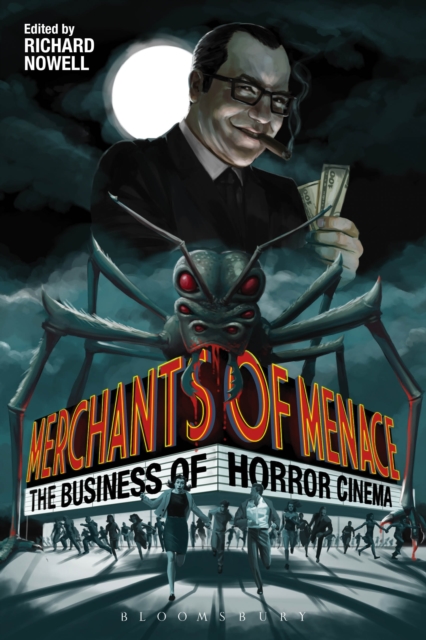
Merchants of Menace
Even though horror has been a key component of media output for almost a century, the genre's industrial character remains under explored and poorly understood. Merchants of Menace: The Business of Horror Cinema responds to a major void in film history by shedding much-needed new light on the economic dimensions of one of the world's most enduring audiovisual forms. Given horror cuts across budgetary categories, industry sectors, national film cultures, and media, Merchants of Menace also promises to expand understandings of the economics of cinema generally. Covering 1930-present, this groundbreaking collection boasts fourteen original chapters from world-leading experts taking as their focus such diverse topics as early zombie pictures, post-WWII chillers, Civil Rights-Era marketing, Hollywood literary adaptations, Australian exploitation, \"torture-porn\" Auteurs, and twenty-first-century remakes.
eBook

Between the scenes : what every film director, writer, and editor should know about scene transitions
\"Between the Scenes delivers a fresh approach to film directing, screenwriting, and editing. once you've got your scenes planned out, this book steps in by shifting your focus to how your individual sequences and scenes connect to each other. you'll find new ways to create emotional feelings in your audience. From location choices, to character movement between scenes, to the use of music, scene transitions are where the meat is in your story, and now you'll discover a new pallet of creative possibilities. \"-- Provided by publisher.
Book
Music Editing for Film and Television
Making music for the movies is a complicated, involved, and challenging process. Music Editing for Film and Television covers the practical skills needed to successfully hone your craft. Through an overview of the music editing process, this book will equip you with detailed techniques to solve musical problems encountered during editing. An abundance of interviews with well-known professionals provide a wide range of perspectives on music editing for film, while special features address an array of projects, from a low-budget documentary, to a Hollywood blockbuster, to indie projects.
eBook

Quentin Tarantino's Django unchained : the continuation of metacinema
\"Django Unchained is certainly Quentin Tarantino's most commercially-successful film and is arguably also his most controversial. Fellow director Spike Lee has denounced the representation of race and slavery in the film, while many African American writers have defended the white auteur. The use of extremely graphic violence in the film, even by Tarantino's standards, at a time when gun control is being hotly debated, has sparked further controversy and has led to angry outbursts by the director himself. Moreover, Django Unchained has become a popular culture phenomenon, with t-shirts, highly contentious action figures, posters, and strong DVD/BluRay sales. The topic (slavery and revenge), the setting (a few years before the Civil War), the intentionally provocative generic roots (Spaghetti Western and Blaxploitation) and the many intertexts and references (to German and French culture) demand a thorough examination. Befitting such a complex film, the essays collected here represent a diverse group of scholars who examine Django Unchained from many perspectives\"-- Provided by publisher.
Book
Declarations of independence
American independent cinema has gained mainstream popularity in recent years as audiences tire of the bloated, clichéd spectacle of Hollywood films. But how independent are these movies? As John Berra contends in Declarations of Independence, the supposedly alternative film scene employs the same production techniques as its Hollywood counterparts and may find an uncritical audience in fans looking to attach personal sentiments and social reference points to art forms. This provocative volume questions the autonomy of independent film, asking if it is possible for a unique filmic vision to thrive in an industry of mass production.
eBook