
Catalogue Search | MBRL


Are you sure you want to remove the book from the shelf?

{{itemTitle}}
2,426,368
result(s) for
"financial industry"
Sort by:


The Global City
This classic work chronicles how New York, London, and Tokyo became command centers for the global economy and in the process underwent a series of massive and parallel changes. What distinguishes Sassen's theoretical framework is the emphasis on the formation of cross-border dynamics through which these cities and the growing number of other global cities begin to form strategic transnational networks. All the core data in this new edition have been updated, while the preface and epilogue discuss the relevant trends in globalization since the book originally came out in 1991.
eBook


Capital Ideas
The right of governments to employ capital controls has always been the official orthodoxy of the International Monetary Fund, and the organization's formal rules providing this right have not changed significantly since the IMF was founded in 1945. But informally, among the staff inside the IMF, these controls became heresy in the 1980s and 1990s, prompting critics to accuse the IMF of indiscriminately encouraging the liberalization of controls and precipitating a wave of financial crises in emerging markets in the late 1990s. In Capital Ideas, Jeffrey Chwieroth explores the inner workings of the IMF to understand how its staff's thinking about capital controls changed so radically. In doing so, he also provides an important case study of how international organizations work and evolve.
eBook

The little book of robo investing : how to make money while you sleep
\"A robo-advisor (also sometimes spelled as roboadvisor) is a digital platform that provides automated, algorithm-driven financial planning and investment services with little to no human supervision. A typical robo-advisor asks questions about your financial situation and future goals through an online survey. It then uses the data to offer advice and automatically invest for you\"-- Provided by publisher.
Book
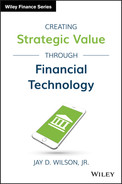
Creating strategic value through financial technology
\"Creating Strategic Value through Financial Technology explores the growing Financial Technology (FinTech) industry to provide insight on how traditional financial institutions and FinTech companies can boost innovation and enhance valuation in a complex regulatory environment. In plumbing the depth and breadth of several niches within in the FinTech sector, author Jay Wilson uncovers key themes that have contributed to the industry's success; in this book, he maps them together to provide useful guideposts for investors, entrepreneurs, and traditional institutions looking to facilitate growth as technology and financial services collide. With an expert's perspective on FinTech history and outlook, certain trends and examples of value-enhancing strategies stand out. FinTech niches covered include: payments, crowdfunding, alternative/marketplace lending, the blockchain, and technology solutions in the context of banking, insurance, and investment companies\"--Publisher's website.
eBook


Gender Bias and Digital Financial Services in South Asia
Gender Bias and Digital Financial Services in South Asia: Obstacles and Opportunities on the Road to Equal Access examines access to financial services to women in general in South Asia and specifically their access to digital financial services.
eBook


Access for all : building inclusive financial systems
Unlock the transformative power of microfinance for global poverty reduction.This insightful title explores how to build inclusive financial systems that empower the poor and drive economic growth in developing countries.Drawing on a decade of CGAP experience, it offers a comprehensive framework for expanding access to financial services for all.
eBook