
Catalogue Search | MBRL


Are you sure you want to remove the book from the shelf?

{{itemTitle}}
26
result(s) for
"fluorescent brightener"
Sort by:

Live Detection of Intracellular Chitin in Butterfly Wing Epithelial Cells In Vivo Using Fluorescent Brightener 28: Implications for the Development of Scales and Color Patterns
Chitin is the major component of the extracellular cuticle and plays multiple roles in insects. In butterflies, chitin builds wing scales for structural colors. Here, we show that intracellular chitin in live cells can be detected in vivo with fluorescent brightener 28 (FB28), focusing on wing epithelial cells of the small lycaenid butterfly Zizeeria maha immediately after pupation. A relatively small number of cells at the apical surface of the epithelium were strongly FB28-positive in the cytosol and seemed to have extensive ER-Golgi networks, which may be specialized chitin-secreting cells. Some cells had FB28-positive tadpole-tail-like or rod-like structures relative to the nucleus. We detected FB28-positive hexagonal intracellular objects and their associated structures extending toward the apical end of the cell, which may be developing scale bases and shafts. We also observed FB28-positive fibrous intracellular structures extending toward the basal end. Many cells were FB28-negative in the cytosol, which contained FB28-positive dots or discs. The present data are crucial to understanding the differentiation of the butterfly wing epithelium, including scale formation and color pattern determination. The use of FB28 in probing intracellular chitin in live cells may be applicable to other insect systems.
Journal Article

Integrated qPCR and Staining Methods for Detection and Quantification of Enterocytozoon hepatopenaei in Shrimp Litopenaeus vannamei
Enterocytozoon hepatopenaei (EHP) is an obligate, intracellular, spore-forming parasite, which mainly infects the gastrointestinal tract of shrimp. It significantly hinders the growth of shrimp, which causes substantial economic losses in farming. In this study, we established and optimized a SYBR Green I fluorescent quantitative PCR (qPCR) assay based on the polar tube protein 2 (PTP2) gene for the quantitative analysis of EHP-infected shrimp. The result showed that the optimum annealing temperature was 60 °C for the corresponding relation between the amplification quantitative (Cq) and the logarithmic of the initial template quantity (x), conformed to Cq = −3.2751x + 31.269 with a correlation coefficient R2 = 0.993. The amplification efficiency was 102%. This qPCR method also showed high sensitivity, specificity, and repeatability. Moreover, a microscopy method was developed to observe and count EHP spores in hepatopancreas tissue of EHP-infected shrimp using Fluorescent Brightener 28 staining. By comparing the PTP2-qPCR and microscopy method, the microscopic examination was easier to operate whereas PTP2-qPCR was more sensitive for analysis. And we found that there was a correspondence between the results of these two methods. In summary, the PTP2-qPCR method integrated microscopy could serve for EHP detection during the whole period of shrimp farming and satisfy different requirements for detecting EHP in shrimp farming.
Journal Article

Fluorescein-derived carbon dots with chitin-targeting for ultrafast and superstable fluorescent imaging of fungi
Fluorescence microscopy based on fluorochrome has been rapidly developed as the candidate for morphological identification of pathogenic fungi over recent years, offering superior rapidity and efficacy over traditional culture methods. However, the intrinsic quenching properties of fluorescein limit the clinical application of fluorescence imaging. Herein, we report a nano-strategy by converting a commercial fluorescein dye, fluorescent brightener-33 (FB-33), into carbon dots (FB-CDs) through a one-pot hydrothermal method. FB-CDs exhibit a chitin-targeting capacity allowing the selective recognition and ultrafast imaging of fungi within 30 s. The fluorescence quantum yield of FB-CDs is 51.6% which is 8.6-fold higher than that of commercial dye, FB-33. Moreover, FB-CDs also display superstable fluorescence signals under continuous intense light irradiation for 2 h and long-term storage for more than 2 months. The significantly improved photobleaching resistance meets the prolonged fluorescence observation and quantitative analysis of microbial samples. This work offers a novel nanoconversion strategy of commercial dyes for point-of-care testing of pathogenic organisms.
Journal Article

Light and perspiration stability of triazinylstilbene fluorescent brighteners on cotton fabrics
Light and perspiration stability of triazinylstilbene fluorescent brighteners (TFBs) for cotton fabrics was investigated and many factors affecting the photo-fading of TFBs viz. substituent groups, artificial perspirations and their components were discussed. The experimental results indicated that the TFB with morpholine groups appeared to be the most sensitive one under simultaneous exposure to light and perspiration, whereas the TFBs containing sulfonic acid and diethanolamine groups exhibited the best stability. Among the three selected standards of artificial perspiration, the alkaline Association for Textile Technical Study standard perspiration retarded the photo-fading of TFBs on cotton fabrics remarkably. Furthermore, the study on the contribution of artificial perspiration components disclosed that the sodium salt played the predominant role in decelerating the photo-reaction of TFBs on cotton fabrics, while the influence of lactic acid was usually depended on two factors: the pH value and its reducibility.
Journal Article

A novel polymeric fluorescent brightener agent based on 4,4′-diamino-stilbene-2,2′-disulfonic acid-triazine structure: synthesis, characterization, photo-property, and performance on paper as light stabilizer, fluorescent brightener, and surface-sizing agent
In this work, a novel polymeric fluorescent brightener agent based on 4,4′-diamino-stilbene-2,2′-disulfonic acid-triazine structure has been synthesized by radical polymerization. The structure of 4,4′-diamino-stilbene-2,2′-disulfonic acid -based polymeric fluorescent brightener agent was characterized by Fourier-transform-infrared spectroscopy,
1
HNMR, and gel permeation chromatography. Photo-property was measured and analyzed by the ultraviolet–vis spectra and fluorescence spectra. The performance on paper was evaluated by determining the surface strength and smoothness, the brightness degree, and the post color number value of paper. Results showed that 4,4′-diamino-stilbene-2,2′-disulfonic acid-based polymeric fluorescent brightener agent had a better light stability in water solution than that of 4,4′-diamino-stilbene-2,2′-disulfonic acid-based fluorescent monomer as light stabilizer. Through the surface-sizing experiment and ultraviolet aging experiment, the 4,4′-diamino-stilbene-2,2′-disulfonic acid-based polymeric fluorescent brightener agent not only enhanced the surface strength and smoothness of paper as a surface-sizing agent, but also had a better effect on anti-ultraviolet aging than that of 4,4′-diamino-stilbene-2,2′-disulfonic acid-based fluorescent monomer as a light stabilizer and fluorescent brightener agent.
Journal Article
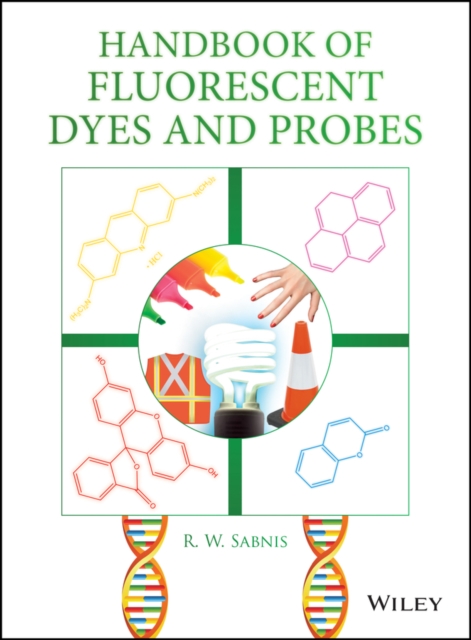
Handbook of Fluorescent Dyes and Probes
A COMPLETE, UP-TO-DATE RESOURCE OF INFORMATION ON MORE THAN 150 FLUORESCENT DYES AND PROBES Handbook of Fluorescent Dyes and Probes is the most comprehensive volume available on the subject, covering all the available dyes and probes known to date in the literature for uses in various fields. Top dye expert Dr. Ram Sabnis organizes the compounds alphabetically by the most commonly used chemical name. He presents an easy-to-use reference complete with novel ideas for breakthrough research in medical, biological, chemical, color, material, physical and related allied fields. The ease of use of the handbook is further enhanced by various appendixes provided at the end of the book to conveniently and easily locate the dye as per the reader's need. This is the first book to give the CAS registry numbers, chemical structure, Chemical Abstract (CA) index name, all other chemical names, Merck Index number, chemical/dye class, molecular formula, molecular weight, physical form, solubility, melting point, boiling point, pKa, absorption maxima, emission maxima, molar extinction coefficient, and quantum yield of fluorescent dyes and probes, as well as to provide access to synthetic procedures (lab scale and industrial scale) of dyes and probes in a single source. This user-friendly handbook also features references on safety, toxicity and adverse effects of dyes and probes on humans, animals and the environment, including: acute/chronic toxicity aquatic toxicity carcinogenicity cytotoxicity ecotoxicity genotoxocity hematotoxicity hepatotoxicity immunotoxicity marine toxicity microbial toxicity mutagenicity nephrotoxicity neurotoxicity nucleic acid damage oral toxicity phototoxicity phytotoxicity reproductive toxicity skin toxicity Containing imaging/labeling applications, biological/medical applications and industrial applications, Handbook of Fluorescent Dyes and Probes is a convenient, vital resource for industrial and academic researchers, and a valuable desktop reference for medical professionals, lab supervisors, scientists, chemists, biologists, engineers, physicists, intellectual property professionals, students, and professors. * Includes all fluorescent dyes & probes known to date and provides a complete, up-to-date library of information in one reference/handbook * Includes more than 300 fluorescent dyes & probes organized alphabetically by the commonly used Chemical Name * Provides access to synthesis procedures (lab scale and industrial scale) of fluorescent dyes & probes * First book to provide references on safety, toxicity and adverse effects of fluorescent dyes and probes on humans, animals, and the environment * User-friendly and convenient resource guide for chemical, biological, medical, and intellectual property professionals in a broad range of disciplines
eBook

Synthesis and performances of extended conjugated stilbene fluorescent dye
Purpose
The purpose of this paper is to explore the optic performance of extended stilbene derivative.
Design/methodology/approach
Five steps were adopted to synthesise novel 4, 4′-bis (2-cyanostyryl) stilbene, which contained three vinyl units in the skeleton (S3E). The structure of S3E was characterised by 1H NMR and EI-MS. Its absorption and emission spectra were also given.
Findings
Compared to C.I. Fluorescent Brightener 199, which contains two vinyl units in the skeleton, S3E showed obvious bathochromic shifts in both UV-VIS and FL spectra. The maximum absorption wavelength and fluorescent wavelength were at 390 nm and 464 nm, respectively, with Stoke’s shift of 74 nm. The absolute fluorescence quantum yield was 0.42. Thermogravimetric analysis (TGA) revealed that the weight loss of S3E was less than 5 per cent at 300 °C. Moreover, the light resistance test showed that S3E in PVC plate can keep the good fluorescent intensity for more than seven days exposed to xenon light. Therefore, it is believed that S3E could satisfy the requirements of colouring PVC as a fluorescent dye.
Practical implications
S3E can be used as a candidate of fluorescent dye in the development of thermoplastics.
Originality/value
The present paper designed and synthesised a new derivative of stilbene, which showed its preference to be a colourant of thermoplastics.
Journal Article

Coloring properties of novel 1,4-distyrylbenzene and 4,4′-distyrylbiphenyl fluorescent brighteners and their arrangement in cotton and polyester fiber
Some novel 1,4-distyrylbenzene (DSB) and 4,4′-distyrylbiphenyl (DSBP) fluorescent brighteners (FBs) were used to dye polyester and cotton fabrics. The CIE whiteness, color hue and reflectance spectrum of dyed fabrics were compared. DSBP derivatives could dye the cotton and polyester fabrics with a higher whiteness level and had a lower fluorescent quenching concentration than DSB derivatives. The color hue for the fabric dyed with DSB FBs was yellow-green, whereas that dyed with DSBP was blue–violet. The molecular arrangement in the fiber had a significant influence on their optical properties, resulting in different coloring properties. The increase in molecule planarity and rigidity generated by the interaction between the polymer and FB molecules caused a remarkable bathochromic shift in emission and excitation spectra. The H-aggregate of the DSB molecule in the fiber was easily generated, and the degree of aggregation increased with the molecular polarity. However, the aggregation of DSBP molecules in the polyester and cotton fiber was not found. The surface region of the cotton fiber was filled with FB molecules, whereas FB molecules in the polyester fiber aggregated easily, and incident light could pass through the surface region.
Journal Article

An improved method for the visualization of conductive vessels in Arabidopsis thaliana inflorescence stems
Dye perfusion is commonly used for the identification of conductive elements important for the study of xylem development as well as precise hydraulic estimations. The tiny size of inflorescence stems, the small amount of vessels in close arrangement, and high hydraulic resistivity delimit the use of the method for quantification of the water conductivity of Arabidopsis thaliana, one of the recently most extensively used plant models. Here, we present an extensive adjustment to the method in order to reliably identify individual functional (conductive) vessels. Segments of inflorescence stems were sealed in silicone tubes to prevent damage and perfused with a dye solution. Our results showed that dyes often used for staining functional xylem elements (safranin, fuchsine, toluidine blue) failed with Arabidopsis. In contrast, Fluorescent Brightener 28 dye solution perfused through segments stained secondary cell walls of functional vessels, which were clearly distinguishable in native cross sections. When compared to identification based on the degree of development of secondary cell walls, identification with the help of dye perfusion revealed a significantly lower number of functional vessels and values of theoretical hydraulic conductivity. We found that lignified but not yet functional vessels form a substantial portion of the xylem in apical and basal segments of Arabidopsis and, thus, significantly affect the analyzed functional parameters of xylem. The presented methodology enables reliable identification of individual functional vessels, allowing thus estimations of hydraulic conductivities to be improved, size distributions and vessel diameters to be refined, and data variability generally to be reduced.
Journal Article
Study on the Reflecting Properties of PET Composites with TiO2, Glass Beads and Fluorescent Brightener
Subscript textIn this paper the influence of glass beads (GB), Fluorescent Brightener (FB), titanium dioxide (TiO2) on light reflecting performance of PET was studied. The composites of PET, GB, FB, and TiO2 were prepared by twin screw extruder. The dispersive characterization of GB with diameter of 20μm to 90μm was observed by the optical microscope and the reflective properties of injected sample of PET composites were evaluated by experiment. The results show that GB are dispersed homogeneously in PET matrix and the reflectivity of the PET/GB samples increase with the decrease of the diameter of GB. Introduction of FB in PET/GB composites leads to the increase of the reflective light within wavelength from 400 to 600nm, increasing by 10%. By adding TiO2 into PET, the reflectivity of PET composites could be increased over 80%. And by adding FB into PET/TiO2 composites, the reflectivity of PET/TiO2/FB within wavelength from 400 to 600nm could be increased up to 110% , due to fluorescent brightening.
Journal Article