
Catalogue Search | MBRL


Are you sure you want to remove the book from the shelf?

{{itemTitle}}
92,903
result(s) for
"food supply chain"
Sort by:

Competitiveness of Small Farms and Innovative Food Supply Chains: The Role of Food Hubs in Creating Sustainable Regional and Local Food Systems
Over the last decades, the economic, social and environmental sustainability of the conventional agri-food system has and continues to be contested within both academic and public institutions. For small farms, the unsustainability of the food system is even more serious; farms’ declining share of profit and the cost-price squeeze of commodity production has increased barriers to market access with the inevitable effect of agricultural abandonment. One way forward to respond to the existing conventional agri-food systems and to create a competitive or survival strategy for small family farms is the re-construction of regional and local agri-food systems, aligning with Kramer and Porter’s concept of shared value strategy. Through a critical literature review, this paper presents “regional and local food hubs” as innovative organizational arrangements capable of bridging structural holes in the agri-food markets between small producers and the consumers—individuals and families as well as big buyers. Food hubs respond to a supply chain (or supply network) organizational strategy aiming at re-territorialising the agri-food systems through the construction of what in the economic literature are defined as values-based food supply chains.
Journal Article

How do food supply chain performance measures contribute to sustainable corporate performance during disruptions from the COVID-19 pandemic emergency?
PurposeThis study aims to the development of the scale of supply chain performance measures (SCPMs), food supply chain resilience (FSCS) and sustainable corporate performance (SCP) in small- and medium-sized enterprises (SMEs) in an emerging market. Based on this purpose, the study examines the relationships between SCPMs and SCP by exploring the mediating role of FSCS in emerging markets.Design/methodology/approachBased on a comprehensive literature review on the SCPMs, FSCS and SCP, the author evaluates the nexus of these constructs on disruptions during the COVID-19 pandemic emergency in an emerging market. The article follows a quantitative approach. A total of 567 valid responses from managers at senior and middle levels were received and used for data analysis. The Smart PLS version 3.3.2 was employed to analyse Structural Equation Modelling (SEM) to investigate the relationships between constructs and latent variables.FindingsThis study provides some theoretical contributions to expand the extant literature on the domain of SCPMs. First, the findings determine that multidimensional measures of flexibility, diversity, agility, inventory efficiency, redundancy and robustness are appropriate for measuring food SC performance in disruptions during the COVID-19 emergency. Besides, this study enriches the existing literature on SC disruption by providing extensive empirical evidence on SCPMs in disruptions during the COVID-19 emergency. Finally, this research provides an integrated empirical model that explores the link between the identified food SCPMs to FSCS and SCP.Originality/valueThe contributions may be of interest to business practitioners, business leaders and academics. In addition, this study provides empirical evidence to demonstrate that food SC performance, as measured by these measures, is strongly related to the firm's food supply chain resilience. This is the novel contribution of this study to the current literature on food SC management. Furthermore, this study provides further empirical evidence demonstrating the partial mediating role of the firm's food supply chain resilience in the nexus between food SC performance and SCP. The unique contribution of this study is an extension of the body of knowledge of SC management literature from a comprehensive approach by providing a proven set of performance measures of SC management to which it can drive SC resilience and SCP for food manufacturing SMEs in an emerging economy that hardly found in the current literature.
Journal Article

Logistics network configuration for seasonal perishable food supply chains
Purpose: The location of actors and production, transformation, commercialization and distribution facilities generate the configuration of the perishable food supply chain (PFSC). The logistics network design (LND) lead to different supply, storage and distribution environments and result in flows, these logistics operations have an impact on the performance of the chain of fresh agricultural products. Specifically, in the PFSC with seasonality, a temporary imbalance between supply and demand is generated, which affects the balance in the flows and affects the losses, costs and response capacity. This research study that problem. Design/methodology/approach: A multi-echelon, multi-objective and multi-product model is established that determines the configuration of the logistics network of the PFSC with seasonally and allows actors to approach efficiency frontiers, which contribute to their permanence in the markets. The model was applied to the case of the perishable fruit supply chain, in a developing country, Colombia. The population information was taken from government surveys and studies, which allowed parameterizing the model. Findings: The application of model permitted to answer the next questions: How does improve the performance from PFSC through logistics network design? And, How the existence of smallholdings in food production and from retail merchants is preserved? In the perishable food supply chain. Social implications: Where the perishable food supply chain actors are located in non-efficient borders and their sustainability may be affected by competition factors, the stakeholders should focus on increasing food availability and reducing losses to improve access and therefore food security. Originality/value: A new model for the logistics network configurations of seasonal perishable fruit supply chain was development, the optimizing from five objectives with two sub-models is obtained, one for surplus and the other for the deficit moments. The model includes real conditions, such as, fruit loss due T0 and RH by different thermal floors and the means used for the transport of fruits in mountain areas at countries in route of development. The impact over the small producers, retailers and consumers in the times of scarcity or surplus was analyzed.
Journal Article

Food loss and waste in the central market of a developing country: The case of Merida, Mexico
Hunger and malnutrition have been an important challenge facing the world, with food insecurity being their main contributing factor. However, as the solving strategies focus on increasing production, food losses that reduce availability for consumption and affect climate change tend to happen. In this study, the nutritional composition and microbiological quality of food losses in the central market of Merida, Mexico, were determined. The study population was composed of a set of discarded foods that were deposited in containers at the central market. Three types of sampling were obtained: for solid waste, for the calculation of the food percentage contained in the solid waste, and for chemical and microbiological analysis. The sample data was recorded and analyzed with descriptive statistics. The average solid waste generated per day was 1185.02 kg, with more than three-quarters (86.08%) of its content consisting of fruit and vegetable groups. No animal-derived foods were found among the food losses since this central market doesn’t supply them. The greatest amount of protein and fiber was present in vegetables, while fruits had the greatest amount of moisture and carbohydrates. The presence of microorganisms, mainly yeasts, was higher than the established limit, making the food unsuitable for human consumption. However, it was found to be a good source of lipids and organic matter, making them useful for composting, biofuel production, or the extraction of bioactive compounds.
Journal Article

Short food supply chain adoption in Chilean organic and agroecological organizations: a qualitative comparative analysis
In contrast to the historical development of short food supply chains (SFSCs) in North America and Europe, the institutional and political environment in Chile has been characterized by market liberalization and the promotion of food exports, relegating the adoption of SFSCs to conditions of informality, uncertain quality, and low prices in the domestic market. In the last decade, this situation has begun to change as incomes have risen and consumers have become more aware of food quality. The present research analyzes the adoption of SFSC in Chilean organic and agroecological farmers’ organizations. Using the method of qualitative comparative analysis for crisp sets, three configurations of favorable conditions for the adoption of SFSC are identified, related to the types of products and services offered by the organizations to their members. This provides valuable background information for the formulation of public policies that promote a transformation toward more equitable and sustainable food systems.
Journal Article

A conceptual understanding of criminality and integrity challenges in food supply chains
PurposeBusiness, consumers and governmental organisations are harbouring a growing need to gain an appreciation of behaviours connected to food criminality. In order to acquire a cross-functional understanding of these thematic areas (crime and fraud) the mapping of existing research is needed. The paper aims to discuss these issues.Design/methodology/approachThis paper contributes to the process of knowledge understanding, by systematically reviewing literature to provide an analysis of the current body of business knowledge against the thematic criterion of “supply chain food crime” and “supply chain food fraud”. The analysis derives themes from the literature and maps this across the eight pillars underpinning the UK Government paper on food supply chain resilience.FindingsA distinct gap lies with the eight pillars of food supply chain resilience, business interest into supply chain criminality and academic research into the field. There are noteworthy gaps when the literature is analysed to that of the UK Government report.Research limitations/implicationsThe limitation of the study was its focus on business-only journals; a plethora of literature resides in the science field (e.g. testing) that has not made its way to business text.Practical implicationsDrawing inference between business research and the government report, clear identification and tangible research areas can be immediately exploited to align cross-functional thinking.Social implicationsThe gap of consumer is not as yet addressed in this field, this research contributes originally to this gap and the need to address the same for societal benefit.Originality/valueThe paper concentrates on the metrics know to contribute to “food crime” and “food fraud” and deviating views of academic vs non-academic literature. In conclusion the paper identifies thematic areas for further research and presents a conceptual framework of food supply chain resilience.
Journal Article

A Framework for Assessing Effects of the Food System
How we produce and consume food has a bigger impact on Americans' well-being than any other human activity. The food industry is the largest sector of our economy; food touches everything from our health to the environment, climate change, economic inequality, and the federal budget. From the earliest developments of agriculture, a major goal has been to attain sufficient foods that provide the energy and the nutrients needed for a healthy, active life. Over time, food production, processing, marketing, and consumption have evolved and become highly complex. The challenges of improving the food system in the 21st century will require systemic approaches that take full account of social, economic, ecological, and evolutionary factors. Policy or business interventions involving a segment of the food system often have consequences beyond the original issue the intervention was meant to address.
A Framework for Assessing Effects of the Food System develops an analytical framework for assessing effects associated with the ways in which food is grown, processed, distributed, marketed, retailed, and consumed in the United States. The framework will allow users to recognize effects across the full food system, consider all domains and dimensions of effects, account for systems dynamics and complexities, and choose appropriate methods for analysis. This report provides example applications of the framework based on complex questions that are currently under debate: consumption of a healthy and safe diet, food security, animal welfare, and preserving the environment and its resources.
A Framework for Assessing Effects of the Food System describes the U.S. food system and provides a brief history of its evolution into the current system. This report identifies some of the real and potential implications of the current system in terms of its health, environmental, and socioeconomic effects along with a sense for the complexities of the system, potential metrics, and some of the data needs that are required to assess the effects. The overview of the food system and the framework described in this report will be an essential resource for decision makers, researchers, and others to examine the possible impacts of alternative policies or agricultural or food processing practices.
eBook

Enhancing Food Safety
Recent outbreaks of illnesses traced to contaminated sprouts and lettuce illustrate the holes that exist in the system for monitoring problems and preventing foodborne diseases. Although it is not solely responsible for ensuring the safety of the nation's food supply, the U.S. Food and Drug Administration (FDA) oversees monitoring and intervention for 80 percent of the food supply. The U.S. Food and Drug Administration's abilities to discover potential threats to food safety and prevent outbreaks of foodborne illness are hampered by impediments to efficient use of its limited resources and a piecemeal approach to gathering and using information on risks. Enhancing Food Safety: The Role of the Food and Drug Administration , a new book from the Institute of Medicine and the National Research Council, responds to a congressional request for recommendations on how to close gaps in FDA's food safety systems.
Enhancing Food Safety begins with a brief review of the Food Protection Plan (FPP), FDA's food safety philosophy developed in 2007. The lack of sufficient detail and specific strategies in the FPP renders it ineffectual. The book stresses the need for FPP to evolve and be supported by the type of strategic planning described in these pages. It also explores the development and implementation of a stronger, more effective food safety system built on a risk-based approach to food safety management. Conclusions and recommendations include adopting a risk-based decision-making approach to food safety; creating a data surveillance and research infrastructure; integrating federal, state, and local government food safety programs; enhancing efficiency of inspections; and more.
Although food safety is the responsibility of everyone, from producers to consumers, the FDA and other regulatory agencies have an essential role. In many instances, the FDA must carry out this responsibility against a backdrop of multiple stakeholder interests, inadequate resources, and competing priorities. Of interest to the food production industry, consumer advocacy groups, health care professionals, and others, Enhancing Food Safety provides the FDA and Congress with a course of action that will enable the agency to become more efficient and effective in carrying out its food safety mission in a rapidly changing world.
eBook
Staging value creation processes in short food supply chains of Italy
Farmers’ markets, as a short food supply chain system, are considered schemes that can contribute to local development, producing economic, environmental, and social value. These three facets of value can set the stage for building up the farmers' market value proposition. In the present study, we use the theoretical concept of the territorial staging system to identify farmers’ markets as sociotechnical contexts where producers and consumers interact to provide experiential resources and experiential engagement. This paper focused on the supply side of the proposed framework: by interviewing farmers markets’ directors and producers, an empirical analysis has been carried out with the purpose of identifying how these actors evaluate the three facets of value (economic, social, and environmental). The results show that, while directors emphasize economic value, farmers attribute higher importance to the environmental and, especially, social facet of value. These findings, which represent a primary research step that includes the consumers' contribution to the stage setting, highlight the diverging views of the actors involved. Results suggest that developing a stage that enhances consumer experience is a complex process and requires understanding different viewpoints.
Journal Article
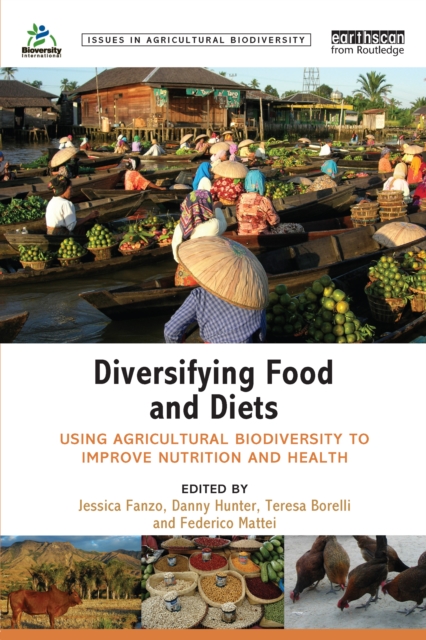
Diversifying Food and Diets
Currently 868 million people are undernourished and 195 million children under five years of age are stunted. At the same time, over 1 billion people are overweight and obese in both the developed and developing world. Diseases previously associated with affluence, such as cancer, diabetes and cardio-vascular disease, are on the rise. Food system-based approaches to addressing these problems that could enhance food availability and diet quality through local production and agricultural biodiversity often fall outside the traditional scope of nutrition, and have been under-researched. As a consequence, there remains insufficient evidence to support well-defined, scalable agricultural biodiversity interventions that can be linked to improvements in nutrition outcomes.
Agricultural biodiversity is important for food and nutritional security, as a safeguard against hunger, a source of nutrients for improved dietary diversity and quality, and strengthening local food systems and environmental sustainability. This book explores the current state of knowledge on the role of agricultural biodiversity in improving diets, nutrition and food security. Using examples and case studies from around the globe, the book explores current strategies for improving nutrition and diets and identifies key research and implementation gaps that need to be addressed to successfully promote the better use of agricultural biodiversity for rural and urban populations and societies in transition.
eBook