
Catalogue Search | MBRL


Are you sure you want to remove the book from the shelf?

{{itemTitle}}
9,518
result(s) for
"futur"
Sort by:

Come with me if you want to live : the future as foretold in classic sci-fi films
\"If our near future sometimes feels like a dystopian sci-fi movie, that's because it is. Come With Me If You Want to Live reveals how great science fiction films predicted the world we're increasingly living in, but how we can still avoid the worst of what they warned us about\"-- Provided by publisher.
BOOK


Machinehood
\"Welga Ramirez, executive bodyguard and ex-special forces, is about to retire early when her client is killed in front of her. It's, 2095 and people don't usually die from violence. Humanity is entirely dependent on pills that not only help them stay alive but allow them to compete with artificial intelligence in an increasingly competitive gig economy. Daily doses protect against designer diseases, flow enhances focus, zips and buffs enhance physical strength and speed, and juvers speed the healing process. All that changes when Welga's client is killed by The Machinehood, a new and mysterious terrorist group that has simultaneously attacked several major pill funders. The Machinehood operatives seem to be part human, part machine, something the world has never seen. They issue an ultimatum: stop all pill production in one week. Global panic ensues as pill production slows and many become ill. Thousands destroy their bots in fear of a strong AI takeover. But the US government believes the Machinehood is a cover for an old enemy. One that Welga is uniquely qualified to fight. Welga, determined to take down the Machinehood, is pulled back into intelligence work by the government that betrayed her. But who are the Machinehood, and what do they really want?\"-- Publisher.
Book
Ethics for the Future
Which of the possible futures might be a good future, and how do we know? Stephanie Bender looks at contemporary films and novels to address major ethical challenges of the future: the ecological catastrophe, digitalisation and biotechnology. She proposes that fiction and its modes of aesthetic simulation and emotional engagement offer a different way of knowing and judging possible futures. From a critical posthumanist angle, she discusses works ranging from Don DeLillo's Zero K (2017) and Margaret Atwood's MaddAddam Trilogy (2003-2013) to Kim Stanley Robinson's New York 2140 as well as Avatar (2009), and Blade Runner 2049 (2017) among many others.
eBook

Hyperobjects
Having set global warming in irreversible motion, we are facing the possibility of ecological catastrophe. But the environmental emergency is also a crisis for our philosophical habits of thought, confronting us with a problem that seems to defy not only our control but also our understanding. Global warming is perhaps the most dramatic example of what Timothy Morton calls \"hyperobjects\"-entities of such vast temporal and spatial dimensions that they defeat traditional ideas about what a thing is in the first place. In this book, Morton explains what hyperobjects are and their impact on how we think, how we coexist with one another and with nonhumans, and how we experience our politics, ethics, and art.
Moving fluidly between philosophy, science, literature, visual and conceptual art, and popular culture, the book argues that hyperobjects show that the end of the world has already occurred in the sense that concepts such as world, nature, and even environment are no longer a meaningful horizon against which human events take place. Instead of inhabiting a world, we find ourselves inside a number of hyperobjects, such as climate, nuclear weapons, evolution, or relativity. Such objects put unbearable strains on our normal ways of reasoning.
Insisting that we have to reinvent how we think to even begin to comprehend the world we now live in,Hyperobjectstakes the first steps, outlining a genuinely postmodern ecological approach to thought and action.
eBook
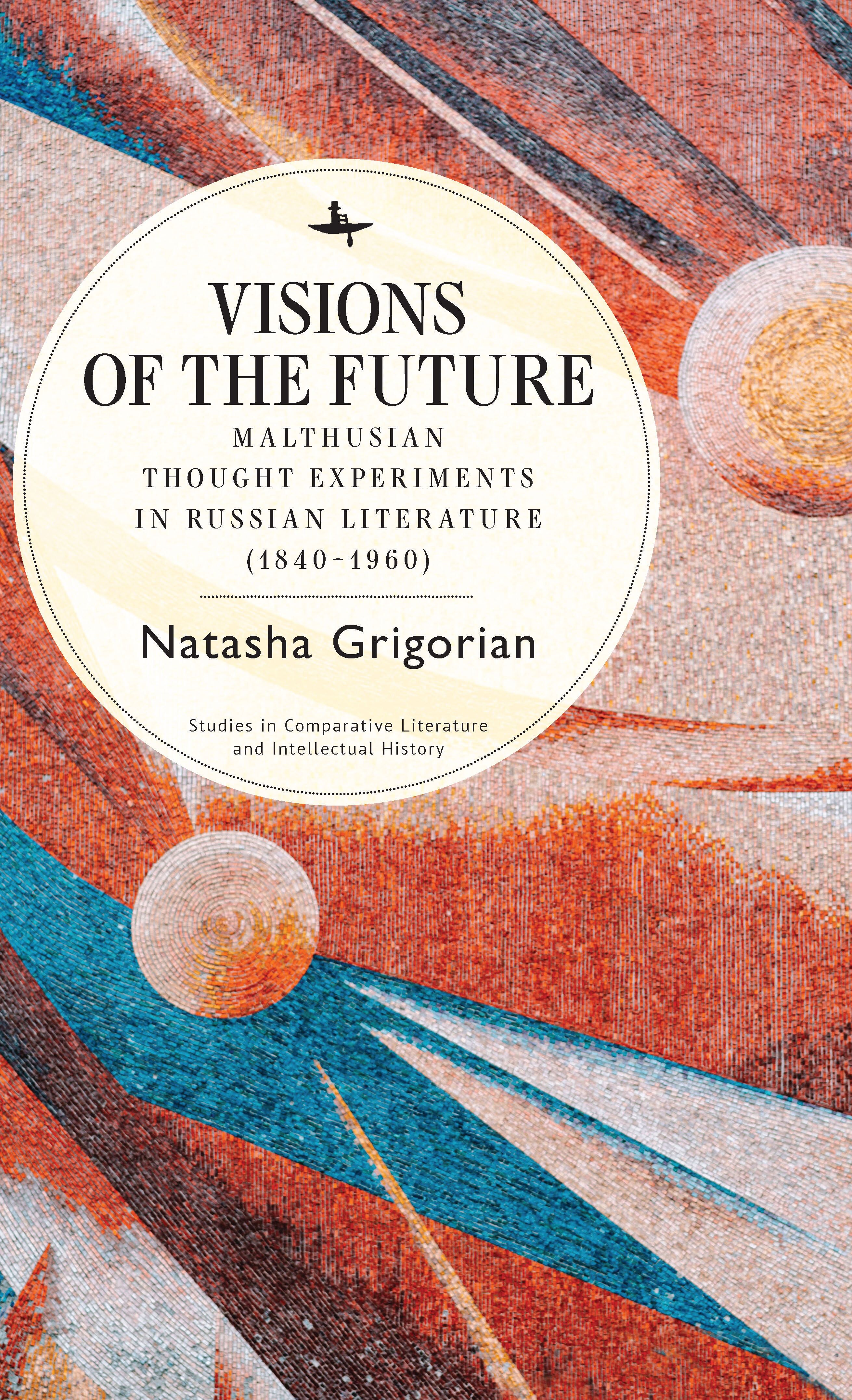
Visions of the Future
This book is inspired by the author’s work as part of a major international and interdisciplinary research group at the University of Konstanz, Germany: “What If—On the Meaning, Relevance, and Epistemology of Counterfactual Claims and Thought Experiments.” Having contributed to great discoveries, such as those by Galileo and Einstein, thought experiments are especially topical in the twenty-first century, since this is a concept that bridges the gap between the arts and the sciences, promoting interdisciplinary innovation. To study thought experiments in literature, it is imperative to examine relevant texts closely: this has rarely been done to date and this is precisely what this book does as a pilot study focusing on selected works of philosophy and literature. Specifically, thought experiments by Thomas Malthus are analyzed side by side with short stories and novels by Vladimir Odoevsky and Nikolai Chernyshevsky, Alexander Bogdanov and Aleksei Tolstoy, Alexander Chaianov and Nina Berberova.
eBook

Innovative Concepts for Alternative Migration Policies
This book is directed at researchers and policymakers at all levels and is intended to stimulate fresh thinking for the development of unconventional and innovative ideas for migration policymaking. The papers in this edited volume are the results of a joint ICMPD/IMISCOE workshop on Innovative Concepts for Alternative Migration Policies, held at the International Centre for Migration Policy Development in Vienna in 2006, with the participation of migration researchers, policymakers and representatives of international organisations. Based on the strengths of the combined ideas presented by the authors of these ten short papers, eight basic principles for the design of innovative migration policy approaches are presented and developed. This title is available in the OAPEN Library - http://www.oapen.org.
eBook

Ecological restoration for future sustainability in a changing environment
Since its emergence in the past decades, restoration ecology has demonstrated an astounding growth as a new discipline of applied science. At the same time, this young discipline has been criticized for its retrospective goals largely based on the past, its fragmented approach, and its idealistic goals, which do not relate to the real world context. Restoration with past-focused, idealistic, and/or ad hoc goals may not work in the future because an ecosystem that is restored for the past environment is not likely to be sustainable in the changing environment of the future, simple recomposition of isolated and fragmented naturalistic patches is not likely to restore ecosystem functions, and unrealistic goals and work plans are not likely to gain public support. We advocate directing the principles and practice of ecological restoration to the future. Future- aimed restoration should acknowledge the changing and unpredictable environment of the future, assume the dynamic nature of ecological communities with multiple trajectories, and connect landscape elements for improving ecosystem functions and structures. In this paper, we discuss the predictability of restoration trajectories under changing environmental conditions, the application of ecological theories to restoration practice, the importance of interdisciplinary approaches and human interventions in ecosystem recovery, and the social context of ecological restoration.
Journal Article

Applications, benefits, challenges, and areas of development in the use of AI-chatbots in education: A systematic literature review
Entre les tecnologies que han irromput recentment en l’àmbit de l’educació destaquen els xatbots d’IA, (ex. Duolingo Bot, IBM Watson Tutor o, fins i tot, ChatGPT). El present estudi duu a terme una revisió sistemàtica de la literatura (RSL), seguint el protocol PRISMA, en què s’analitzen 47 articles recuperats de les bases de dades Web of Science i Scopus entre els anys 2016 i 2024. Els resultats permeten identificar un mapa conceptual amb quatre dimensions diferenciades (i catorze subdimensions) en l’ús dels xatbots d’IA en l’àmbit educatiu. A saber: 1) Contextos d'aplicació (Processos d'ensenyament-aprenentatge, Contextos de gestió i Contextos de recerca); 2) Beneficis existents (Per a l'estudiantat, Per al professorat, Per a la prestació de serveis administratius i Per als serveis de biblioteca); 3) Reptes actuals (Ètics, D'actitud de l'usuari, De programació i De supervisió i manteniment); i 4) Àrees de desenvolupament (Avanços tècnics, Proves d'usabilitat i Definició de codis ètics). Aquest estudi facilita, pel que fa a RSL prèvies, una visió plenament actualitzada de l'estat de l'art sobre la investigació sobre l'ús d'IA-Chatbots a l'àmbit educatiu. Però, sobretot, ofereix un mapa conceptual clar i ben definit de les dimensions crítiques que cal tenir en compte, identificant-ne tots els possibles contextos d'aplicació, els beneficis, els reptes presents, i les àrees pendents de desenvolupar; en un treball que convida docents, investigadors, serveis de gestió i organismes al càrrec del disseny de polítiques educatives, a reflexionar sobre les implicacions de l'ús d'aquestes tecnologies.
Among the technologies that have recently burst into the field of education, AI-Chatbots stand out (e.g. Duolingo Bot, IBM Watson Tutor, or even ChatGPT). The present study conducts a systematic literature review (SLR) following the PRISMA protocol, analyzing 47 articles retrieved from the Web of Science and Scopus databases between 2016 and 2024. The results show the existence of a conceptual map with four key dimensions (and fourteen subdimensions) in the use of AI-Chatbots in education. Namely: 1) Application contexts (Teaching-learning processes, Management contexts, and Research contexts); 2) Existing benefits (For students, For teachers, For the provision of administrative services, and For library services); 3) Current challenges (Ethical, User attitude, Programming, and Supervision and maintenance); and 4) Development areas (Technical advances, Usability testing, and Definition of ethical codes). Compared to previous SLRs, this study provides a fully updated overview of the state of the art in research on the use of AI-Chatbots in education. Most importantly, it provides a clear and well-defined conceptual map of the critical dimensions to be considered, identifying all possible application contexts, benefits, present challenges, and areas to be developed. This work invites teachers, researchers, management services and organizations responsible for designing educational policies to reflect on the implications of using these technologies.
Entre las tecnologías que han irrumpido recientemente en el ámbito de la educación destacan los IA-Chatbots (ej. Duolingo Bot, IBM Watson Tutor, o incluso ChatGPT). El presente estudio lleva a cabo una revisión sistemática de la literatura (RSL), siguiendo el protocolo PRISMA, en la que se analizan 47 artículos recuperados de las bases de datos Web of Science y Scopus entre 2016 y 2024. Los hallazgos permiten identificar un mapa conceptual con cuatro dimensiones diferenciadas (y catorce subdimensiones) en el uso de IA-Chatbots en el ámbito educativo. A saber: 1) Contextos de aplicación (Procesos de enseñanza-aprendizaje, Contextos de gestión, y Contextos de investigación); 2) Beneficios existentes (Para el estudiantado, Para el profesorado, Para la prestación de servicios administrativos, y Para los servicios de biblioteca); 3) Retos actuales (Éticos, De actitud del usuario, De programación, y De supervisión y mantenimiento); y 4) Áreas de desarrollo futuro (Avances técnicos, Pruebas de usabilidad, y Definición de códigos éticos). El presente estudio facilita, con respecto a RSL previas, una visión plenamente actualizada del estado del arte sobre la investigación en torno al uso de IA-Chatbots en el ámbito educativo. Pero, sobre todo, ofrece un mapa conceptual claro y bien definido de las dimensiones críticas a tener en cuenta, identificando todos sus posibles contextos de aplicación, sus beneficios, los retos presentes, y las áreas pendientes de desarrollar; en un trabajo que invita a docentes, investigadores, servicios de gestión, y organismos al cargo del diseño de políticas educativas, a reflexionar sobre las implicaciones del uso de estas tecnologías.
Journal Article
A brief history of the future. Episode 6, Tomorrows
Examining the ways we often see the future as a rigid and singular concept rather than the multiple possible futures before us, the crucial need to think much, much bigger about what could come next, and how we all have more personal agency than we realize.
Streaming Video