
Catalogue Search | MBRL


Are you sure you want to remove the book from the shelf?

{{itemTitle}}
46,670
result(s) for
"government participation"
Sort by:

Local politics and participation in Britain and France
Local participation can and does influence the political process. This is a unique comparative study of the involvement of average citizens in local politics and government. It is a product of collaborative research carried out at the Universities of Manchester and Bordeaux.
Book
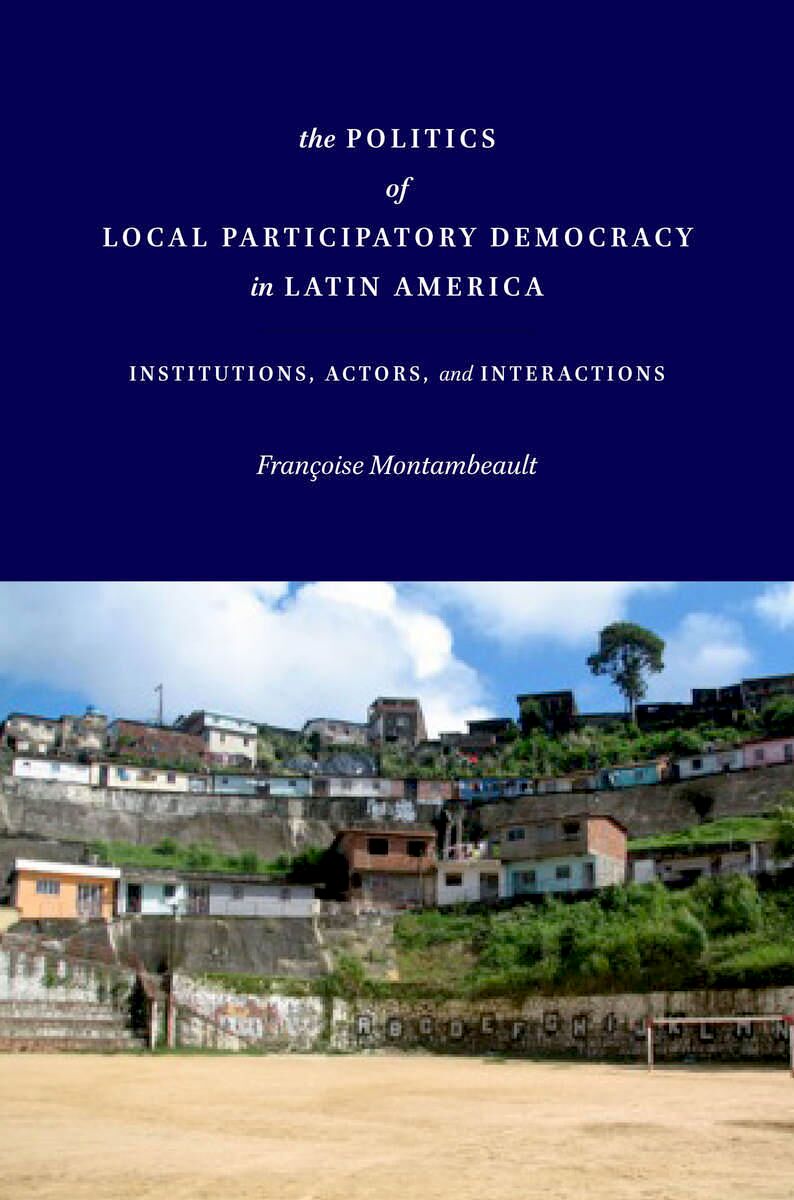
The Politics of Local Participatory Democracy in Latin America
Participatory democracy innovations aimed at bringing citizens back into local governance processes are now at the core of the international democratic development agenda. Municipalities around the world have adopted local participatory mechanisms of various types in the last two decades, including participatory budgeting, the flagship Brazilian program, and participatory planning, as it is the case in several Mexican municipalities. Yet, institutionalized participatory mechanisms have had mixed results in practice at the municipal level. So why and how does success vary? This book sets out to answer that question.
Defining democratic success as a transformation of state-society relationships, the author goes beyond the clientelism/democracy dichotomy and reveals that four types of state-society relationships can be observed in practice: clientelism, disempowering co-option, fragmented inclusion, and democratic cooperation.
Using this typology, and drawing on the comparative case study of four cities in Mexico and Brazil, the book demonstrates that the level of democratic success is best explained by an approach that accounts for institutional design, structural conditions of mobilization, and the configurations, strategies, behaviors, and perceptions of both state and societal actors.
Thus, institutional change alone does not guarantee democratic success: the way these institutional changes are enacted by both political and social actors is even more important as it conditions the potential for an autonomous civil society to emerge and actively engage with the local state in the social construction of an inclusive citizenship.
eBook


Governed by a spirit of opposition : the origins of American political practice in colonial Philadelphia
Civic engagement in the City of Brotherly Love gave birth to the American Revolution.
Winner of the Athenaeum of Philadelphia Literary Award of The Athenaeum of Philadelphia
During the colonial era, ordinary Philadelphians played an unusually active role in political life. Because the city lacked a strong central government, private individuals working in civic associations of their own making shouldered broad responsibility for education, poverty relief, church governance, fire protection, and even taxation and military defense. These organizations dramatically expanded the opportunities for white men—rich and poor alike—to shape policies that immediately affected their communities and their own lives.
In Governed by a Spirit of Opposition, Jessica Choppin Roney explains how allowing people from all walks of life to participate in political activities amplified citizen access and democratic governance. Merchants, shopkeepers, carpenters, brewers, shoemakers, and silversmiths served as churchwardens, street commissioners, constables, and Overseers of the Poor. They volunteered to fight fires, organized relief for the needy, contributed money toward the care of the sick, took up arms in defense of the community, raised capital for local lending, and even interjected themselves in Indian diplomacy. Ultimately, Roney suggests, popular participation in charity, schools, the militia, and informal banks empowered people in this critically important colonial city to overthrow the existing government in 1776 and re-envision the parameters of democratic participation.
Governed by a Spirit of Opposition argues that the American Revolution did not occasion the birth of commonplace political activity or of an American culture of voluntary association. Rather, the Revolution built upon a long history of civic engagement and a complicated relationship between the practice of majority-rule and exclusionary policy-making on the part of appointed and self-selected constituencies.
eBook

Collective Action and Urban Poverty Alleviation
An estimated 600 million people now live in informal or 'squatter' settlements in the rapidly growing cities of the developing world. With such settlements often lacking basic necessities, there is an urgent need to address this urban crisis. Recently, innovative approaches have focused on the role of community-based organizations (CBOs) in setting up self-help and participatory programmes. This incisive book questions whether communities have the ability to organize, engage government and undertake major redevelopment. It also examines when and how mobilization of communities occurs and if such organizations possess any influence in the intensely political decision-making arena of urban land development. It is illustrated by a detailed analysis of the experience of CBOs in Manila, as the Philippine government has undertaken what is perhaps the most radical experiment in decentralized, participatory approaches to urban governance in the world. The book emphasizes the external conditions that influence patterns of collective action within communities and addresses issues such as the local political economy and the communities' place within the global economy.
eBook

Urban Chinese governance, contention, and social control in the new millennium
\"Bringing together a wide range of leading experts across several disciplines, this book offers critical insights on some of the most important questions of contemporary urban Chinese politics and society. Drawing on extensive research across different localities and issues in China, the chapters offer rich data and fresh analyses of the shifting contours of urban governance, social mobilization and contention, and the mechanisms of social control in the new Millennium. Taken together, this collection represents the most comprehensive look in some years at how urban Chinese political institutions have adapted and responded to challenges and how social actors and groups have mobilized to press for redress of substantial new grievances\"-- Provided by publisher.
Book

Participatory democracy in Brazil : socioeconomic and political origins
The largely successful trajectory of participatory democracy in post-1988 Brazil is well documented, but much less is known about its origins in the 1970s and early 1980s. In Participatory Democracy in Brazil: Socioeconomic and Political Origins, J. Ricardo Tranjan recounts the creation of participatory democracy in Brazil. He positions the well-known Porto Alegre participatory budgeting at the end of three interrelated and partially overlapping processes: a series of incremental steps toward broader political participation taking place throughout the twentieth century; short-lived and only partially successful attempts to promote citizen participation in municipal administration in the 1970s; and setbacks restricting direct citizen participation in the 1980s. What emerges is a clearly delineated history of how socioeconomic contexts shaped Brazil's first participatory administrations.
Tranjan first examines Brazil's long history of institutional exclusion of certain segments of the population and controlled inclusion of others, actions that fueled nationwide movements calling for direct citizen participation in the 1960s. He then presents three case studies of municipal administrations in the late 1970s and early 1980s that foreground the impact of socioeconomic factors in the emergence, design, and outcome of participatory initiatives. The contrast of these precursory experiences with the internationally known 1990s participatory models shows how participatory ideals and practices responded to the changing institutional context of the 1980s. The final part of his analysis places developments in participatory discourses and practices in the 1980s within the context of national-level political-institutional changes; in doing so, he helps bridge the gap between the local-level participatory democracy and democratization literatures.
eBook


The Impact of Government Participation on the Political Trust of Populist Party Supporters
Citizens are more trustful of politics if their preferred party is an electoral winner and becomes part of the government. However, there remains the question of whether this positive effect of joining the government also holds for supporters of populist parties. Populists show low levels of political trust, as they strongly criticize the political elite. This study argues that voters of populist parties perceive the political system as more responsive to their concerns when their preferred party becomes part of the government and so they become more trustful of politics. Drawing on the case of Austria, the analyses demonstrate that political trust among populist party voters is higher when their party is in government. In contrast, non-populist voters' level of political trust is more stable, even when their party is not in government.
Journal Article