
Catalogue Search | MBRL


Are you sure you want to remove the book from the shelf?

{{itemTitle}}
709
result(s) for
"gregorian chant"
Sort by:

Tolkien's Tune for \Namarie\ is an Actual Gregorian Chant
In response to Tom Emanuel's essay on the Tolkien Society's Enyalie ceremony (Mythlore #146), notes the origin of Tolkien's tune for the poem. Additional Keywords Namarie; Gregorian chant; Enyalie ceremony
Journal Article

Learning to Pray by Singing
Gregorian chants are mostly based on Old Testament texts, predominantly from the Psalms. Decisive for their interpretation in the light of the New Testament are texts of the Church Fathers (Augustine, Gregory the Great, etc.). The texts often do not follow their canonical order in the Bible, but were primarily compiled on the basis of broader associations. Hence, it is not uncommon for new content references to emerge that are committed to a Christian perspective, emotionally and theologically very bold. This article describes an imaginary ‘Gregorian Composition Workshop’: the individual ‘chambers’ include compiling texts, the choice of a suitable mode and melody, as well as the most refined rhythmic differentiations. The final piece, through its unique quality as the ‘sounding word of Holy Scripture’ permits an intensive view of the spirituality of the ninth and tenth centuries, and a realistic understanding of the Psalms as the basis of Christian existence.
Journal Article

Melos, Satz und Zusammenklang
Victoria’s four-part Requiem is overshadowed by his later six-part setting, in spite of the fact that for centuries it was the more widespread and better known of the two. Its exemplary application of established liturgical requirements and customs of the genre provide critical orientation for the later work. In addition to the artful variability of the musical declamation and means of interpreting the text, the liturgical cantus firmus informs the composition in a fundamental, multidimensional way. With regard to the work’s construction, harmonies, and motivic inflections, Victoria combines the seven parts of the plenary mass and the added Libera me consequentially and with differentiation to form a coherently unified whole.
Journal Article
Melos, Satz und Zusammenklang
Victoria’s four-part Requiem is overshadowed by his later six-part setting, in spite of the fact that for centuries it was the more widespread and better known of the two. Its exemplary application of established liturgical requirements and customs of the genre provide critical orientation for the later work. In addition to the artful variability of the musical declamation and means of interpreting the text, the liturgical cantus firmus informs the composition in a fundamental, multidimensional way. With regard to the work’s construction, harmonies, and motivic inflections, Victoria combines the seven parts of the plenary mass and the added Libera me consequentially and with differentiation to form a coherently unified whole.
Journal Article
Christmas concert at the Sistine Chapel. Gaudete in Domino semper : Gregorian chant
The Vatican Library is home to the most important and extensive collection of sacred music manuscripts in the world and the Sistine Chapel Choir has unlimited access to this extraordinary archive. The Sistine Chapel choir, the oldest choir in the world, has sung this music for centuries, and in recent years has reached new musical heights of excellence. The Director of the Sistine Chapel, Monsignor Massimo Palombella, has taken on an exciting double challenge. On the one hand, he is presenting polyphonic works from the Vatican Library in new editions reflecting the very highest standards of contemporary academic scholarship in polyphony. On the other hand, he is also developing performance practices for the choir to bring even the most intricate and impossibly difficult motets to life in a way which respects and clarifies the liturgical meaning of the music. Many of the works on this recording by famous names such as Palestrina and Desprez, all written to form part of Papal Celebrations for Advent and Christmas, have never been heard before.
Streaming Video

Beyond the Gradual. An Analysis of the Recited Layers of Mass Propers and the Impact of Regensburg on the Early Hungarian Liturgy
This study is intended to introduce a pioneering project called Missalia that should serve to enable the analysis and comparison of the Mass proper as a whole, including not only the chanted parts in the strict sense, but also the so-called euchological material, and the corpus of lessons. Given that they belong to the same system, their analysis is indispensable for the interpretation of musical sources, because the layer of the Gradual in its entirety is far less variable than that of the Sacramentary or the Lectionary. Some new principles and methods are proposed in order to describe and classify the Mass proper of medieval liturgical uses, pre-eminently the necessity of a Europe-wide sampling and the importance of early printed material. As a case study, a recent discovery is presented which demonstrates a close and exclusive link between the euchological layers of the late printed Missals of Regensburg and Zagreb. This relationship can be traced back to, and becomes even more obvious in the early 13ᵗʰ century, and a conclusion can be drawn that it originated in the first decades of the 11ᵗʰ century. In this period, and in this period only, is it feasible to suppose that Regensburg exerted a strong influence on the composition of the early Hungarian Sacramentary.
Journal Article
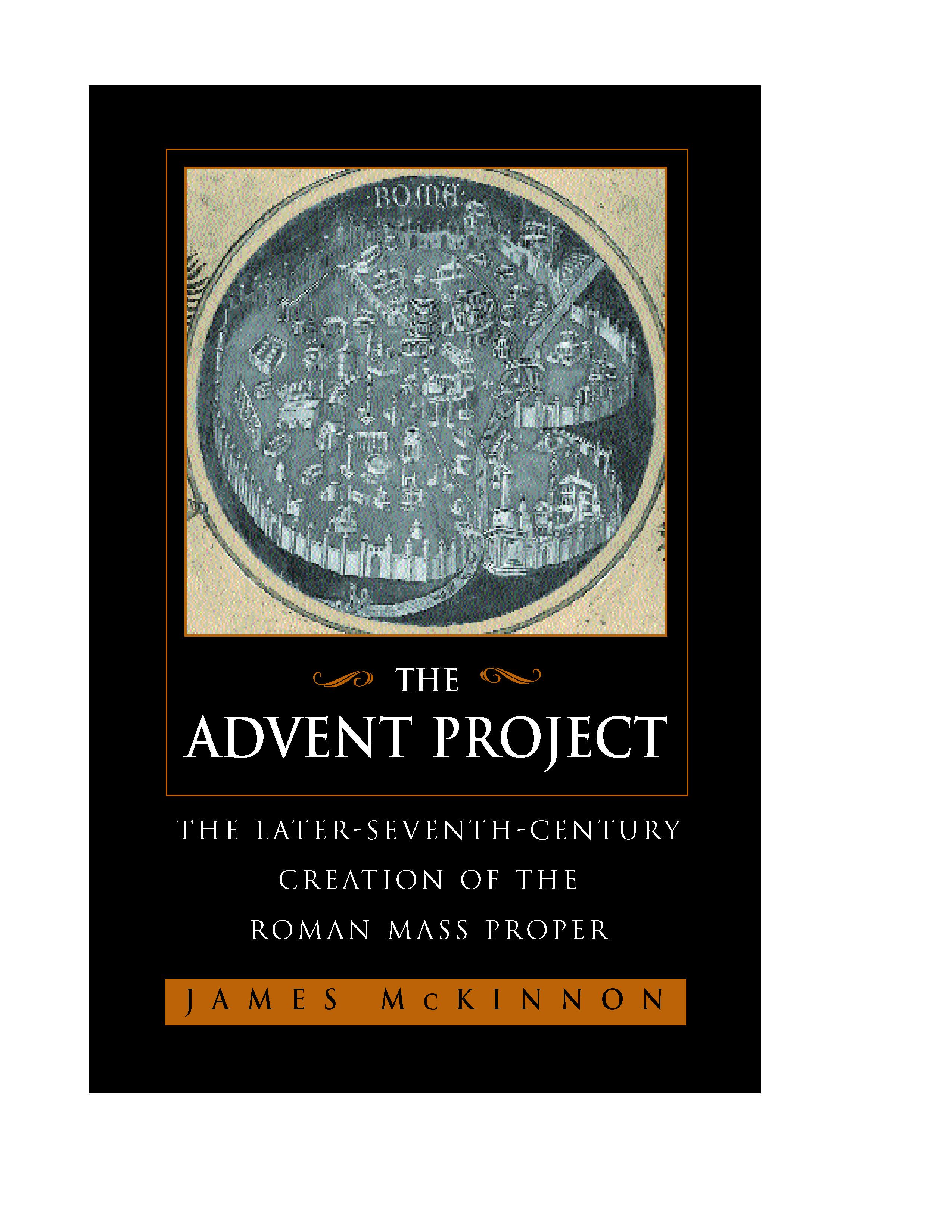
The Advent Project
In his final accomplishment of an extraordinarily distinguished career, James W. McKinnon considers the musical practices of the early Church in this incisive examination of the history of Christian chant from the years a.d. 200 to 800. The result is an important book that is certain to have a long-lasting impact on musicology, religious studies, and history.
eBook

Introducing Gregorian Chant to a Malaysian Methodist Congregation: A Case Study
This study explores the feasibility of introducing Gregorian chant into contemporary Chinese Methodist worship in Malaysia. Using ethnographic methods including participant observation, interviews, and focus groups, this article documents a pilot study conducted at Sing Ang Tong Methodist Church in Sibu, Sarawak, where seven singers learned and performed the communion chant Gustate et videte. Three different transcription editions were created to bridge the gap between medieval square notation and modern Western notation, which is more familiar to the participants. The chant was translated into Chinese alongside the original Latin text. The majority preferred the quaver-crotchet notation edition and supported performing the chant in both Latin and Chinese to balance authenticity with accessibility. Participants found the modal melodic structure and free rhythm challenging initially but developed appreciation for the chant’s meditative qualities. The performance during Holy Communion services in October 2022 received mixed congregational responses, with many describing it as creating a “calm and prayerful atmosphere” while some expressed discomfort with the unfamiliar musical style. The study demonstrates that Gregorian chant can be successfully integrated into Chinese Methodist worship contexts, particularly during solemn liturgical occasions, when approached with appropriate liturgical sensitivity and cultural adaptation.
Journal Article
The Liturgical Usage of Translated Gregorian Chant in the Korean Catholic Church
For centuries, Gregorian chant has served as a monophonic song written for the religious services of the Roman Catholic Church, but Korean Catholics first encountered this chant in the early nineteenth century. Korean Catholics ultimately became more attracted to the Korean translations of these chants, as opposed to the original Latin versions. This article introduces some issues related to the language translation of Gregorian chant, especially for chants performed in Holy Week. The issues include discrepancies in the number of syllables, shifts in melismatic emphasis, difficult diction in vocalization, briefer singing parts because of space limitations, challenging melodic lines, and translation losses from neumes to modern notes.
Journal Article
The Natural Power of Music
Among the early medieval authors, Amalarius of Metz (8th–9th century) is one of those who discussed the impact of religious music and song on the body and soul. In his main work: the Liber Officialis, listening and singing liturgical music are depicted as having a corporeal effect that generates sensations of an intense sensory and emotional character. In Amalarius, living the musical religious phenomenon not only coincides with the idea that music can evoke emotions but there is something that goes further. What Amalarius emphasizes is a particular emotion: a “spiritual state” of the nakedness of the heart, almost a weakness of those who are capable of tears and sensitive to God’s voice. During the patristic era, especially in the East, “penthos” (compunction) was used to describe the experience of tears in prayer or meditation; however, Fathers of the Church described liturgical music as an obstacle to compunction. For this reason, an evolution of that compunctory doctrine emerges from the exposition of Amalarius. In this context, it is not a question of crying for one’s sins but of exploiting a natural power (vis) of music. By simply listening to music, a person would seem capable of being moved and reaching a particularly “receptive state” to welcome the Word of God and make it bear fruit. What Amalarius describes in religious music seems to be the natural experience that one feels when, just listening to a melody, a tear spontaneously falls. This physical reaction is connected to a spiritual transformation that seems to pass through the flesh (carnalia) of our humanity. The result of this singular experience, strongly connected to musical ethics, is the conversion to good action and the possibility to dispose human beings to attentive, deep, and fruitful listening.
Journal Article