
Catalogue Search | MBRL


Are you sure you want to remove the book from the shelf?

{{itemTitle}}
3,739
result(s) for
"grouse"
Sort by:


Prairie grouse and wind energy
How to shape the anticipated build-out of industrial-scale renewable energy in a way that minimizes risk to wildlife remains contentious. The challenge of balancing wildlife conservation and decarbonization of the electricity sector is well illustrated in the grasslands and shrub-steppe of North America. Here, several endemic species of grouse are the focus of intensive, long-term conservation action by a host of governmental and nongovernmental entities, many of whom are now asking whether anticipated increases in the number of wind-energy facilities will exacerbate declines or prevent recovery of these species. To address this question, we synthesized the potential consequences of wind-energy development on prairie grouse. Published literature on behavior or demography of prairie grouse at wind-energy facilities is sparse, with studies having been conducted at only 5 different facilities in the United States. Only 2 of these studies met the standard for robust impact analysis by collecting preconstruction data and using control sites or gradient designs. Only one species, greater prairie chicken, had published results available for >1 facility. Most (10/12) studies also drew conclusions based on short (4 years) periods of study, which is potentially problematic when studying highly philopatric species. Given these caveats, we found that, in the short-term, adult survival and nest success appear largely unaffected in populations exposed to wind-energy facilities. However, changes in habitat use by female greater sage-grouse and female greater prairie-chicken during some seasons and reduced lek persistence among male greater prairie-chickens near wind turbines suggest behavioral responses that may have demographic consequences. Prairie grouse can coexist with wind-energy facilities in some cases, at least in the short term, but important uncertainties remain, including the potential for long-term, cumulative effects of the extensive development expected as states attempt to meet goals for generating electricity from renewable sources.
Journal Article

Lek habitat suitability for the sharp-tailed grouse
Grassland birds in North America face many problems as a result of habitat loss and fragmentation; understanding their habitat requirements is critical for their conservation and management. The sharp-tailed grouse (Tympanuchus phasianellus) can be found throughout North American grasslands and is a species of economic and cultural importance, but it has experienced population declines over the last few decades. A large part of sharp-tailed grouse life history is focused on and around lekking grounds, which makes leks an essential feature for sharp-tailed grouse management. We used information from 596 leks and landcover predictors within 1-km and 5-km squares to perform Habitat Suitability Index modeling for sharp-tailed grouse on the Northern Great Plains in Saskatchewan, Canada. The proportion of grasslands at the 5-km scale and the 1-km scale were the two most important factors affecting lek occurrence (permutation importance = 34.8% and 26.9%, respectively). In every case, the 5-km scale predictors were ranked as having a more significant influence on lek occurrence than the 1-km scale. Other factors of importance included topographic roughness (9.7% permutation importance), and the proportion of human disturbance at the 5-km scale (5% permutation importance). Our study highlights the importance of large patches of grassland to support the occurrence of sharp-tailed grouse leks, and that a diverse set of habitat features are needed for sharp-tailed grouse management.
Journal Article

Managing multiple vital rates to maximize greater sage-grouse population growth
Despite decades of field research on greater sage-grouse, range-wide demographic data have yet to be synthesized into a sensitivity analysis to guide management actions. We reviewed range-wide demographic rates for greater sage-grouse from 1938 to 2011 and used data from 50 studies to parameterize a 2-stage, female-based population matrix model. We conducted life-stage simulation analyses to determine the proportion of variation in population growth rate (λ) accounted for by each vital rate, and we calculated analytical sensitivity, elasticity, and variance-stabilized sensitivity to identify the contribution of each vital rate to λ. As expected for an upland game bird, greater sage-grouse showed marked annual and geographic variation in several vital rates. Three rates were demonstrably important for population growth: female survival, chick survival, and nest success. Female survival and chick survival, in that order, had the most influence on λ per unit change in vital rates. However, nest success explained more of the variation in λ than did the survival rates. In lieu of quantitative data on specific mortality factors driving local populations, we recommend that management efforts for greater sage-grouse first focus on increasing female survival by restoring large, intact sagebrush-steppe landscapes, reducing persistent sources of human-caused mortality, and eliminating anthropogenic habitat features that subsidize species that prey on juvenile, yearling, and adult females. Our analysis also supports efforts to increase chick survival and nest success by eliminating anthropogenic habitat features that subsidize chick and nest predators, and by managing shrub, forb, and grass cover, height, and composition to meet local brood-rearing and nesting habitat guidelines. We caution that habitat management to increase chick survival and nest success should not reduce the cover or height of sagebrush below that required for female survival in other seasons (e.g., fall, winter). The success or failure of management actions for sage-grouse should be assessed by measuring changes in vital rates over long time periods to avoid confounding with natural, annual variation.
Journal Article
Winter habitat use of greater sage-grouse relative to activity levels at natural gas well pads
Energy development in western North America has been shown to negatively influence greater sage-grouse (Centrocercus urophasianus) populations. No effective methods of reducing on-site impacts of energy development to greater sage-grouse are known. We investigated greater sage-grouse use of wintering habitats relative to distances to infrastructure, densities of infrastructure, and activity levels associated with infrastructure of a natural gas field over 5 years in southwestern Wyoming. We compared year-long drilling locations, locations of conventional well pads, locations of well pads with off-site condensate and produced water gathering systems (LGS), and plowed main haul roads to the number of and time associated with greater sage-grouse visits to continually monitored, distinct patches of habitat. Liquid gathering systems reduced human activity levels at producing well pads approximately 53%. We used data loggers to monitor distinct patches of habitat throughout the 2005–2006 to 2009–2010 winters and used the number of times and the amount of time individuals from a sample of greater sage-grouse (n = 236) were detected at data logger stations to model frequency and time of occurrence as functions of anthropogenic and habitat variables. Greater sage-grouse avoided suitable winter habitats in areas with high well pad densities regardless of differences in activity levels associated with well pads. Our results further suggested that greater sage-grouse avoidance of conventional well pads was stronger than LGS well pads. We found relatively consistent positive relationships between distance to infrastructure with high levels of human activity and average hours greater sage-grouse spent in an area. Greater sage-grouse avoidance of natural gas field infrastructure during the winter may be explained mechanistically as movements of individuals from areas close to high levels of activity—movements that may occur at the time human activity is experienced—followed by a lack of movement back into these areas. Minimizing the densities of well pads may reduce on-site impacts of energy development on wintering greater sage-grouse. Our study, additionally, indicated that reducing anthropogenic activity levels associated with energy developments may reduce the temporal scale of indirect greater sage-grouse winter habitat loss. © 2015 The Wildlife Society.
Journal Article
Yearling Greater Sage-Grouse Response to Energy Development in Wyoming
Sagebrush (Artemisia spp.)-dominated habitats in the western United States have experienced extensive, rapid changes due to development of natural-gas fields, resulting in localized declines of greater sage-grouse (Centrocercus urophasianus) populations. It is unclear whether population declines in natural-gas fields are caused by avoidance or demographic impacts, or the age classes that are most affected. Land and wildlife management agencies need information on how energy developments affect sage-grouse populations to ensure informed land-use decisions are made, effective mitigation measures are identified, and appropriate monitoring programs are implemented (Sawyer et al. 2006). We used information from radio-equipped greater sage-grouse and lek counts to investigate natural-gas development influences on 1) the distribution of, and 2) the probability of recruiting yearling males and females into breeding populations in the Upper Green River Basin of southwestern Wyoming, USA. Yearling males avoided leks near the infrastructure of natural-gas fields when establishing breeding territories; yearling females avoided nesting within 950 m of the infrastructure of natural-gas fields. Additionally, both yearling males and yearling females reared in areas where infrastructure was present had lower annual survival, and yearling males established breeding territories less often, compared to yearlings reared in areas with no infrastructure. Our results supply mechanisms for population-level declines of sage-grouse documented in natural-gas fields, and suggest to land managers that current stipulations on development may not provide management solutions. Managing landscapes so that suitably sized and located regions remain undeveloped may be an effective strategy to sustain greater sage-grouse populations affected by energy developments.
Journal Article
Age and Sex Identification From Wings of Sage-Grouse
We redefine and clarify procedures to classify sex and age (juveniles, yearlings, adults, and breeding-age) of greater (Centrocercus urophasianus) and Gunnison sage-grouse (C. minimus) from wings. Existing keys for greater sage-grouse age and sex classification do not incorporate more recent information on timing and sequence of molt or regional variation. We evaluated keys with the aid of gonadally inspected, hunter-harvested sage-grouse in Colorado (1973–1990) and with birds captured and measured in Washington (1992–1997) and Oregon (2008–2012). The technique is accurate and transferable among biologists who have basic training in reading a key and examining wings (primaries, secondaries, tertials, and coverts). Accurate information on sex and age of grouse, particularly during harvest, is a fundamental component of our understanding of population dynamics, which ultimately enables improved management.
Journal Article
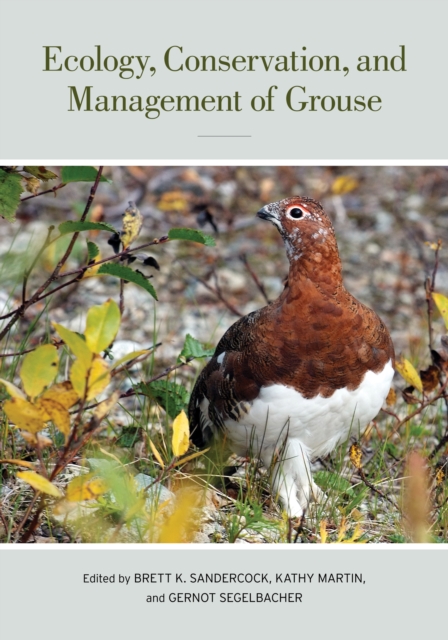
Ecology, Conservation, and Management of Grouse
Grouse—an ecologically important group of birds that include capercaillie, prairie chickens, and ptarmigan—are distributed throughout the forests, grasslands, and tundra of Europe, Asia, and North America. Today, many grouse populations are in decline, and the conservation and management of these charismatic birds is becoming a global concern. This volume summarizes current knowledge of grouse biology in 25 chapters contributed by 80 researchers from field studies around the world. Organized in four sections—Spatial Ecology, Habitat Relationships, Population Biology, and Conservation and Management—the chapters offer important insights into spatial requirements, movements, and demography of grouse. Much of the research employs emerging tools in ecology that span biogeochemistry, molecular genetics, endocrinology, radio-telemetry, and remote sensing. The chapters explore topics including the impacts of climate change, energy development, and harvest, and give new evidence for life-history changes in response to human activities.
eBook
Changes in hunting season regulations
Hunter harvest is a potential factor contributing to population declines of sage-grouse (Centrocercus spp.). As a result, wildlife agencies throughout western North America have set increasingly more conservative harvest regulations over the past 25 years to reduce or eliminate hunter success and concomitant numbers of harvested greater (C. urophasianus) and Gunnison (C. minimus) sage-grouse. Sage-grouse hunting has varied widely over time and space, which has made a comprehensive summary of hunting management challenging. We compiled data on harvest regulations among 11 western U.S. states and 2 Canadian provinces from 1870-2019 to create a timeline representative of hunting regulations. We compared annual harvest boundaries and area-weighted average hunting regulations, 1995-2018, relative to administrative boundaries and areas of high probability of sage-grouse occupation. We also summarized estimated numbers of birds harvested and hunters afield, 1995-2018, across both species' ranges. From 1995-2018, there was a 30% reduction in administrative harvest boundaries across the greater sage-grouse range compared to a 16.6% reduction in area open to harvest within 8 km from active leks. Temporary closures occurred in response to wildfires, disease outbreaks, low population numbers, and two research projects; whereas, permanent closures primarily occurred in small populations and areas on the periphery of the species distribution. Similarly, area-weighted possession limits and season length for greater sage-grouse decreased 52.6% and 61.0%, respectively, while season start date stayed relatively stable (mean start date ~259 [mid-September]). In contrast, hunting of the now federally-threatened Gunnison sage-grouse ended after 1999. While restrictions in harvest regulations were large in area, closures near areas of high greater sage-grouse occupancy were relatively smaller with the same trend for Gunnison sage-grouse until hunting ceased. For greater sage-grouse, most states reduced bag and possession limits and appeared to adhere to recommendations for later and shorter hunting seasons, reducing potential for additive mortality.
Journal Article