
Catalogue Search | MBRL


Are you sure you want to remove the book from the shelf?

{{itemTitle}}
1,812
result(s) for
"guru"
Sort by:
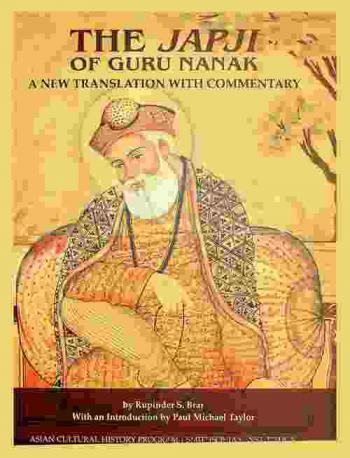
The Japji of Guru Nanak : a new translation with commentary
The Japji is by far the best-known work of Guru Nanak (1469-1539) -- poet, philosopher, historian, composer, First Sikh Guru and founder of the Sikh faith. Many Sikhs recite its sacred verses daily. Its title derives from the root \"jap-\" meaning to recite or chant. Dr. Rupinder Singh Brar provides in this book a compelling new translation with commentary. He also examines its core concepts, and presents the Japji as a condensed summary of Guru Nanak's philosophy. Dr. Brar notes that, perhaps due to its exalted status as a religious text, the Japji remains under-appreciated as a literary and philosophical gem, and that its importance within South Asia's literary and cultural heritage is still litle known outside the Sikh community. This highly readable translation and commentary are published by the Smithsonian's Asian Cultural History Program in conjunction with the 550th anniversary of Guru Nanak's birth (1469-2019). -- Introduction.
Book

The Socially Involved Renunciate
The Socially Involved Renunciate is an in-depth analysis
and an original English translation of the Siddh Goṣṭ , a
fundamental philosophical text of the Sikh tradition. The work
reflects the distinctive worldview of Sikhism, the only major
Indian religion that does not regard asceticism as a legitimate
path to liberation. Composed by Guru Nānak, a medieval, north
Indian saint-poet and venerated founder of the Sikh tradition, the
Siddh Goṣṭ is a dialogue between Guru Nānak and several
Nāth yogis who had been pursuing a rigorous path of hath-yoga as
renunciates of the material world. Through their dialogue, Guru
Nānak teaches the Nāth yogis a spiritual path that also includes
involvement in the social world and offers a practical way to
achieve liberation. In The Socially Involved Renunciate, Kamala
Elizabeth Nayar and Jaswinder Singh Sandhu provide background on
Sikhism, highlight the ethical teachings expounded in the Siddh
Goṣṭ , and demonstrate how Guru Nānak reconciles the
polarities of the ascetic and householder ideals.
eBook

Zorba the Buddha
Zorba the Buddha is the first comprehensive study of the life, teachings, and following of the controversial Indian guru known in his youth as Bhagwan Shree Rajneesh and in his later years as Osho (1931-1990). Most Americans today remember him only as the \"sex guru\" and the \"Rolls Royce guru,\" who built a hugely successful but scandal-ridden utopian community in central Oregon during the 1980s. Yet Osho was arguably the first truly global guru of the twentieth century, creating a large transnational movement that traced a complex global circuit from post-Independence India of the 1960s to Reagan's America of the 1980s and back to a developing new India in the 1990s. The Osho movement embodies some of the most important economic and spiritual currents of the past forty years, emerging and adapting within an increasingly interconnected and conflicted late-capitalist world order. Based on extensive ethnographic and archival research, Hugh Urban has created a rich and powerful narrative that is a must-read for anyone interested in religion and globalization.
eBook

Guru Nanak’s Siddh Gosti: a Dialogue Between Established and Emerging Discourse
The present paper analyses the Siddh Gosti, a composition of Guru Nanak to understand the interface of Guru Nanak’s philosophy with prevailing philosophical traditions of his time. The study views the composition as an effort on the part of the Guru to engage with and demolish the philosophical hegemony of an established belief system that held sway in Northwest India in order to make way for the establishment of his own philosophy. Guru Nanak does this by providing new interpretations of constructs which the Siddhs and Naths concerned themselves with. These new interpretations were more practicable, socially relevant and humane as compared to the ways of the Siddh and Nath Yogi traditions thus making Sikhism a more acceptable religion.
Journal Article

‘Mass Castration’, Mechanical Devotion? Slavery, Surgery and As-If Devotion in a North Indian Guru Movement
This essay examines mass castration allegations within the North Indian guru movement Dera Sacha Sauda. Drawing on court records, public commentary, and prior fieldwork, it traces how surgical procedures served as a mechanism of enforced proximity and devotional binding. Castration here functions less as renunciation than as anatomical control within a system of engineered devotion that sutures followers into machinic forms of loyalty. The essay situates these acts within a broader politics of sacrificial excess, linking them to hijra initiation, Mughal-coded sovereignty, and strategies of masculine containment. What emerges is a devotional regime of irreversible subtraction and a sovereignty staged through ritual overreach.
Journal Article
Sevā as a Postcapitalist Model for Environmental and Collective Well-Being in the Postsecular Age
This paper analyzes the Hindu concept of sevā—selfless service—as a theo-ethical practice that reconfigures the relationship between religion and economy, offering a snapshot of an Indian perspective on the convergence between postsecularism and postcapitalist discourses. Rather than being reducible to acts of charity, sevā integrates spiritual, ethical, and social dimensions that challenge the neoliberal emphasis on individual self-interest and material accumulation. Rooted in the pursuit of liberation and relational well-being, sevā frames economic and moral agency in terms of embeddedness, reciprocity, and care. To illustrate sevā’s unique attributes, the paper engages with two case studies. The first explores Mahatma Gandhi’s philosophy, where sevā is articulated through a non-anthropocentric ethic of nonviolence (ahiṃsā), obliging the reconstruction of eco-economic mechanisms and environmental responsibility. The second examines contemporary guru-bhakti communities in Delhi’s urban peripheries, where sevā functions as spiritual discipline (sādhana), a means for communal uplifting, and the expression of kalyāṇ—holistic well-being that transcends individual boundaries. In both contexts, sevā emerges as a practice that intervenes in and reshapes socio-economic life. By foregrounding sevā as a lived practice, the paper situates Indian religious traditions as a distinctive contribution to broader postcapitalist and postsecular debates. It argues that sevā offers an alternative model of personhood and ethical intentionality—one that contests dominant binaries of spiritual/material, secular/religious, and human/nature, and reimagines human flourishing through the lens of relational ontology and collective responsibility.
Journal Article
Hindu Nationalism, Gurus and Media
This commentary offers a reflection on the triangular interactive relationship between Hindutva, gurus and media. It suggests that Hindu nationalists understand gurus to be a specific form of valued Hindu cultural good, which helps to explain mediatised activist attempts to defend gurus from legal and media scrutiny, and historicises the theme of guru domination, caste politics and Hindutva through the optics of matter and media, exploring both the mass remediation of Brahmanical guruship models that attended Hindutva’s rise in the 1990s and the oppositional response it provoked, which we term ‘the subaltern counter-publicity of the guru’. It discloses how Hindutva is itself structurally composed of guru logics at different scales; it embodies a kind of ‘fractal guruship’. However, if Hindutva mediates principles of guruship, we also see how a multitude of public gurus mediates principles of Hindutva. This ‘bi-instrumentalism’ of Hindu nationalism and some gurus is witnessed in the instances we describe of gurus—and the idea of India as a guru—being used as a means of branding in order to convey and normalise the ‘Hindutva idea of India’. We suggest, in light of the frequent mutual mediation of gurus and Hindutva, that continued investment by devotees and commentators in gurus as figures embodying hope and the promise of post-communal amity can aptly be described using Berlant’s evocative phrase ‘cruel optimism’.
Journal Article
The Mahimā of Ājali Āi and the Persecuted Māyāmārā Śatra: Guru-Mā as Holy Patroness and Divine Mother
Every year around 200,000 Māyāmārā Vaiṣṇavas congregate in a small village in Mājulī, Assam, India, for the annual śevā, or worship service, to Ājali Āi, a 16th-century female figure. She was the mother of Sri Sri Aniruddhadeva, the founder of Māyāmārā Vaiṣṇavism, a religious sect originating in medieval Assam that experienced royal persecution and ethnic cleansing. Among contemporary Māyāmārā Vaiṣṇavas, veneration of Ājali Āi as the mother of the founding Guru has become popular, which is somewhat puzzling since historical information about her life is scarce. Nevertheless, as Guru-Mā, Ājali Āi today has become a symbol of holiness in Māyāmārā society with community members attributing to her mahimā, translated as a divine agency, mysterious glory, or supremacy. Guru-riṇ and Mātri-ṛin, categories that are a part of the Vaiṣṇava and the larger Hindu canon, can generally explain the holiness accorded to the mother of the Guru. In the case of the Māyāmārā Vaiṣṇavas, however, they are not sufficient to explain the power in the form of mahimā that the community ascribes to her in the present day to the degree of attributing to her the power to grant wishes. This exploratory chapter argues for a systems approach to understand the phenomenon of the mahimā of Ājali Āi in contemporary Māyāmārā society. The chapter finds that socio-economic and political forces interacted with extant legends around Ājali Āi and ideas around Āi as Devi and mother in complex ways to create the community’s contemporary understanding of Ājali Āi as a holy and loving maternal figure with mahimā—one who keeps a watchful and nurturing eye over the community and grants the wishes of ardent devotees.
Journal Article
In the Presence of the Guru: Listening to Danzanravjaa’s Teaching Through His Poetic Voice
Vajrayāna teaching places the guru outside space and time, while simultaneously manifest in the teacher’s physical body. Those who regard Danzanravjaa primarily as a Buddhist teacher even today have his poems as a potent source of his teaching and consequently as a catalyst for their own spiritual development. But what can we hear across two centuries, and how can we actively listen to his religious teaching through his singular, aphoristic, and complex poetics? And to what extent can we understand today his nomadic perspective on Buddhist teaching in order better to understand the particular nature of Mongolian Buddhism? This paper will examine Danzanravjaa’s poetry in both Mongolian and Tibetan through the intertwining outer, inner, and secret levels of Tibeto-Mongolian Vajrayāna Buddhism, listening to how his poetic language and down-to-earth themes might have spoken to his contemporaries, as well as how they might speak to us today. In doing so, it presents Danzanravjaa’s poetry in a different light—not in terms of nineteenth century literature but as actionable spiritual wisdom from a teacher who, like any other, presents his own direct apprehension of Buddha nature in a challenging, personal style.
Journal Article

Death, deathless states, and time-consciousness in Sikh philosophy
This article examines Sikh conceptualizations about death and immortality, focusing on several thematic lines of inquiry drawn from the utterances of the Sikh Gurus (gurbāṇī): (i) ordinary or empirical death; (ii) deathless states; (iii) after death? (iv) this life; (v) personhood and the (non-)existence of God. These themes address philosophical issues related to concerns about fear of death, belief in an afterlife, as well as its implications for the nature of self and the concept of God in Sikhism. At the same time, however, the article complicates our understanding of these topics by resituating them within discussions of time and time-consciousness, thereby highlighting the need for a form of logic more conducive to the understanding of death and immortality in Sikh thought.
Journal Article