
Catalogue Search | MBRL


Are you sure you want to remove the book from the shelf?

{{itemTitle}}
86,431
result(s) for
"habits"
Sort by:


Developing new habits for Physics teachers through Creative Ateliers
Inspired by the Reggio Emilia Atelier experience and embracing the DHAC (Development of Habits in Apprenticeship Community) framework, we promoted an in-service Physics teacher training program called “Creative Atelier for Physics Exercises and Problems”. The program aimed to activate teachers’ creativity and skills, expanding their knowledge in deconstructing and re-building from “regular” problems and exercises to the ten ISLE types for developing scientific abilities. We report teachers’ process of activating new habits and the strategies we employed in the organization of the program.
Journal Article


Food marketing to children and youth
Creating an environment in which children in the United States grow up healthy should be a high priority for the nation. Yet the prevailing pattern of food and beverage marketing to children in America represents, at best, a missed opportunity, and at worst, a direct threat to the health prospects of the next generation. Children's dietary and related health patterns are shaped by the interplay of many factors-their biologic affinities, their culture and values, their economic status, their physical and social environments, and their commercial media environments-all of which, apart from their genetic predispositions, have undergone significant transformations during the past three decades. Among these environments, none have more rapidly assumed central socializing roles among children and youth than the media. With the growth in the variety and the penetration of the media have come a parallel growth with their use for marketing, including the marketing of food and beverage products.
What impact has food and beverage marketing had on the dietary patterns and health status of American children? The answer to this question has the potential to shape a generation and is the focus of Food Marketing to Children and Youth . This book will be of interest to parents, federal and state government agencies, educators and schools, health care professionals, industry companies, industry trade groups, media, and those involved in community and consumer advocacy.
eBook

Tasting history : explore the past through 4,000 years of recipes
\"What began as a passion project when Max Miller was furloughed during Covid-19 has become a viral YouTube sensation. The Tasting History with Max Miller channel has thrilled food enthusiasts and history buffs alike as Miller recreates a dish from the past, often using historical recipes from vintage texts, but updated for modern kitchens as he tells stories behind the cuisine and culture. From ancient Rome to Ming China to medieval Europe and beyond, Miller has collected the best-loved recipes from around the world and has shared them with his fans. Now, with beautiful photographs portraying the dishes and historical artwork throughout, Tasting History compiles over sixty dishes\"-- Provided by publisher
Book

Food Culture in Colonial Asia
Presenting a social history of colonial food practices in India, Malaysia and Singapore, this book discusses the contribution that Asian domestic servants made towards the development of this cuisine between 1858 and 1963. Domestic cookbooks, household management manuals, memoirs, diaries and travelogues are used to investigate the culinary practices in the colonial household, as well as in clubs, hill stations, hotels and restaurants.
Challenging accepted ideas about colonial cuisine, the book argues that a distinctive cuisine emerged as a result of negotiation and collaboration between the expatriate British and local people, and included dishes such as curries, mulligatawny, kedgeree, country captain and pish pash. The cuisine evolved over time, with the indigenous servants preparing both local and European foods. The book highlights both the role and representation of domestic servants in the colonies. It is an important contribution for students and scholars of food history and colonial history, as well as Asian Studies.
eBook

Can a cat do that?
Shows different animals behaving as they normally do, such as running or pinching, and asks if a cat can do the same. Includes word list and follow-up questions.
Book
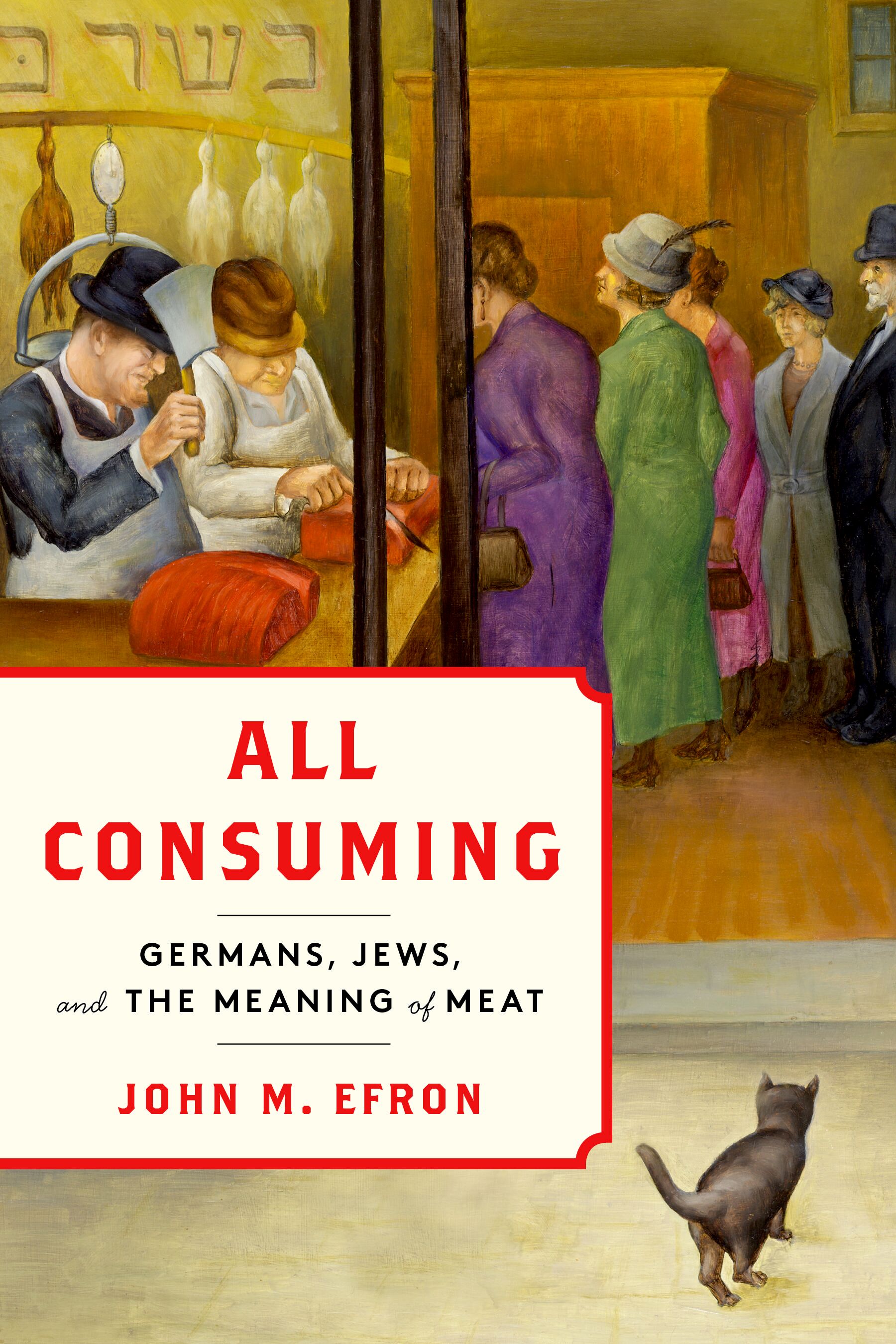
All Consuming
An engaging 700-year history of meat at the intersection of German and Jewish culture, uniquely illuminating the rich, fraught, and tragic history of German Jewry. In Judaism, meat is of paramount importance as it constitutes the very focal point of the dietary laws. With an intricate set of codified regulations concerning forbidden and permissible meats, highly prescribed methods of killing, and elaborate rules governing consumption, meat is one of the most visible, and gustatory, markers of Jewish distinctness and social separation. It is an object of tangible, touchable, and tastable difference like no other. In All Consuming, historian John M. Efron focuses on the contested culture of meat and its role in the formation of ethnic identities in Germany. To an extent not seen elsewhere in Europe, Germans have identified, thought about, studied, decried, and gladly eaten meat understood to be \"Jewish.\" Expressions of this engagement are found across the cultural landscape—in literature, sculpture, and visual arts—and are evident in legal codes and commercial enterprises. Likewise, Jews in Germany have vigorously defended their meats and the culture and rituals surrounding them by educating Germans and Jews alike about their meaning and relevance. Exploring a cultural history that extends some seven hundred years, from the Middle Ages to today, Efron goes beyond a discussion of dietary laws and ritual slaughter to take a broad view of what meat can tell us about German-Jewish identity and culinary culture, Jewish and Christian religious sensibilities, and religious freedom for minorities in Germany. In so doing, he provides a singular window into the rich, fraught, and ultimately tragic history of German Jewry.
eBook

Reinforcement Framework : Strengthening Implementation Intentions to Support Habit Formation
Mobile apps targeting the formation of new habits are gaining popularity in the market. Although the majority of these apps support repetition of behaviours using reminders, it could lead to a dependency and hinder the development of habits. On the other hand, simple techniques such as implementation intentions remain underused despite having promising results to support habit formation. This thesis proposes a mechanism to form new habits by using reinforced implementation intentions. Even though it has been suggested that implementation intentions could help to form new habits, they are prone to forgetfulness. We used mood tracking as the intended habit in this study, considering the benefits of regularly tracking mood for mental-health. We proposed a framework for reinforcements targeting the underlying processes of implementation intentions, mainly strengthening the link between a cue and its associated response. We investigated the framework's application in Mood Journal app through a series of empirical studies using different reinforcement strategies: passive, active, and context-aware. We measured the impact of reinforcements on two important aspects of habits: compliance and automaticity. Our findings suggest that adding reinforcements could maintain the compliance level, but it is not necessarily the same in terms of automaticity. We also discuss how the potential use of reinforcements can be improved in the future.
Dissertation