
Catalogue Search | MBRL


Are you sure you want to remove the book from the shelf?

{{itemTitle}}
13,366
result(s) for
"health care provider"
Sort by:
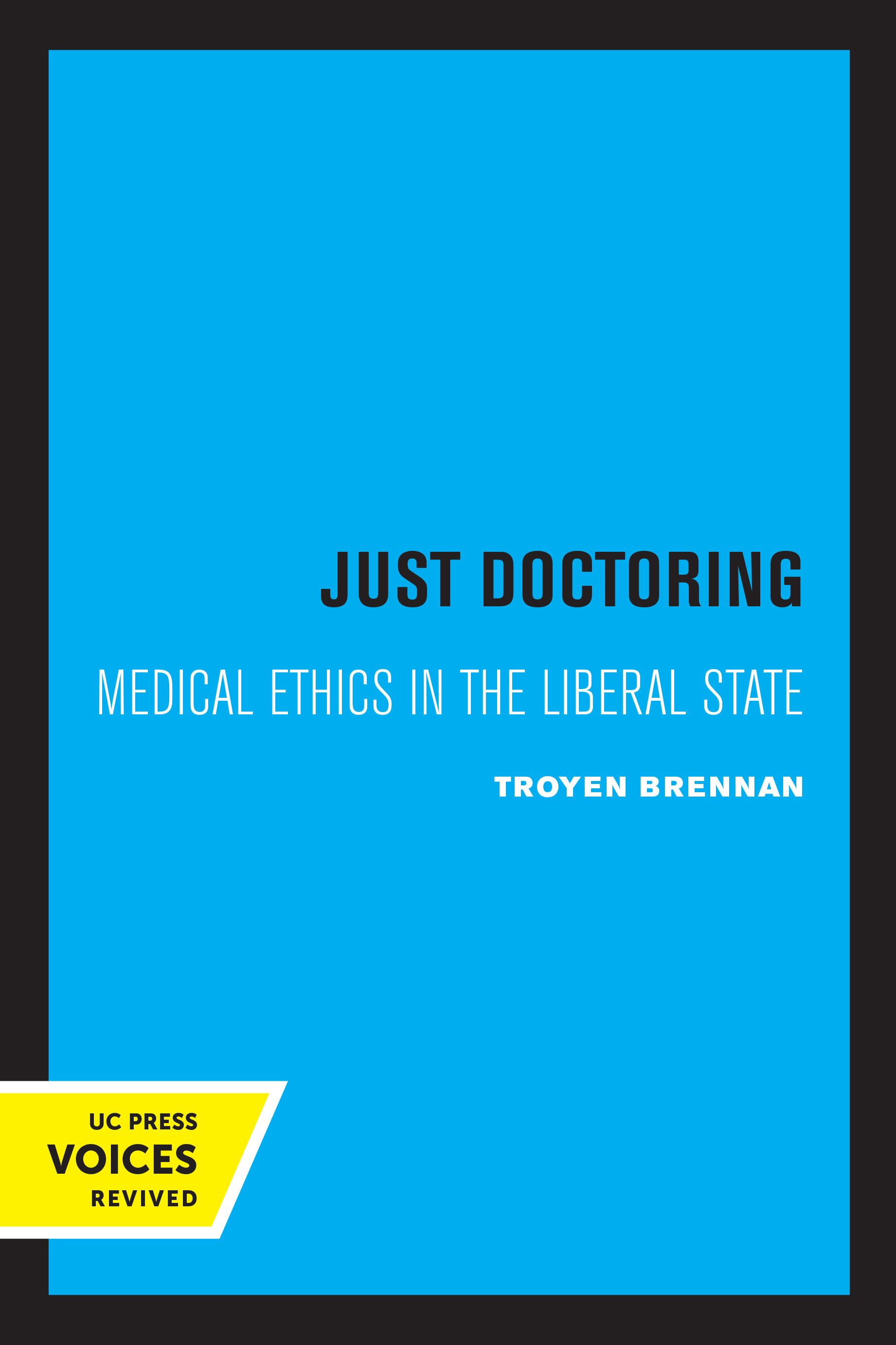
Just Doctoring
Just Doctoring draws the doctor-patient relationship out of the consulting room and into the middle of the legal and political arenas where it more and more frequently appears. Traditionally, medical ethics has focused on the isolated relationship of physician to patient in a setting that has left the physician virtually untouched by market constraints or government regulation. Arguing that changes in health care institutions and legal attention to patient rights have made conventional approaches obsolete, Troyen Brennan points the way to a new, more aware and engaged medical ethics. The medical profession is no longer isolated, even theoretically, from the liberal, market-dominated state. Old ideas of physician beneficence and altruism must make way for a justice-based medical ethics, assuming a relationship between equals more compatible with liberal political philosophy. Brennan offers clinical examples of many of today's most challenging medical problems--from informed consent to care rationing and the repercussions of the HIV epidemic--and gives his recommendation for a new ethical perspective. This lively and controversial plea for a rethinking of medical ethics goes right to the heart of medical care at the end of the twentieth century. This title is part of UC Press's Voices Revived program, which commemorates University of California Press's mission to seek out and cultivate the brightest minds and give them voice, reach, and impact. Drawing on a backlist dating to 1893, Voices Revived makes high-quality, peer-reviewed scholarship accessible once again using print-on-demand technology. This title was originally published in 1991. Many titles in the Voices Revived program are also newly available as ebooks, offered at a discounted price to support wider access to scholarly work.
eBook

Respecting patients’ rights in hospitals: patients’ and health-care workers’ perspectives
Considering the importance of respecting and observing patients’ rights, this study aimed to assess the level of observance of hospitalized patients’ rights from both patients’ and health-care workers' (HCWs) perspectives. This cross-sectional descriptive-analytic study reports the responses of 486 patients and 887 HCWs in a public referral university hospital. The study illustrates that patients and HCWs think patients’ rights are respected at a medium level; however, HCWs reported lower levels of respect for patients’ rights than patients, and senior HCWs reported even lower levels than their younger colleagues. Older patients and those hospitalized in internal medicine wards reported lower respect for autonomy and responsiveness, and patients’ companions reported lower levels of respect for patients’ rights than the patients themselves.
Journal Article

Black Mental Health
Novel in its approach and unique in its scope, Black Mental Health: Patients, Providers, and Systems examines the role of African Americans within American psychiatric health care from distinct but interconnected perspectives. The experiences of both black patients and the black mental health professionals who serve them are analyzed against the backdrop of the cultural, societal, and professional forces that have shaped their place in this specialized health care arena. The volume opens with the singular, first-person accounts of five senior black psychiatrists -- including Dr. Altha J. Stewart, president of the American Psychiatric Association -- who describe their individual journeys to the top of their field, not shying away from discussing the racism and discrimination that have challenged their paths to leadership. The book's second part focuses on the complexities of and opportunities for delivering mental health care to various subsets of the African American population, including children, women, elderly patients, and LGBTQ individuals. System design strategies, biological therapies, and church-based mental health promotion initiatives are all considered as methods for reducing racial and ethnic disparities in access to effective treatment. Part III examines the training of black mental health professionals and their representation in psychiatry, particularly in the face of discrimination and implicit bias. A chapter on historically black colleges and universities discusses the importance of their role in the delivery of psychiatric services and research development for African Americans. The fourth part builds on this discussion, addressing research that is relevant to the care of the black population. A concluding chapter highlights the key themes that emerged from each of the previous four parts, providing a holistic view of the place of black patients and providers in American psychiatry. With its blend of scholarship, clinical insight, and training analysis, Black Mental Health is compulsory reading both for trainees -- as care delivery to minority groups is of ever greater importance -- and practicing clinicians, who will glean useful information from the chapters on research advances and treatment modalities. Additionally, policy makers, educators, and historians, among others, will gain a better understanding of the challenges and necessity of developing integrated approaches to the care of nondominant groups.
eBook

Cultural Competence and Cultural Intelligence of Healthcare Professionals Providing Emergency Medical Services
Background: There are more and more foreigners in Poland who become clients of the Polish healthcare system. They use, among others, emergency medical services provided by healthcare professionals: doctors, nurses, and paramedics. Skillful care for culturally different patients requires cultural competencies and cultural intelligence to ensure good quality of care and cultural safety. The study aimed to measure and assess the cultural competencies and cultural intelligence of medical professionals working in hospital emergency departments (HEDs) and hospital emergency rooms (HERs) in Małopolska, a region in southern Poland. Methods: The following questionnaires were used in the study: the Cross-Cultural Competence Inventory (CCCI), the Cultural Intelligence Scale (CQS), and Questionnaire on Attitudes Towards Culturally Divergent People. In total, 709 medical professionals participated in the study, including 363 nurses, 223 paramedics, and 123 doctors. Results: Cultural intelligence—the overall score and the scores on the metacognitive, cognitive, motivational, and behavioral subscales were significantly higher among HED and HER doctors. Cultural competencies—the overall score and the score on the cultural adaptation subscale were also significantly higher among HED and HER doctors. The CCCI and CQS scores were influenced by selected variables: taking care of and close interactions with representatives of other cultural circles; staying outside Poland for more than a month. Doctors were the group of medical professionals that were most tolerant and most positive towards people from other cultures. Conclusions: The research results confirm the positive impact of contact of medical professionals with people from other cultures on their cultural competencies and cultural intelligence. They indicate the need for training in acquiring cultural competencies and developing cultural intelligence, especially among nurses. They demonstrate the need to raise awareness among HED and HER medical professionals about issues in intercultural care and to increase diversity efforts, especially among nurses.
Journal Article

Women doctors in war
In their efforts to utilize their medical skills and training in the service of their country, women physicians fought not one but two male-dominated professional hierarchies: the medical and the military establishments. In the process, they also contended with powerful social pressures and constraints. Throughout Women Doctors in War, the authors focus on the medical careers, aspirations, and struggles of individual women, using personal stories to illustrate the unique professional and personal challenges female military physicians have faced. Military and medical historians and scholars in women’s studies will discover a wealth of new information in Women Doctors in War.
eBook

A Caring Approach in Nursing Administration
Current mainstream books and publicity about management and administration in health care are concerned with the takeover of health care by managed-care organizations. Many provide lots of quick and externally focused answers. Many of them are economically driven, to the exclusion of humans, values, ethics, and the human spirit of all those who pass through systems as deliverers and receivers of care. On the other hand, there is a new generation of works that address new forms of administration and leadership-works that inspire and evoke foundational changes in health care and forms of organizational leadership and management. This work by Dr. Jan Nyberg is guided by a lifelong career of administration and management that is informed by deeper human dimensions of caring, and more lasting approaches to change than quick-fix, economic takeovers.
Jan Nyberg,an experienced nursing administrator, scholar, and educator, knows another way-from the inside out rather than the outside in. She brings forth her wisdom and knowledge, experiences, and insights so that others may now grasp another way to transform systems for delivery of human caring and healing. This work informs, instructs, and inspires; it invites nurse leaders and other health administrators to reach for what might be, rather than succumbing to what already is.
eBook

Diversity in career preferences of future health workers in Rwanda : where, why, and for how much?
The Government of Rwanda has identified human resources for health as one of its Policy priorities. This study aims to contribute to building a better understanding of health worker choice and behavior, and to improve evidence based policies. The work was undertaken by The Ministry of Health in a collaborative effort with the World Bank, building on the results of qualitative pre research, and is the first wave of a cohort survey with medical and nursing students. In comparison with other African countries, migration of health workers abroad may be less of a problem for Rwanda. The study finds that 80 percent of nursing and medical students report to have no intention to migrate abroad in the coming five years. Using a contingent valuation method to measure the reservation wage to migrate, we find that at the current public sector starting salary more than half the students will choose a job in Kigali instead of going abroad. But there is considerable heterogeneity in the willingness to work abroad. For example, students who are married or engaged are less likely to move abroad. Younger medical students require a higher average salary to stay in Rwanda compared to older students. Although Rwanda has a relatively low HIV prevalence compared to other African countries, there are problems with attitudes to HIV/AIDS, although the attitudes differ greatly between students, with medical students consistently more positive than nurses. Medical students score higher than nurses on medical knowledge related to HIV/AIDS, have higher levels of self reported knowledge on AIDS, and are also more familiar with HIV. Health students are generally averse to taking up work in high HIV prevalence areas but preferences vary widely, as is reflected in the wide span of reservation wages to accept a job in a high HIV prevalence area. Students are less willing to work in high HIV prevalence areas than to take up rural service.
eBook


Mentoring health science professionals
This volume goes beyond examining traditional mentoring agendas by comprehensively addressing contemporary issues relating to mentoring. This unique reference covers ethical and legal matters, issues pertaining to diversity, aligning learning and teaching styles between mentee and mentor, and cross-cultural mentoring. Chapters provide an integration of current mentoring literature across diverse settings, and conclude with detailed case studies of successful mentoring relationships. The book considers the theoretical underpinnings of mentoring and covers the mentoring relationship with faculty, students, and professionals in the early stages of growth. It also contains insight on how to develop and evaluate a mentoring program. Mentoring Health Science Professionals ultimately provides an invaluable blueprint for successful mentoring that considers the process, content, goals, and outcomes of modern-day mentoring in the health sciences.
eBook

Healthcare providers’ readiness for electronic health record adoption: a cross-sectional study during pre-implementation phase
Background
The adoption of an electronic health record (EHR) in the healthcare system has the potential to make healthcare service delivery effective and efficient by providing accurate, up-to-date, and complete information. Despite its great importance, the adoptions of EHR in low-income country settings, like Ethiopia, were lagging and increasingly failed. Assessing the readiness of stakeholders before the actual adoption of EHR is considered the prominent solution to tackle the problem. However, little is known about healthcare providers’ EHR readiness in this study setting. Accordingly, this research was conducted aiming at examining healthcare providers’ readiness for EHR adoption and associated factors in southwestern Ethiopia.
Methods
An institutional-based cross-sectional study was conducted from September 1 to October 30, 2021. A total of 423 healthcare providers working in public hospitals were selected using a simple random sampling technique. Multivariable logistic regression was fitted to identify determinant factors of overall healthcare providers’ readiness after the other covariates were controlled.
Result
In this study, the overall good readiness level of EHR adoption was 52.8% (
n
= 204) [95% CI of 47.9% to 56.6%]. Age, computer literacy, computer access at health facilities, attitude towards EHRs, awareness about EHRs, perceived benefit, and perceived technology self-efficacy were significantly associated with the overall health care providers’ readiness for the adoption of EHR using a cut point of
P
-value less than 0.05.
Conclusion
Around half of the respondents had a good level of overall healthcare providers’ readiness for the adoption of EHR which was considered inadequate. This finding implied that a huge effort is required to improve readiness before the actual implementation of EHRs. The finding implied that younger-aged groups were more ready for such technology which in turn implied; the older one needs more concern. Enhancing computer literacy, confidence building to raise self-efficacy of such technology, addressing the issue of computer availability at health facilities, building a positive attitude, awareness campaign of EHR, and recognizing the usefulness of such systems were the necessary measures to improve EHR readiness in this setting.
Additionally, further studies are recommended to encompass all types of EHR readiness such as organizational readiness, technology readiness, societal readiness, and so on. Additionally, exploring the healthcare provider opinion with qualitative study and extending the proposed study to other implementation settings are recommended to be addressed by future works.
Journal Article