
Catalogue Search | MBRL


Are you sure you want to remove the book from the shelf?

{{itemTitle}}
1,556
result(s) for
"hieroglyphics"
Sort by:

Hieroglyphs
Children can create hieroglyphic messages and \"works of art\" while learning about the pictograms of Ancient Egypt.
Book


Egyptian hieroglyphs for complete beginners
Teaches how to translate Egyptian hieroglyphs into English using a step-by-step procedure that includes the use of photographs and line drawings.
Book

Indigenous Graphic Communication Systems
Indigenous Graphic Communication Systems challenges the adequacy of Western academic views on what writing is and explores how they can be expanded by analyzing the sophisticated graphic communication systems found in Central Mesoamerica and Andean South America. By examining case studies from across the Americas, the authors pursue an enhanced understanding of Native American graphic communication systems and how the study of graphic expression can provide insight into ancient cultures and societies, expressed in indigenous words. Focusing on examples from Central Mexico and the Andes, the authors explore the overlap among writing, graphic expression, and orality in indigenous societies, inviting reevaluation of the Western notion that writing exists only to record language (the spoken chain of speech) as well as accepted beliefs of Western alphabetized societies about the accuracy, durability, and unambiguous nature of their own alphabetized texts. The volume also addresses the rapidly growing field of semasiography and relocates it more productively as one of several underlying operating principles in graphic communication systems. Indigenous Graphic Communication Systems reports new results and insights into the meaning of the rich and varied content of indigenous American graphic expression and culture as well as into the societies and cultures that produce them. It will be of great interest to Mesoamericanists, students, and scholars of anthropology, archaeology, art history, ancient writing systems, and comparative world history. The research for and publication of this book have been supported in part by the National Science Centre of Poland (decision no. NCN-KR-0011/122/13) and the Houston Museum of Natural Science. Contributors: Angélica Baena Ramírez, Christiane Clados, Danièle Dehouve, Stanisław Iwaniszewski, Michel R. Oudijk, Katarzyna Szoblik, Loïc Vauzelle, Gordon Whittaker, Janusz Z. Wołoszyn, David Charles Wright-Carr
eBook

Rocket Robinson. 1, Rocket Robinson and the pharaoh's fortune
Upon finding a note written in hieroglyphics, Rocket Robinson and his pet monkey team up with gypsy girl Nuri in 1933 Cairo to unscramble the code and locate an ancient pharaoh's fortune before thief Otto von Stürm can find it.
Book

An account of the kings of Kanu'l as recorded on the hieroglyphic stair of K'an II of Caracol
Many questions remain about the hieroglyphic stair dedicated in a.d. 642 by K'an II, the great king of Caracol. Constituent panels have been found at Caracol, Ucanal, Naranjo, and Xunantunich—archaeological sites spread between Guatemala and Belize. The most recently discovered Panels 3 and 4 at Xunantunich shed light on the tumultuous decades of the seventh century. Panel 4, which opened the hieroglyphic stair, makes a surprising statement from the outset, clarifying that Kanu'l political authority was irrevocably established at Calakmul. This bold statement serves as a synoptic précis for the entire narrative and explains why the deeds of K'an II are related, but only to the extent that these could be interwoven with the history of the Kanu'l. This makes the hieroglyphic stair such an important source, because it tracks the rulers of the Kanu'l dynasty from the vantage of a close ally. These monuments attest to the fissioning of the Kanu'l dynasty and its eventual restoration at Calakmul, from whence Classic Maya politics would be overseen for the remainder of the seventh century. In this article, we build on earlier studies and add our most recent observations and new readings based on renewed inspections of the existing panels.
Journal Article

Death and the Classic Maya Kings
Like their regal counterparts in societies around the globe, ancient Maya rulers departed this world with elaborate burial ceremonies and lavish grave goods, which often included ceramics, red pigments, earflares, stingray spines, jades, pearls, obsidian blades, and mosaics. Archaeological investigation of these burials, as well as the decipherment of inscriptions that record Maya rulers' funerary rites, have opened a fascinating window on how the ancient Maya envisaged the ruler's passage from the world of the living to the realm of the ancestors.
Focusing on the Classic Period (AD 250-900), James Fitzsimmons examines and compares textual and archaeological evidence for rites of death and burial in the Maya lowlands, from which he creates models of royal Maya funerary behavior. Exploring ancient Maya attitudes toward death expressed at well-known sites such as Tikal, Guatemala, and Copan, Honduras, as well as less-explored archaeological locations, Fitzsimmons reconstructs royal mortuary rites and expands our understanding of key Maya concepts including the afterlife and ancestor veneration.
eBook

The Humanist Interpretation of Hieroglyphs in the Allegorical Studies of the Renaissance
The Hieroglyphenkunde by Karl Giehlow published in 1915, described variously by critics as \"a masterpiece\", \"magnificent\", \"monumental\" and \"incomparable\", is here translated into English for the first time. Giehlow's work with an initial focus on the Hieroglyphica of Horapollo, the manuscript of which was discovered by Giehlow, was a pioneering attempt to introduce the thesis that Egyptian hieroglyphics had a fundamental influence on the Italian literature of allegory and symbolism and beyond that on the evolution of all Renaissance art. The present edition includes the illustrations of Albrecht Dürer from the Pirckheimer translation of the Horapollo from the early fifteenth century.
eBook
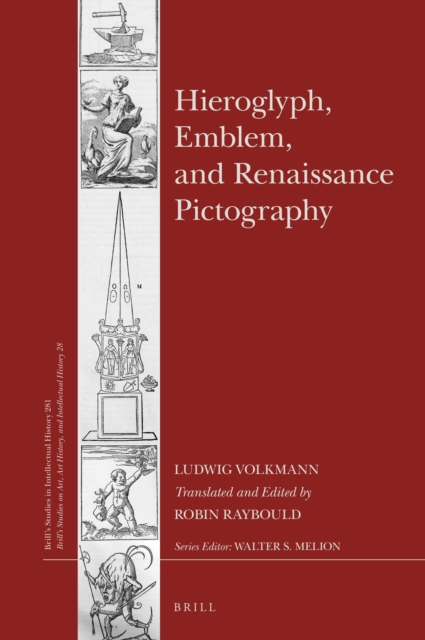
Hieroglyph, Emblem, and Renaissance Pictography
The first English translation of Volkmann's Bilderschriften der Renaissance, the pioneering review of the influence of the hieroglyph on Renaissance culture, focused on the literature of emblem and device in Germany and France.
eBook
Evidence for lexical and phonetic determinatives in Mayan writing: The case of T713
This article utilizes the Maya Hieroglyphic Database (Looper and Macri 1991–2022) to study the spellings of three glyphic values based on T713 (Thompson 1962), namely, the logogram K′AB′ ‘hand, arm’ (n = 88), the logogram K′AL ‘to close, wrap, adorn’ (n = 484), and the syllabogram mi (n = 68), cataloged as MZ1, MR1, and MR2, respectively, by Looper et al. (2022). The main goal is to study the functions of certain graphemes typically placed atop T713 (T713's “holding site”) when it has the value K′AL, and to determine to what extent such signs can be described as lexical determinatives. The article concludes that MZ1 K′AB′ constitutes the unmarked value of T713, while MZ1 K′AL requires contextual or graphemic disambiguation, the latter facilitated by means of phonetic complements (e.g., k′a or la) or lexical determinatives (e.g., T617/1M3). Syntagmatic contextual associations resulting from frequent proximity to other signs was a common factor in the establishment of certain signs as lexical determinatives. The question of MR2 mi, which can be analyzed as either a digraph or a case of a “phonetic determinative” (distinct from “phonetic complement”) in the holding site of T713, is left open to future research.
Journal Article