
Catalogue Search | MBRL


Are you sure you want to remove the book from the shelf?

{{itemTitle}}
20,873
result(s) for
"highland"
Sort by:

Educated for freedom : the incredible story of two fugitive schoolboys who grew up to change a nation
\"Educated for Freedom\" explores the story of two fugitive schoolboys who grew up to change a nation\"-- Provided by publisher.
Book

Debating the highland clearances
Storm clouds always gather over the story of the Highland Clearances. The eviction of the Highlanders from the glens and straths of the Highlands and Islands of the north of Scotland still causes great historical dispute more than a century after the events. The Highland Clearances also generated a great deal of contemporary controversy and documentation. The record comes in diverse forms and with radically different provenances, offering excellent material for exercises in historical analysis and selection. Debating the Highland Clearances introduces the Highland Clearances as a classic historical problem. Eric Richards reviews the historical debate and examines the methods and sources employed by the combatants past and present. The debates among historians, novelists, politicians and economists are no less passionate today and raise major questions about interpretation and the appropriate frame of reference for the noisy and continuing public debate about the Highland Clearances.This book presents a representative anthology of documents illustrating the historical foundations on which the debate is built. The debate is set in context and the author explains why it is not only important for Scottish patriots but for history in general.Key Features:• Organised into two parts; the first considers debates surrounding the Clearances, the second examines a selection of the sources which inform these debates• Presents and analyses an anthology of source material compiled to introduce the debates surrounding the Highland Clearances to audiences learning about historical analysis• Asks why passionate debate about the Clearances has been sustained and provides a modern introduction to its main issues
eBook
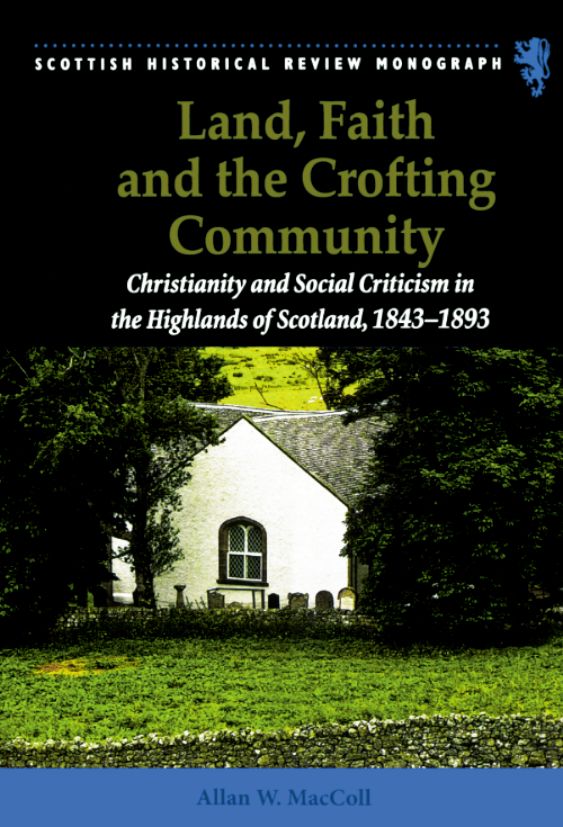
Land, Faith and the Crofting Community
Probes the deep-rooted links between the land, the people and the religious culture of the Scottish Highlands and Islands in the nineteenth century.
eBook

No stone unturned : a history of farming, landscape and environment in the Scottish Highlands and Islands
A survey of how Highland society organised its farming communities, exploited its resource base and interacted with its environment from prehistory to 1914.
eBook

Out of Place
The Kakoli of the Western Highlands of Papua New Guinea (PNG), the focus of this study, did not traditionally have a concept of mental illness. They classified madness according to social behaviour, not mental pathology. Moreover, their conception of the person did not recognise the same physical and mental categories that inform Western medical science, and psychiatry in particular was not officially introduced to PNG until the late 1950s. Its practitioners claimed that it could adequately accommodate the cultural variation among Melanesian societies. This book compares the intent and practice of transcultural psychiatry with Kakoli interpretations of, and responses to, madness, showing the reasons for their occasional recourse to psychiatric services. Episodes involving madness, as defined by the Kakoli themselves, are described in order to offer a context for the historical lifeworld and praxis of the community and raise fundamental questions about whether a culturally sensitive psychiatry is possible in the Melanesian context.
eBook

The Highlands
Think of the Highlands as the \"backyard\" and \"backstop\" of the Philadelphia-New York-Hartford metroplex. A backyard that spans over three million acres across Pennsylvania, New York, and Connecticut, the Highlands serves as recreational open space for the metroplex's burgeoning human population. As backstop, Highlands' watersheds provide a ready source of high-quality drinking water for over fifteen million people.
The Highlandsis the first book to examine the natural and cultural landscape of this four-state region, showing how it's distinctive and why its conservation is vital. Each chapter is written by a different leading researcher and specialist in that field, and introduces readers to another aspect of the Highlands: its geological foundations, its aquifers and watersheds, its forest ecology, its past iron industry.
In the 1800s, the Highlands were mined, cutover, and then largely abandoned. Given time, the forests regenerated, the land healed, and the waters cleared. Increasingly, however, the Highlands are under assault again-polluted runoff contaminating lakes and streams, invasive species choking out the local flora and fauna, exurban sprawl blighting the rural landscape, and climate change threatening the integrity of its ecosystems.
The Highlandsmakes a compelling case for land use planning and resource management strategies that could help ensure a sustainable future for the region, strategies that could in turn be applied to other landscapes threatened by urbanization across the country. The Highlands are a valuable resource. And now, so isThe Highlands.
eBook

Culture Change and Ex-Change
How is cultural change perceived and performed by members of the Bena Bena language group, who live in the Eastern Highlands of Papua New Guinea? In her analysis, Knapp draws upon existing bodies of work on 'culture change', 'exchange' and 'person' in Melanesia but brings them together in a new way by conjoining traditional models with theoretical approaches of the new Melanesian ethnography and with collaborative, reflexive and reverse anthropology.
eBook

Role of Highland–Lowland Linkage as a Coping Strategy for Global Environmental and Socioeconomic Changes: The Case of Southeast Ethiopia
This study in Bale administrative zone, Oromia National Regional State, Ethiopia, aimed to investigate the vulnerability of livelihoods of highlanders and lowlanders to global environmental and socioeconomic changes and how highland–lowland linkage could function as a coping strategy. Multistage cluster sampling techniques were employed to select 403 sample respondents from the 2 agroecological regions. The primary data were collected using questionnaires, interviews, and focus group discussions. The data were analyzed by employing descriptive statistics and multiple linear regressions. The results indicated that both the highlanders and lowlanders were vulnerable to stresses, seasonality, and shocks due to natural hazards. The highlanders were vulnerable to crop failure and occasional floods, while the lowlanders were more vulnerable to drought, livestock disease, and conflict. However, they had devised various coping strategies, such as diversifying income sources and increasing mobility. Some of the coping strategies that were adopted necessitated a mutual understanding between the highlanders and lowlanders. Hence, strengthening complementarities between them by broadening their resource base could contribute to building resilient livelihoods for both communities, particularly the highly vulnerable lowlanders.
Journal Article

An adaptive teosinte mexicana introgression modulates phosphatidylcholine levels and is associated with maize flowering time
Native Americans domesticated maize (Zea mays ssp. mays) from lowland teosinte parviglumis (Zea mays ssp. parviglumis) in the warm Mexican southwest and brought it to the highlands of Mexico and South America where it was exposed to lower temperatures that imposed strong selection on flowering time. Phospholipids are important metabolites in plant responses to low-temperature and phosphorus availability and have been suggested to influence flowering time. Here, we combined linkage mapping with genome scans to identify High PhosphatidylCholine 1 (HPC1), a gene that encodes a phospholipase A1 enzyme, as a major driver of phospholipid variation in highland maize. Common garden experiments demonstrated strong genotype-by-environment interactions associated with variation at HPC1, with the highland HPC1 allele leading to higher fitness in highlands, possibly by hastening flowering. The highland maize HPC1 variant resulted in impaired function of the encoded protein due to a polymorphism in a highly conserved sequence. A meta-analysis across HPC1 orthologs indicated a strong association between the identity of the amino acid at this position and optimal growth in prokaryotes. Mutagenesis of HPC1 via genome editing validated its role in regulating phospholipid metabolism. Finally, we showed that the highland HPC1 allele entered cultivated maize by introgression from the wild highland teosinte Zea mays ssp. mexicana and has been maintained in maize breeding lines from the Northern United States, Canada, and Europe. Thus, HPC1 introgressed from teosinte mexicana underlies a large metabolic QTL that modulates phosphatidylcholine levels and has an adaptive effect at least in part via induction of early flowering time.
Journal Article
