
Catalogue Search | MBRL


Are you sure you want to remove the book from the shelf?

{{itemTitle}}
1,477
result(s) for
"historiae"
Sort by:

Justin and Pompeius Trogus
Around 200AD, Marcus Junianus Justinus produced an abridged or 'epitomized' version of the Philippic Histories of the Augustan historian Pompeius Trogus. In doing so, he omitted all he did not find either intrinsically interesting or of use for historical examples. Over the centuries that followed, the abridgement eclipsed the original work in popularity, to the extent that Trogus' original work vanished and only Justin's version survived.
In this investigation of the language of theEpitome, the first in almost a century, J.C. Yardley examines the work to establish how much of the text belongs to Trogus, and how much to Justin. His study compares words and expressions used in theEpitomewith the usage of other Roman authors, and establishes areas where diction is similar to Augustan-era Latin and less in use in Justin's time. Yardley's extensive analysis reveals that there is more of Justin in the work than is often supposed, which may have implications for the historical credibility of the document. Yardley also demonstrates how much Trogus was influenced by his contemporary Livy as well as other Roman authors such as Sallust and Caesar, and how theEpitomereveals the influence of Roman poetry, especially the work of Virgil.
eBook

Cultural politics in Polybius's Histories
Polybius was a Greek statesman and political prisoner of Rome in the second century B.C.E. His Histories provide the earliest continuous narrative of the rise of the Roman Empire. In this original study informed by recent work in cultural studies and on ethnicity, Craige Champion demonstrates that Polybius's work performs a literary and political balancing act of heretofore unappreciated subtlety and interest.
eBook

Creation of the Journal “Studia Historiae Oeconomicae”
Creation of the Journal “Studia Historiae Oeconomicae”
Journal Article

The Proper Office for St Pancras (Pancratius) in the Cluniac Breviary-Missal of Lewes, Cambridge, Fitzwilliam Museum, Ms. 369
A plainchant office (historia) for St Pancras was composed for the Cluniac monastery dedicated to the saint at Lewes, Sussex, England. The style of its Latin texts and melodies suggests a date close to the foundation of the monastery in 1077.
Journal Article

The History of Make-Believe
A theoretically sophisticated and illuminating reading of Tacitus, especially theHistories, this work points to a new understanding of the logic of Roman rule during the early Empire. Tacitus, in Holly Haynes' analysis, does not write about the reality of imperial politics and culture but about the imaginary picture that imperial society makes of these concrete conditions of existence-the \"making up and believing\" that figure in both the subjective shaping of reality and the objective interpretation of it. Haynes traces Tacitus's development of thisfingere/crederedynamic both backward and forward from the crucial year A.D. 69. Using recent theories of ideology, especially within the Marxist and psychoanalytic traditions, she exposes the psychic logic lurking behind the actions and inaction of the protagonists of theHistories. Her work demonstrates how Tacitus offers penetrating insights into the conditions of historical knowledge and into the psychic logic of power and its vicissitudes, from Augustus through the Flavians. By clarifying an explicit acknowledgment of the difficult relationship betweenresandverba,in theHistories,Haynes shows how Tacitus calls into question the possibility of objective knowing-how he may in fact be the first to allow readers to separate the objectively knowable from the objectively unknowable. Thus, Tacitus appears here as going further toward identifying the object of historical inquiry-and hence toward an \"objective\" rendering of history-than most historians before or since.
eBook

Ewolucyjna transformacja czasopisma. Część 8
Naszkicowano ósmy etap rozwijania czasopisma Studia Historiae Scientiarum(wcześniejsza nazwa Prace Komisji Historii Nauki PAU).Podano m.in. informacje o ewaluacji czasopisma w „ICI Master Journal List 2019” (koniec 2020 r.), przez MEiN (9 lutego / 18 lutego 2021 r.), w Scopus (6 kwietnia 2021 r.) oraz w SCImago Journal Rankings 2020 (17 maja 2021 r.; dane dotyczące czasopisma są niezgodne ze stanem faktycznym:pominięto większość cytowalnych tekstów tomu z 2020 r., które są indeksowane w Scopus) oraz liczbie zagranicznych autorów i recenzentów bieżącego tomu czasopisma.Od tomu 21(2022) czasopismo Studia Historiae Scientiarumwdroży dodatkowe rozwiązania organizacyjne: licencję CC BY dla tekstów artykułów (zachowując możliwość innych licencji dla ilustracji), usługę CrossMark oraz opcję wydawniczą, tzw. „Artykuły FirstView”.---Article available under CC BY license.License text: https://creativecommons.org/licenses/by/4.0/legalcode
Journal Article
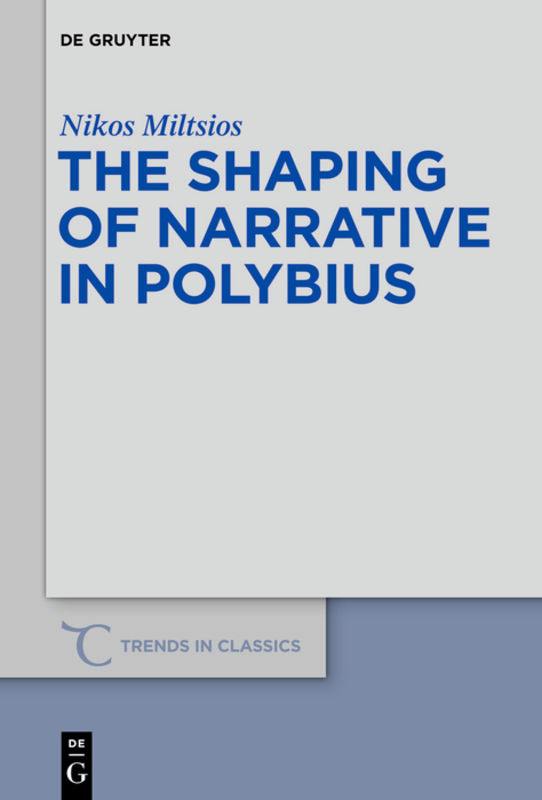
The Shaping of Narrative in Polybius
The narrative artistry of Polybius has received relatively little scholarly attention. Critics have tended to discuss his reflections on the various issues presented in his work or to use him as a source of valuable information about the historical period that he records. This volume, which draws on narratology's analytical tools, focuses instead on the narrative of the Histories, exploring the sophisticated narrative techniques that have gone into shaping it. In doing so, it pays particular attention to the ways the formal aspects of the text contribute to promoting Polybius' thematic concerns. Its aim is not only to present the Histories as the work of an author who has taken pains to provide us with a carefully structured story, but also to illustrate how interpretations of this story can be enriched by a sensitivity to factors such as chronological displacements and variations of focalization.
eBook

The Escalating Repetitiveness of Civil War: Lucanian Allusions in Tacitus' Account of the Conflict between Otho and Vitellius in Historiae 1–2
This paper shows that Tacitus patterns his account of the civil war between Otho and Vitellius in Historiae 1–2 on Lucan's account of the conflict between Pompey and Caesar in the Bellum Civile. The characters involved, the setting of the decisive clash, and the sequence of events of the two conflicts are analogous. By emulating Lucan, Tacitus suggests that the civil war that he is recounting is the worst of all times, for both sides implicated in the conflict are potentially harmful for Rome.
Journal Article
The Evolutionary Transformation of the Journal. Part 10
Naszkicowano dziesiąty etap rozwijania czasopisma Studia Historiae Scientiarum (wcześniejsza nazwa Prace Komisji Historii Nauki PAU).Podano m.in. informacje o ewaluacji czasopisma w „ICI Master Journal List 2021” (koniec 2022 r.), CWTS Journal Indicators 2022 (5 czerwca 2023), w SCImago Journal Rankings 2022 (oparty o dane z bazy Scopus z kwietnia 2023) oraz w Scopus 2022 (aktualizacja 5 czerwca 2023 r.), a także liczbie zagranicznych autorów i recenzentów bieżącego tomu czasopisma.
Journal Article
