
Catalogue Search | MBRL


Are you sure you want to remove the book from the shelf?

{{itemTitle}}
261,250
result(s) for
"history of war"
Sort by:

Declaring war in early modern Europe
\"A noteworthy development is recent history has been the disappearance of formal declarations of war. Many Americans argue that the result of this development has been to abrogate the US Constitution, which delegates the authority to declare war to the Congress. The goal of this book is to examine the history of declaring war in the early modern era up to the time when the Constitution was written in order to understand what the framers of the Constitution had in mind when gave the power to declare war to Congress. In the late middle ages, formal declarations of war were highly ritualistic acts, but by the early seventeenth century, they had changed into a practice whereby an ambassador presented a printed declaration to an enemy king. Key issues include determining how and when the medieval practices of declaring war gave way to the more modern ones, and the extent to which American framers accepted or rejected the practice of their era. While the debate over recent congressional resolutions authorizing use of the armed forces overseas has generated many publications, the wider history of declaring war has been far less a topic of study, and the early modern era has been all but ignored. This book's primary sources include ambassadorial reports, especially those from Venetian ambassadors, declarations of war, published works by noted contemporary thinkers, and several early modern literary works that depict the high drama of declaring war\"-- Provided by publisher.
Book

Shaky Foundations
Numerous popular and scholarly accounts have exposed the deep impact of patrons on the production of scientific knowledge and its applications.Shaky Foundationsprovides the first extensive examination of a new patronage system for the social sciences that emerged in the early Cold War years and took more definite shape during the 1950s and early 1960s, a period of enormous expansion in American social science.
By focusing on the military, the Ford Foundation, and the National Science Foundation, Mark Solovey shows how this patronage system presented social scientists and other interested parties, including natural scientists and politicians, with new opportunities to work out the scientific identity, social implications, and public policy uses of academic social research. Solovey also examines significant criticisms of the new patronage system, which contributed to widespread efforts to rethink and reshape the politics-patronage-social science nexus starting in the mid-1960s.
Based on extensive archival research,Shaky Foundationsaddresses fundamental questions about the intellectual foundations of the social sciences, their relationships with the natural sciences and the humanities, and the political and ideological import of academic social inquiry.
eBook


Children born of war in the twentieth century
This book explores the life courses of children born of war in different twentieth-century conflicts, including the Second World War, the Vietnam War, the Bosnian War, the Rwandan Genocide and the LRA conflict. It investigates both governmental and military policies vis-à-vis children born of war and their mothers, as well as family and local community attitudes, building a complex picture of the multi-layered challenges faced by many children born of war within their post-conflict receptor communities. Based on extensive archival research, the book also uses oral history and participatory research methods which allow the author to add the voices of the children born of war to historical analysis.
eBook

The War of 1812 : the fight for American trade rights
This book examines the War of 1812, the conflict itself and the controversies surrounding it.
Book
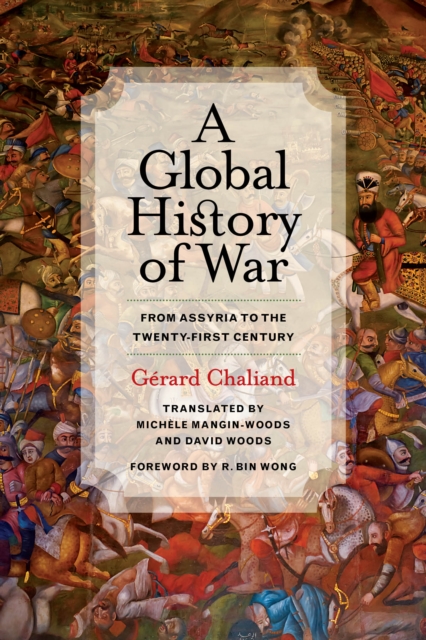
A global history of war
While many books examine specific wars, few study the history of war worldwide and from an evolutionary perspective. A Global History of War is one of the first works to focus not on the impact of war on civilizations, but rather on how civilizations impact the art and execution of war. World-renowned scholar Gérard Chaliand concentrates on the peoples and cultures who have determined how war is conducted and reveals the lasting historical consequences of combat, offering a unique picture of the major geopolitical and civilizational clashes that have rocked our common history and made us who we are today. Chaliand's questions provoke a new understanding of the development of armed conflict. How did the foremost non-European empires rise and fall? What critical role did the nomads of the Eurasian steppes and their descendants play? Chaliand illuminates the military cultures and martial traditions of the great Eurasian empires, including Turkey, China, Iran, and Mongolia. Based on fifteen years of research, this book provides a novel military and strategic perspective on the crises and conflicts that have shaped the current world order.
eBook

The War of 1812
Examines the events and people who were involved in the War of 1812 between the United States and what would later become Canada. Unusual for a war, the conflict ended with friendly relations established and no major loss of territory for either country. However, an examination of primary and secondary source materials reveals the War of 1812 is remembered differently in each country, as well as by the Indigenous peoples whose territory and dreams of an independent nation east of the Mississippi River vanished.
BOOK

War, Culture and Society in Early Modern South Asia, 1740-1849
This book argues that the role of the British East India Company in transforming warfare in South Asia has been overestimated. Although it agrees with conventional wisdom that, before the British, the nature of Indian society made it difficult for central authorities to establish themselves fully and develop a monopoly over armed force, the book argues that changes to warfare in South Asia were more gradual, and the result of more complicated socio-economic forces than has been hitherto acknowledged.
The book covers the period from 1740, when the British first became a major power broker in south India, to 1849, when the British eliminated the last substantial indigenous kingdom in the sub-continent. Placing South Asian military history in a global, comparative context, it examines military innovations; armies and how they conducted themselves; navies and naval warfare; major Indian military powers - such as the Mysore and Khalsa kingdoms, the Maratha confederacy - and the British, explaining why they succeeded.
eBook


Ruin Nation
During the Civil War, cities, houses, forests, and soldiers' bodies were transformed into \"dead heaps of ruins,\" novel sights in the southern landscape. How did this happen, and why? And what did Americans-northern and southern, black and white, male and female-make of this proliferation of ruins? Ruin Nation is the first book to bring together environmental and cultural histories to consider the evocative power of ruination as an imagined state, an act of destruction, and a process of change. Megan Kate Nelson examines the narratives and images that Americans produced as they confronted the war's destructiveness. Architectural ruins-cities and houses-dominated the stories that soldiers and civilians told about the \"savage\" behavior of men and the invasions of domestic privacy. The ruins of living things-trees and bodies-also provoked discussion and debate. People who witnessed forests and men being blown apart were plagued by anxieties about the impact of wartime technologies on nature and on individual identities. The obliteration of cities, houses, trees, and men was a shared experience. Nelson shows that this is one of the ironies of the war's ruination-in a time of the most extreme national divisiveness people found common ground as they considered the war's costs. And yet, very few of these ruins still exist, suggesting that the destructive practices that dominated the experiences of Americans during the Civil War have been erased from our national consciousness.
eBook