
Catalogue Search | MBRL


Are you sure you want to remove the book from the shelf?

{{itemTitle}}
11,944
result(s) for
"immigration debate"
Sort by:

Stories from a migrant city
Taking a biographical approach, the book explores the causes and consequences of moving or staying put in the context of class inequality and racisms, and looks for commonalities between people often seen as irredeemably divided.
eBook

Mind-Mapping Migration
This article discusses the issue of migration from various vantage points: political, economic, linguistic, legal, philosophical, and ethical. It is shown that although migration touches upon many areas of human life, it is in reality a straightforward issue. It is basically about human beings in search for a more dignified life. The author critiques the operative dualisms that characterize the migration debate, in doing so undermining the dehumanizing thinking that gives birth to such rhetoric, and suggests an approach to the issue that fosters a transformation rooted in authentic human and spiritual development.
Journal Article

Vulnerability, precarity and the people in debates over immigration in local newspapers
Mexican immigrants to the United States increasingly migrate to relatively new places such as Washington state, which now places in the top eight destination states. States wield increasing power to manage migration and negotiate residency at local scales. Although studies focus on migration debates in national and alternative media, little analysis has been done on newspapers in rural communities where migrants work and settle. We examine local English- and Spanish-language newspapers in rural Washington state to demonstrate how English-language newspapers legitimated competing interests and discourses of vulnerability versus precarity, whereas Spanish-language newspapers constituted a collective for rights connected historically to other subaltern groups. We then evaluate the potential for disrupting dominant discourses by local newspapers.
Journal Article
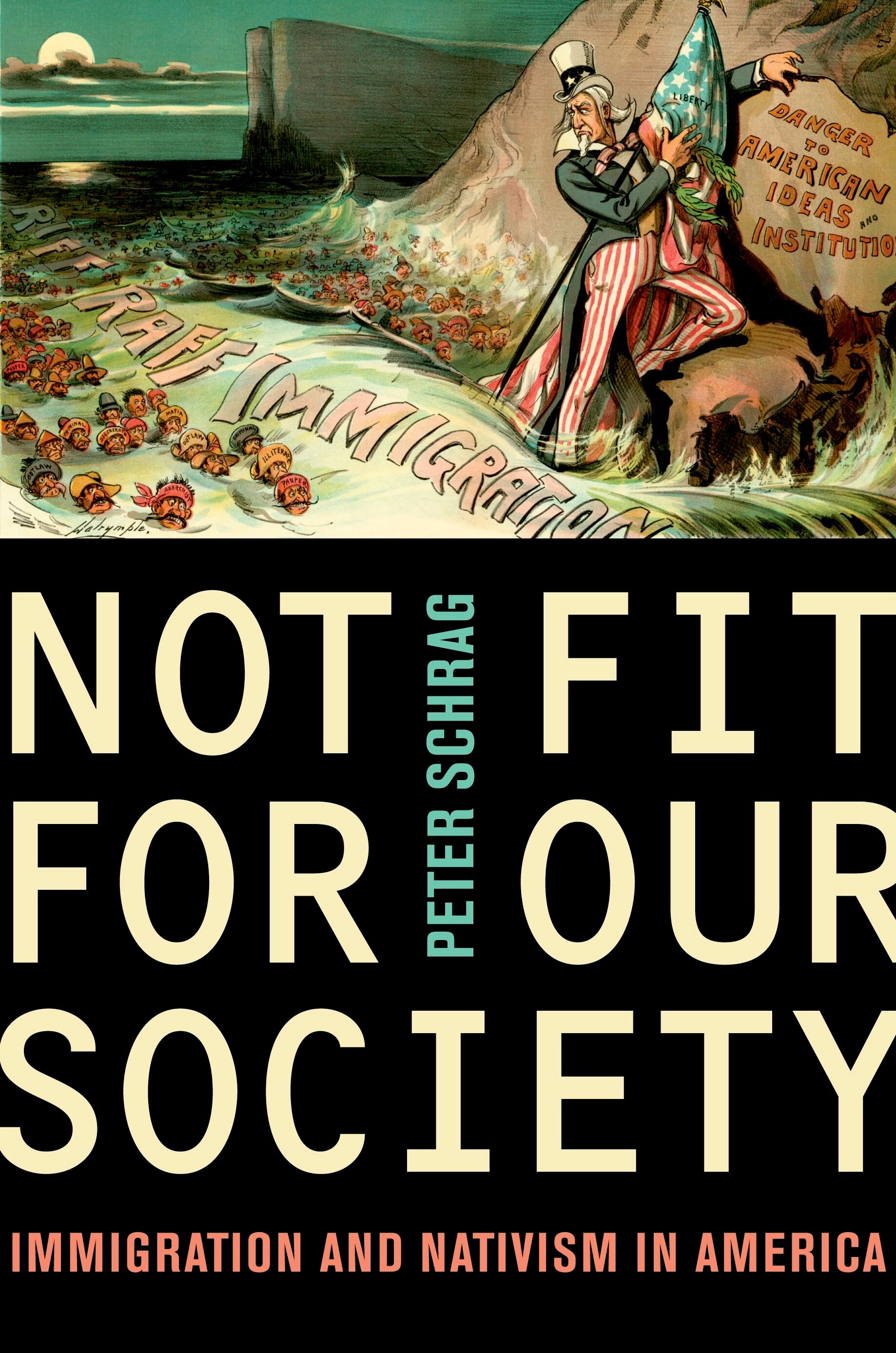
Not Fit for Our Society
In a book of deep and telling ironies, Peter Schrag provides essential background for understanding the fractious debate over immigration. Covering the earliest days of the Republic to current events, Schrag sets the modern immigration controversy within the context of three centuries of debate over the same questions about who exactly is fit for citizenship. He finds that nativism has long colored our national history, and that the fear-and loathing-of newcomers has provided one of the faultlines of American cultural and political life. Schrag describes the eerie similarities between the race-based arguments for restricting Irish, German, Slav, Italian, Jewish, and Chinese immigrants in the past and the arguments for restricting Latinos and others today. He links the terrible history of eugenic \"science\" to ideas, individuals, and groups now at the forefront of the fight against rational immigration policies.Not Fit for Our Societymakes a powerful case for understanding the complex, often paradoxical history of immigration restriction as we work through the issues that inform, and often distort, the debate over who can become a citizen, who decides, and on what basis.
eBook

Immigration Debate in Canada: How Newspapers Reported, 1996–2004
Media representations shape public opinion of immigration, affect policy debate, and influence immigration law. This paper examines media coverage of immigration in the context of the development and conception of the Canadian 2002
Immigration and Refugee Protection Act
. The paper performs a topoi analysis on a data set of 490 articles published in five prominent Canadian English-language daily newspapers that address aspects of immigration law. The results reveal that danger is the most frequent and a relatively consistent theme associated with immigration in media coverage. Cultural aspects are relatively unimportant compared to humanitarian, political, and economic considerations.
Journal Article

Tuberculosis and the Politics of Exclusion
Though notorious for its polluted air today, the city of Los Angeles once touted itself as a health resort. After the arrival of the transcontinental railroad in 1876, publicists launched a campaign to portray the city as the promised land, circulating countless stories of miraculous cures for the sick and debilitated. As more and more migrants poured in, however, a gap emerged between the city's glittering image and its dark reality.
Emily K. Abel shows how the association of the disease with \"tramps\" during the 1880s and 1890s and Dust Bowl refugees during the 1930s provoked exclusionary measures against both groups. In addition, public health officials sought not only to restrict the entry of Mexicans (the majority of immigrants) during the 1920s but also to expel them during the 1930s.
Abel's revealing account provides a critical lens through which to view both the contemporary debate about immigration and the U.S. response to the emergent global tuberculosis epidemic.
eBook

Bienvenidos a Hoosierlandia
This book explores the complex nature of representation and belonging in a midwestern landscape, the city of Lafayette in Indiana. It considers the border as a spatial metaphor that emerged during the 2006 immigration debate, along with the implications of this debate for Latino cultural citizenship. Focusing on the experiences of Latino Hoosiers, the book shows how Latino families, through their bordered negotiations, claimed their own social and physical space in Lafayette. It also examines how Latinos and non-Latinos interacted in Lafayette and sought ways to participate and belong as recognized members of local, regional, national, and transnational communities. Finally, it discusses the ways that Latino Hoosiers continue to alter the changing face of the Midwest through their lives and daily affirmations to ethnic belonging. The book argues that the resiliency of Latino residents amid inhospitable environments can inform other areas of the country that are facing their own politics of belonging.
Book Chapter

Slowing the Wave
The US faces two choices in its future immigration stance: acknowledge that the current scale of immigration conflicts with other national priorities or ignore the problem and run the risk of incurring a nativist reaction to immigration. Policy choices that need to be made are discussed.
Magazine Article
Myths about Immigrants
Immigration has emerged in 1994 as a pivotal issue that defines political conflict over the basic values of US society and evokes racial, cultural and economic anxieties. Misinformation and misperceptions in the field of immigration are addressed.
Magazine Article

Preservation and Education: Monticello and the Thomas Jefferson Foundation
This chapter contains sections titled:
References
Further Reading
Book Chapter