
Catalogue Search | MBRL


Are you sure you want to remove the book from the shelf?

{{itemTitle}}
51
result(s) for
"improving energy efficiency"
Sort by:

Energy Flow Modelling Method of Energy Efficiency Improvement for Power-Using Electromechanical Products
As a crucial factor in the improvement of energy efficiency for power-using electromechanical products, the flow, conversion and distribution of energy are closely related to design variables of products. Simultaneously, performance is the constraint of energy efficiency and is strongly affected by design variables. In order to improve a product’s energy efficiency without compromising performance, an energy flow model with a basic energy flow element (EFE) was built on a functional basis and its modelling procedure is presented in this paper. Containing function, design variable and characteristic energy in EFEs, as well as the interface parameters between EFEs and environment, the model contributes to logically clarifying the relationship between design variables and performance. With the refrigerator as an example, the effectiveness of the energy flow model is verified by a comparison between simulation, based on an energy flow model, and experimentation. Furthermore, five critical design variables of a 265 L refrigerator were screened with the model. Test results of the improved prototype meet the requirements of operating rate and temperature uniformity, and the daily electricity consumption was reduced by about 9%. Comparison between the design results of the energy flow model and the testing results of the prototype demonstrates that the energy efficiency improvement method based on energy flow model is effective.
Journal Article

Implementing energy subsidy reforms
Poorly implemented energy subsidies are economically costly to taxpayers and damage the environment. This report aims at providing the emerging lessons form a representative sample of case studies in 20 developing countries that could help policy makers to address implementation challenges, including overcoming political economy and affordability constraints. The sample has selected on the basis of a number of criteria, including the countrys level of development (and consumption), developing country region, energy security and the fuel it subsidies (petroleum fuel, electricity, natural gas). The case studies were supported by data collection related to direct budgetary subsidies, fuel and electricity tariffs, and household survey data.The analysis provides strong evidence of the success of reforms in reducing the associated fiscal burden. For the sample of countries, the average energy subsidy recorded in the budget was reduced from 1.8% in 2004 to 1.3%GDP in 2010. The reduction of subsidies is particularly remarkable for net energy importers. Pass-through of international fuel prices was also notable in the case of electricity generated by fossil fuel. For the sample of countries, the average end-user electricity tariff increased by 50%, from USD 6 cents in 2002 to USD 9 cents per kWh in 2010.In spite of the relatively price inelastic demand for gasoline and diesel, fossil fuel consumption in the road sector (per unit of GDP) declined in the 20 countries examined from 53 (44) in 2002 to about 23 kt oil equivalent per million of GDP in 2008 in the case of gasoline (Diesel). The most notable decline in consumption was recorded in the low and lower middle income countries. This reflects the much higher rate of growth in GDP in this group of countries and underlines the opportunities to influence future consumption behavior rather than modifying
the existing consumption patterns, overcoming inertia and vested interests. Similar trends are recorded for power consumption.While there is no one-size-fits-all model for subsidy reform, implementation of compensatory social policies and an effective communication strategy, before the changes are introduced, reduces helped with the implementation of reforms.
eBook
Experimental Investigation of Power Signatures for Cavitation and Water Hammer in an Industrial Parallel Pumping System
Among the total energy consumption by utilities, pumping systems contribute 30%. It is evident that a tremendous energy saving potential is achievable by improving the energy efficiency and reducing faults in the pumping system. Thus, optimal operation of centrifugal pumps throughout the operating region is desired for improved energy efficiency and extended lifetime of the pumping system. The major harmful operations in centrifugal pumps include cavitation and water hammering. The pump faults are simulated in a real-time experimental setup and the operating point of the pump is estimated correspondingly. In this article, the experimental power quality and vibration measurements of cascade pumps during cavitation and water hammering is recorded for different operating conditions. The results are compared with the normal operating conditions of the pumping system for fault prediction and parameter estimation in a cascade water pumping system. Moreover, the Fast Fourier Transform (FFT) analysis comparison of normal and water hammering (faulty condition) highlights the frequency response of the pumping system. Also, the various power quality issues, i.e., voltage, current, total harmonic distortion, power factor, and active, reactive, and apparent power for a cascade multipump control is discussed in this article. The vibration, FFT, and various power quality measurements serve as input data for the classification of faulty pump operating condition in contrast with the normal operation of pumping system.
Journal Article

Financing energy efficiency : lessons from Brazil, China, India, and beyond
While energy efficiency projects could partly meet new energy demand more cheaply than new supplies, weak economic institutions in developing and transitional economies impede developing and financing energy efficiency retrofits. This book analyzes these difficulties, suggests a 3-part model for projectizing and financing energy efficiency retrofits, and presents thirteen case studies to illustrate the issues and principles involved.
eBook

Public procurement of energy efficiency services : lessons from international experience
This book explores energy savings performance contracts (ESPCs) as a means of overcoming some of the more difficult hurdles in promoting energy efficiency in public facilities. ESPCs represent a very attractive solution to many of the problems that are unique to public agencies, since they involve outsourcing a full project cycle to a service provider. From the detailed audit through implementation and savings verification, ESPCs can relieve public agencies of bureaucratic hassles, while service providers can secure the off-budget project financing and be paid from the actual energy savings, thus internalizing project performance risks. ESPC bidding also allows public agencies to select from a range of technical solutions, maximizing the benefit to the agency. Global experience suggests that ESPCs have been more effective at realizing efficiency gains than many other policy measures and programs, since the service providers have a vested interest in ensuring that a project is actually implemented. Many of the country governments interviewed for the study also saw enormous potential in bundling, financing, and implementing energy efficiency projects on a larger scale in the public sector, a method that increases the rate of efficiency gains and creates further benefits through economies of scale.
eBook

An empirical study on energy efficiency improving capacity: the case of fifteen countries
The problem of energy shortage is exacerbated by energy waste and low efficiency. Energy efficiency has become a popular research topic, but little research has been performed on the dynamic work of improving energy efficiency. In this paper, energy efficiency improving capacity is first defined to reveal this dynamic work. An evaluation index system is built before a combined weight multilayer evaluation model is applied to calculate the energy efficiency improving capacities of 15 countries from 2001 to 2010. In addition, the evolution equation for energy efficiency improvement driving force is constructed to analyze the changing trend of energy efficiency improving capacity. Next, the stages of the 15 countries’ energy efficiency improving capacities are analyzed through the inflection points. Finally, related conclusions are considered according to the analysis results.
Journal Article
Lights out? The Outlook for Energy in Eastern Europe and Central Asia
Before the current economic crisis hit the Europe and Central Asia (ECA) region in 2008, energy security was a major source of concern in Central and Eastern Europe and in many of the economies in the former Soviet Union. Energy importers were experiencing shortages leading to periodic brownouts and blackouts. An energy crisis seemed imminent. This report analyzes the outlook for energy demand and supply in the region. It estimates the investment requirements and highlights the potential environmental concerns associated with meeting future energy needs, including those related to climate change. The report also proposes the actions necessary to create an attractive environment for investment in cleaner energy. Greater regional cooperation for smart energy and climate action is an important part of the World Bank's engagement in Europe and Central Asia.
eBook
Energy Efficiency
This study is designed to analyze the energy efficiency policies in seven countries that were successful in achieving low energy intensities or in reducing their energy intensity considerably. The study analyzes the evolution of the energy intensity of these countries from 1990 to 2007, identifying points of inflection in the progress towards improvements. Changes to the policy agenda immediately upstream are explored in an effort to identify cause and affect relationships in energy efficiency improvements. Although direct relationships are difficult to isolate, cross country analyses that point to similar successes among a variety of countries give some confidence that these policies have contributed to reducing energy needs. The energy efficiency of new buildings is relatively easily and in expensively addressed by setting standards: making a new building energy efficient typically adds only 5 percent to the total cost. The purpose of this study is to determine what policy changes make a difference in countries' energy in tensity. The starting point for the analysis was the evolution of countries' energy intensity over time to identify inflection points when notable changes took place. Given that the inflection point could have been caused by external price shocks or structural changes, these causes were analyzed and removed from further consideration. Then changes to the policy agenda during identified periods were explored in an effort to identify cause and affect relationships in energy efficiency improvements.
eBook
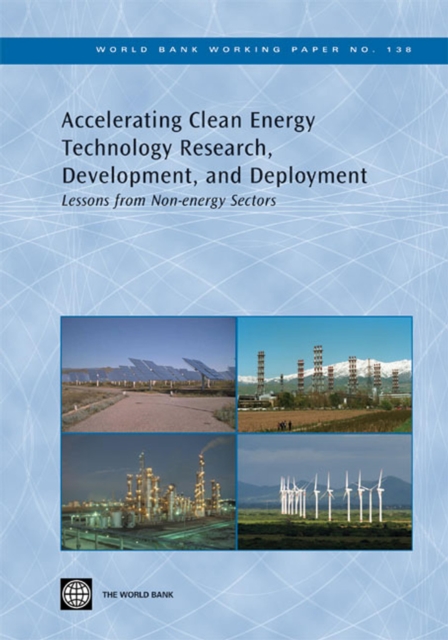
Accelerating clean energy technology research, development, and deployment
Climate change is one of the key challenges of this century. At the same time, energy use—the primary source of climate-altering global greenhouse gas emissions—is increasing at unprecedented rates and is vital to the continued economic growth of developing countries. This poses a serious dilemma that can only be reconciled with new and improved clean energy technologies that balance climate change mitigation and increased energy needs in developing countries. Despite a recent increase in investment, public and private research, development, and deployment (RD&D) funding rates are well below historical levels. In addition, significant barriers impede the ability to develop new technologies, such as the uncertain future value of CO2 emissions, intellectual property rights issues, limited incentives to commercialize technologies for developing countries, and challenges with technology transfer. These factors must be overcome to accelerate innovation in the energy sector. To introduce new thinking to address these concerns, this report examines four cases from outside the energy sector where creative approaches to RD&D have successfully overcome similar barriers. The case studies review approaches to innovation by the Consultative Group on International Agricultural Research, Advanced Market Commitments for Vaccines, the Human Genome Project, and the concept of Distributed Innovation. These case studies show how creative efforts can generate valuable public goods via: (i) international partnerships between public and private actors, (ii) information sharing and intellectual property rights, and (iii) novel financing schemes.
eBook
Balancing act
The cost of energy in Eastern Europe and Central Asia, as elsewhere, is an important policy issue, as shown by the concerns for energy affordability during the past harsh winter. Governments try to moderate the burden of energy expenditures that is experienced by households through subsidies to the energy providers, so that households pay tariffs below the cost recovery level for the energy they use. These subsidies result in significant pressures on government budgets when international prices rise. They also provide perverse incentives for the overconsumption of energy as households do not pay the true cost of energy, and therefore, have fewer incentives to save or to invest in energy efficiency. Balancing competing claims-fiscal and environmental concerns which would push for raising energy tariffs on the one hand, and affordability and political economy concerns which push for keeping tariffs artificially low on the other-is a task that policy makers in the region are increasingly unable to put off. Addressing this issue is all the more pressing as the ongoing crisis continues to add stress to government budgets, and that international energy prices remain high. While challenging, the reforms needed for this balancing act can build on much that has been learned in the last decade about improving the effectiveness of social assistance systems and increasing energy efficiency. This is the first report to assess, at the micro level for the whole region, the distributional impact of raising energy tariffs to cost recovery levels and to simulate policy options to cushion these impacts. In conclusion, this report highlights that countries face a difficult balancing act between fiscal and environmental concerns that call for raising energy tariffs to lower fiscal burdens and curb household consumption and concerns for the affordability of energy and the political economy of unpopular reforms.
eBook