
Catalogue Search | MBRL


Are you sure you want to remove the book from the shelf?

{{itemTitle}}
1,156
result(s) for
"indigenous ecological knowledge"
Sort by:

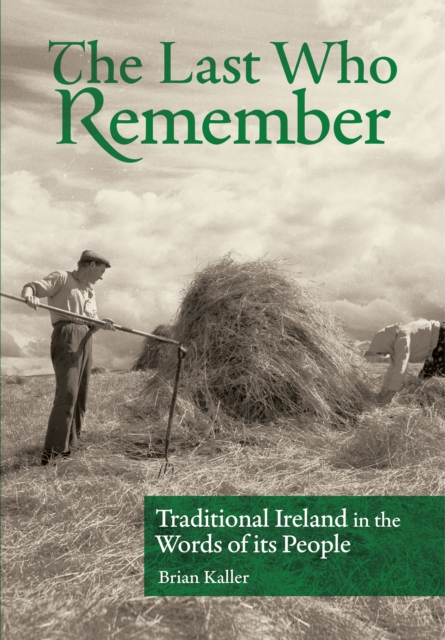
The Last Who Remember
We live in a modern world of social media, cars, electricity, supermarkets, television, fast food, and Hollywood pop culture, and few Westerners have known anything else. Ireland, however, modernized long after most Western countries; many rural areas lacked electricity or technology even in the 1970s. Within living memory villagers lived much as humans had for centuries, or as the Amish do today; they grew and raised their own food, built their own homes, traded with their neighbours, and spent their evenings making their own music and telling their own stories. When Brian Kaller moved to a homestead in rural Ireland, he found that some of his elderly neighbours grew up this way, the last who remember a traditional world. Over the next two decades Kaller interviewed his neighbours and assembled oral histories, archives, diaries and memoirs to create a portrait of their lives that can help illuminate traditional cultures everywhere. The Last Who Remember invites the reader on a tour of agrarian life, with each chapter, devoting chapters to childhood, schooling, working, socialising, courting, and dying. He looks at the safe, literate, high-trust society they created, and shows how their self-reliance and close communities sustained them in times of hardship. He compares it to todays unprecedented levels of unhappiness, mental illness and addiction while surrounded by material goods, and questions what we abandoned when we became modern.
eBook


Cultural Forests of the Amazon
Cultural Forests of the Amazon is a comprehensive and diverse account of how indigenous people transformed landscapes and managed resources in the most extensive region of tropical forests in the world. Until recently, most scholars and scientists, as well as the general public, thought indigenous people had a minimal impact on Amazon forests, once considered to be total wildernesses. William Balée’s research, conducted over a span of three decades, shows a more complicated truth. In Cultural Forests of the Amazon , he argues that indigenous people, past and present, have time and time again profoundly transformed nature into culture. Moreover, they have done so using their traditional knowledge and technology developed over thousands of years. Balée demonstrates the inestimable value of indigenous knowledge in providing guideposts for a potentially less destructive future for environments and biota in the Amazon. He shows that we can no longer think about species and landscape diversity in any tropical forest without taking into account the intricacies of human history and the impact of all forms of knowledge and technology. Balée describes the development of his historical ecology approach in Amazonia, along with important material on little-known forest dwellers and their habitats, current thinking in Amazonian historical ecology, and a narrative of his own dialogue with the Amazon and its people.
eBook

Genetic resources and traditional knowledge : case studies and conflicting interests
This study describes efforts to define and protect traditional knowledge and the associated issues of access to genetic resources, from the negotiation of the Convention on Biological Diveristy through to the Declaration of Rights of Indigenous Peoples and the Nagoya Protocol.
Book

Signifying Ainu Space: Reimagining Shiretoko’s Landscapes through Indigenous Ecotourism1
Recognized as Japan’s indigenous peoples in 2008, the Ainu people of Hokkaido have sought to recuperate land and self-determination by physically reenacting Ainu traditional knowledge through ecotourism in Hokkaido. Colonization and assimilation have severed most contemporary Ainu from relations with nonhuman sentient beings (A. kamuy) rooted in land and waterways. Ecotourism provides a context for reenacting an ancestral ontology through engaging in wild food gathering, relearning subsistence practices for cultural transmission, and reinscribing Ainu cultural logics onto the land through stewardship and language. At the same time, the Japanese government’s campaign to have Siretok nominated as a UNESCO World Heritage site can be interpreted as an attempt to legitimate Japanese claims to Shiretoko and reinscribe the authority of Japan, as both the proper steward to ensure responsible conservation of Shiretoko but also the rightful owner and proper occupant of the promontory and its surrounding waterways. The article reveals how Ainu attempts to establish relationships and assert ancestral claims with the kamuy in the landscape are stymied by the ongoing reality of settler colonialism and erasure of Ainu presence in the landscape. Further, it explores how a capitalist-driven economy of ecotourism unleashes new dynamics in relations between local Ainu fishers and farmers in Shiretoko and outsider Ainu who seek to develop ecotourist initiatives.
Journal Article

Science and sustainability : learning from indigenous wisdom
\"This book is about indigenous science: sustainable knowledge and practice of Indigenous peoples around the world which has usually been developed and handed down for generations, but which was often largely ignored by settlers in their lands. Such science has been passed on in performance, art, stories, and in embodied practice, so the book will necessarily examine the meaning of science, problematizing the idea that Western science is the only type that deserves that name, and drawing attention to some of its shortcomings. Methods of acquiring \"science\" are also examined, notably including a personal account of the author's dissatisfaction with her own undergraduate training, and a realization much later of the reasons for this disillusionment. Throughout the book, the author takes the reader with her on the learning process that brought its content to her attention, and therefore introduces the reasons for wanting to share the examples gathered\"-- Provided by publisher.
Book

Culturally significant fisheries
Indigenous peoples of North America, Australia, and New Zealand have a long tradition of harvesting freshwater animals. Over generations of reliance and subsistence harvesting, Indigenous peoples have acquired a profound understanding of these freshwater animals and ecosystems that have become embedded within their cultural identity. We have identified trans-Pacific parallels in the cultural significance of several freshwater animal groups, such as eels, other finfish, bivalves, and crayfish, to Indigenous peoples and their understanding and respect for the freshwater ecosystems on which their community survival depends. In recognizing such cultural connections, we found that non-Indigenous peoples can appreciate the deep significance of freshwater animals to Indigenous peoples and integrate Indigenous stewardship and Indigenous ecological knowledge into effective comanagement strategies for sustainable freshwater fisheries, such as Indigenous rangers, research partnerships, and Indigenous Protected Areas. Given that many of these culturally significant freshwater species also play key ecological roles in freshwater ecosystems, their recognition and prioritization in management and monitoring approaches should help sustain the health and well-being of both the social and ecological components of freshwater ecosystems.
Journal Article


Using Indigenous and Western knowledge systems for environmental risk assessment
Indigenous rights, knowledge, and value systems are linked inextricably to the lands, waters, and non-human beings that form the environments of Indigenous Peoples. Across the globe, the rights of Indigenous peoples are being formally recognized and as a result, efforts are being made to include Indigenous Knowledge and value systems in environmental policy and decision making. Scientists and decision makers must not only recognize this reality, but also operationalize these efforts through meaningful changes to create space for the inclusion of Indigenous Knowledge, Indigenous values, and sovereignty within the current methods for scientific enquiry and the development of environmental policies. Professionals in the environmental field have a responsibility to ensure that their work has a positive impact on Indigenous Peoples and their environments. In this study, we explore the concept of consultation and informed consent through the lens of the development of environmental policy and decision making. We will discuss these concepts in the context of ecological risk assessment related to a case study focused on contaminated sediment in a harbor within the Great Lakes. We will demonstrate a process that deconstructs the current protocols for risk assessments at sites with localized pollutants in sediment and rebuilds them with elements that recognize both Western and Indigenous knowledge systems. This process includes collaborative fieldwork, relationship building, and informal and formal interviews with participants and community members. By utilizing such approaches, we were able to develop a risk assessment framework that recognizes the sovereignty of Indigenous peoples and promotes effective Nation-to-Nation decision making.
Journal Article