
Catalogue Search | MBRL


Are you sure you want to remove the book from the shelf?

{{itemTitle}}
7,786
result(s) for
"islam ideology"
Sort by:

Without borders : the Haqqani Network and the road to Kabul
\"This is the untold story of the origins, political awakening, and rise of what the United States and its allies call the Haqqani Network, and what the Haqqani family calls the Haqqani Mujahideen. The author lived with the Haqqanis as a young reporter for the New York Times in the 1980s, in the mountains of eastern Afghanistan, when they were America's allies in the Afghan-Soviet war. After 9/11, the network became America's enemy. This book tells the exciting story of how the author began to try to find the Haqqanis again, and, later, his quest to understand their influence in the greater Middle East. This is the story of the rise of an ideology and movement born in the Mongol conquest of Baghdad in 1258, which resurfaced in Arabia and India in the 18th Century, lived on in the anti-Christian, anti-British, anti-European, and anti-Russian colonial movements of the 19th and 20th centuries, and in modern times evolved, with American help, into the Haqqani Mujahideen and their allies and followers around the world\"-- Provided by publisher.
Book

The History of the Civil War in Tajikistan
In Tajikistan, theSoviets used inherent Tajik ideological, regional, and ethnic conflicts to movetheir affairs forward. In 1992, after enduring Soviet imposition for seventyyears, the Tajiks reversed the process and toppled the Soviet power structurein Tajikistan. The volume traces the development of the conflict using primaryTajik sources.
eBook

When Victory Is Not an Option
Throughout the Arab world, Islamist political movements are joining the electoral process. This change alarms some observers and excites other. In recent years, electoral opportunities have opened, and Islamist movements have seized them. But those opportunities, while real, have also been sharply circumscribed. Elections may be freer, but they are not fair. The opposition can run but it generally cannot win. Semiauthoritarian conditions prevail in much of the Arab world, even in the wake of the Arab Spring. How do Islamist movements change when they plunge into freer but unfair elections? How do their organizations (such as the Muslim Brotherhood) and structures evolve? What happens to their core ideological principles? And how might their increased involvement affect the political system?
InWhen Victory Is Not an Option, Nathan J. Brown addresses these questions by focusing on Islamist movements in Egypt, Jordan, Kuwait, and Palestine. He shows that uncertain benefits lead to uncertain changes. Islamists do adapt their organizations and their ideologies do bend-some. But leaders almost always preserve a line of retreat in case the political opening fizzles or fails to deliver what they wish. The result is a cat-and-mouse game between dominant regimes and wily movements. There are possibilities for more significant changes, but to date they remain only possibilities.
eBook

Muslim Palestine
The ideology of Islamic fundamentalists is of central importance in the modern world, but it is often distorted or misunderstood by the international media. This insightful study provides a detailed analysis of the Palestinian Hamas movement's world-view, and shows how the theoretical framework developed by thinkers such as Hassan al-Banna, Sayyis Qutb and al-Mawdudi is applied to a specific political, social and economic context. Nusse explains the fundamentalist position on recent events, such as the Gulf War, the Madrid peace negotiations and the Hebron massacre, and helps to dissipate myths surrounding modern fundamentalist movements and their overwhelming success as opposition movements in the modern world.
eBook

Reformation of Islamic Thought
Ever since the dramatic events of September 11, 2001 the fundamentalist and exclusivist trend prevails in most presentations of Islamic thinking. Indeed, these events have given extremists and fundamentalists a much more prominent position than they might ever have dreamt of. In Reformation of Islamic Thought, the prominent Egyptian scholar Nasr Abû Zayd examines the positive, liberal, and inclusive reaction embedded in the writings of Muslim thinkers. He takes the reader on a critical journey across the Muslim World, where Muslim thinkers from Egypt and Iran to Indonesia seek to divest Islam of traditionalistic and legalistic interpretation. Instead, these thinkers stress the value of a cultural, enlightened Islam, and an individualistic faith. For many, the dogmatic Islam established by the conservatives and supported by totalitarian political regimes is outdated; they want it replaced by a spiritual and ethical Islam. To what extent are these reformist thinkers engaged in a genuine renewal of Islamic thought? Do they succeed in escaping the traditionalist trap of presenting a purely negative image of the West? This title is available in the OAPEN Library - http://www.oapen.org.
eBook

Anti-modernism
The last volume of the Discourses of Collective Identity in Central and Southeast Europe 1770-1945 series presents 46 texts under the heading of antimodernism. In a dynamic relationship with modernism, from the 1880s to the 1940s, and especially during the interwar period, the antimodernist political discourse in the region offered complex ideological constructions of national identification. These texts rejected the linear vision of progress and instead offered alternative models of temporality, such as the cyclical one as well as various narratives of decline. This shift was closely connected to the rejection of liberal democratic institutionalism, and the preference for organicist models of social existence, emphasizing the role of the elites (and charismatic leaders) shaping the whole body politic. Along these lines, antimodernist authors also formulated alternative visions of symbolic geography: rejecting the symbolic hierarchies that focused on the normativity of Western European models, they stressed the cultural and political autarchy of their own national community, which in some cases was also coupled with the reevaluation of the Orient. At the same time, this antimodernist turn should not be confused with rightwing radicalism-in fact, the dialogue with the modernist tradition was often very subtle and the anthology also contains texts which offered a criticism of 'modern' totalitarianism in an antimodernist key.
eBook

The shifts in hizbullah's ideology
The Lebanese Shi'ite resistance movement, Hizbullah, is going through a remarkable political and ideological transformation. Hizbullah was founded in 1978 by various sectors of Lebanese Shi'ite clergy and cadres, and with Iranian backing as an Islamic movement protesting against social and political conditions. Over the years 1984/85 to 1991, Hizbullah became a full-fledged social movement in the sense of having a broad overall organization, structure, and ideology aiming at social change and social justice, as it claimed. Starting in 1992, it became a mainstream political party working within the narrow confines of its pragmatic political program. The line of argument in this dissertation is that Hizbullah has been adjusting its identity in the three previously mentioned stages by shifting emphasis among its three components: (1) from propagating an exclusivist religious ideology (2) to a more encompassing political ideology, and (3) to a down-to-earth political program.
De Libanese Shi'itische verzetsbeweging Hizbullah ondergaat een opzienbarende politieke en ideologische transformatie. Ten tijde van de stichting in 1978, door Libanese geestelijken en leiders en met Iranese steun, was Hizbullah vooral een islamitische beweging die zich verzette tegen sociale en politieke omstandigheden. Gaandeweg ontwikkelde de beweging zich tot een 'volwassen' sociale beweging, met een solide organisatie, structuur en ideologie, gericht op sociale verandering en rechtvaardigheid. Vanaf 1992 manifesteert Hizbullah zich als politieke partij. Deze publicatie schetst een veranderende identiteit door een verschuivende nadruk: van exclusivistische religieuze ideologie, via een ruimere politieke ideologie tot een pragmatisch politiek programma.
eBook
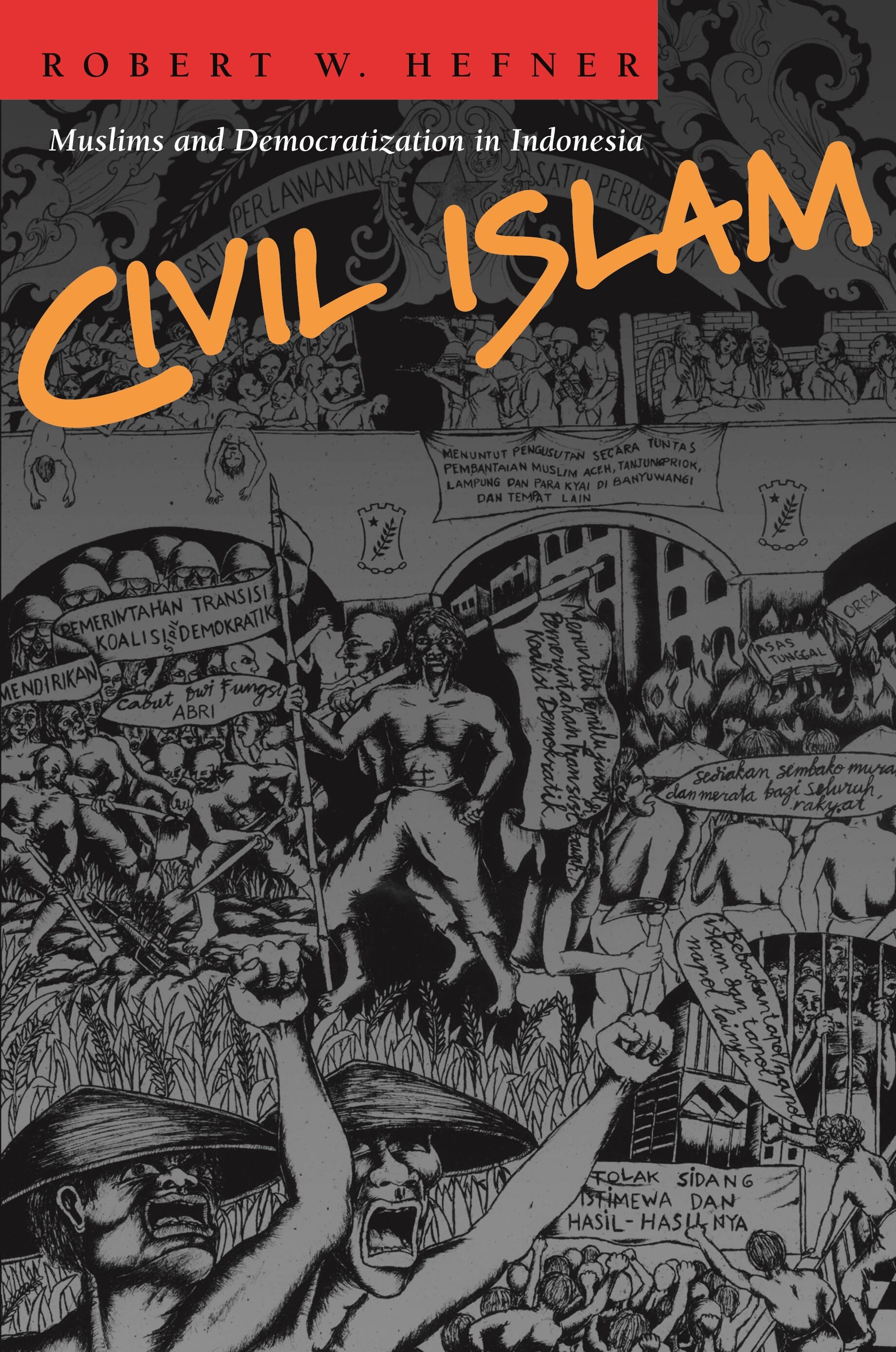
Civil Islam
Civil Islam tells the story of Islam and democratization in Indonesia, the world's largest Muslim nation. Challenging stereotypes of Islam as antagonistic to democracy, this study of courage and reformation in the face of state terror suggests possibilities for democracy in the Muslim world and beyond.
eBook

If Not Him, It Would Have Been His Brother
The Arab-Muslim countries have remained pre-modern as opposed to other countries that have been able to find a balance between their local culture and a universal culture. Arab-Muslims have remained tied to their cultural specificity, a fact which, in my opinion, is related to a complex based on the defensiveness of the former colonized. This complex drives them to remain closed to any cultural communication and therefore to any opening capable of allowing the emergence of a sensibility to their rights as human beings, or even the development of a will to bring about a democratic environment in their countries.
Journal Article

Politics, Law, and Community in Islamic Thought
This revisionist account of the history of Islamic political thought from the early to the late medieval period focuses on Ibn Taymiyya, one of the most brilliant theologians of his day. This original study demonstrates how his influence shed new light on the entire trajectory of Islamic political thought. Although he did not reject the Caliphate ideal, as is commonly believed, he nevertheless radically redefined it by turning it into a rational political institution intended to serve the community (umma). Through creative reinterpretation, he deployed the Qur'anic concept of fitra (divinely endowed human nature) to centre the community of believers and its common-sense reading of revelation as the highest epistemic authority. In this way, he subverted the elitism that had become ensconced in classical theological, legal and spiritual doctrines, and tried to revive the ethico-political, rather than strictly legal, dimension of Islam. In reassessing Ibn Taymiyya's work, this book marks a major departure from traditional interpretations of medieval Islamic thought.
eBook