
Catalogue Search | MBRL


Are you sure you want to remove the book from the shelf?

{{itemTitle}}
22,338
result(s) for
"kinship"
Sort by:


Through the Stomach to the Heart
The concept of families of choice was introduced almost three decades ago by Kath Weston (1997). She used it to describe the situation of the LGBTQ community in the era of the HIV/AIDS crisis, when the relations with families of origin had been heavily tested and proved to fail, whereas relations with friends were the primary source of care and support for the sick and dying, as well as their partners. Since then, contemporary non-heterosexual families are understood as their queer descendants and often the term “families of choice” is used synonymously. However, whereas much had been written about the ideologies of queer kinship, the sphere of the daily, ordinary, and often imperceptible practices of kinning, when nothing exceptional is happening (like a disease or family crisis) has still not been sufficiently examined. Therefore, it could be argued that the debate on queer kinship is rather conceptual and abstract with its focus on normativity/antinormativity (Wiegman and Wilson 2015), whereas the sphere of ordinariness and everydayness, where most of the queer kinning actually happens, is being neglected and marginalised in the discussion on queer kinship. In the paper, we explore this unmapped territory of queer kinship studies and specifically take a closer look at the material and everyday dimensions of kinship. To do so, we use the data gathered within the ethnographic research done within the Families of Choice in Poland-study (2013–2016, PI: Joanna Mizielińska). In this project, during thirty days of observation and several thematic interviews, done with twenty-one families, we were able to capture an in-depth picture of how the kinning practices are performed in daily life. In the paper we explore practices of silent intimacy (Jamieson 1998), focusing on food sharing practices among partners, but also between them and their families of origin that not always fully accept and support their relationship. In critical dialogue with Anglo- American scholarship on queer kinship, which built on and extends Weston’s classic work, we want to demonstrate that changing focus from its antinormative centrality towards embracing the ordinariness (Martin 1997) and everydayness of queer kinning, might not only contribute to developing the field, but also help us to understand the complexity of relational lives.
Journal Article

Finding the “Appropriate Distance” in Egg Donor Kinship Relations
This article explores kinship formation from the perspective of egg donors in Denmark. Through interviews with Danish egg donors, it investigates how the Danish legal framework and specific context, materialise egg donor kinship relations in third party reproduction. The article shows the ways egg donors negotiate normative ideals about family and motherhood through different kinship strategies. It argues that the donors’ relational kinship work is a form of social pioneering work, wherein donors help define what an egg donor kinship relation is and can be. This is analysed through the analytical concept of “appropriate distance.” The analysis shows how different normative constraints are embedded in the legal framework that structure which kinship relations are available. As an example, the different donor types in Denmark, anonymous, open, and known, become a way of disconnecting or connecting to kinship. In line with existing studies, it demonstrates how egg donation in Denmark is structured around ideals of altruism linked to normative ideals of femininity and motherhood. Further, it is concluded that egg donation proposes subversive potential for deconstructing heteronormative kinship ideals about motherhood. At the same time, however, the analyses conclude that heteronormative family ideals often are re-installed through egg donation practices.
Journal Article

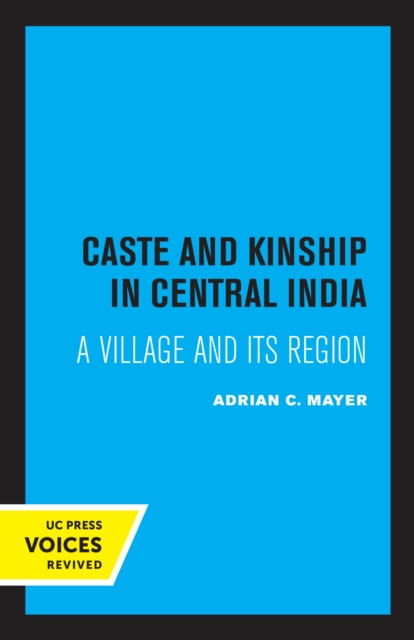
Caste and Kinship in Central India
This title is part of UC Press's Voices Revived program, which commemorates University of California Press's mission to seek out and cultivate the brightest minds and give them voice, reach, and impact. Drawing on a backlist dating to 1893, Voices Revived makes high-quality, peer-reviewed scholarship accessible once again using print-on-demand technology. This title was originally published in 1960.
eBook

The archaeology of kinship : advancing interpretation and contributions to theory
\"Bradley Ensor shows how kinship can be a valuable tool for archaeologists. The Archaeology of Kinship explains how kinship is relevant to contemporary archaeological theory, detailing methods appropriate for archaeological analysis, and provides long-overdue solutions to problems plaguing ethnological hypotheses on the origins and contexts of kinship behaviors\"--Provided by publisher.
Book

