
Catalogue Search | MBRL


Are you sure you want to remove the book from the shelf?

{{itemTitle}}
118
result(s) for
"latina interest"
Sort by:

Surviving HIV/AIDS in the Inner City
Surviving HIV/AIDS in the Inner Cityexplores the survival strategies of poor, HIV-positive Puerto Rican women by asking four key questions: Given their limited resources, how did they manage an illness as serious as HIV/AIDS? Did they look for alternatives to conventional medical treatment? Did the challenges they faced deprive them of self-determination, or could they help themselves and each other? What can we learn from these resourceful women?Based on her work with minority women living in Newark, New Jersey, Sabrina Marie Chase illuminates the hidden traps and land mines burdening our current health care system as a whole. For the women she studied, alliances with doctors, nurses, and social workers could literally mean the difference between life and death. By applying the theories of sociologist Pierre Bourdieu to the day-to-day experiences of HIV-positive Latinas, Chase explains why some struggled and even died while others flourished and thrived under difficult conditions. These gripping, true-life stories advocate for those living with chronic illness who depend on the health care \"safety net.\" Through her exploration of life and death among Newark's resourceful women, Chase provides the groundwork for inciting positive change in the U.S. health care system.
eBook

Emotion, restraint, and community in ancient Rome
Emotion, Restraint, and Community examines the ways in which emotions, and talk about emotions, interacted with the ethics of the Roman upper classes in the late Republic and early Empire. By considering how various Roman forms of fear, dismay, indignation, and revulsion created an economy of displeasure that shaped society in constructive ways, the book casts new light both on the Romans and on cross-cultural understanding of emotions.
eBook

On net interest margins in the Latin American banking sector: a comparative analysis between dollarized vs non-dollarized regimes
Purpose This paper aims to analyze bank concentration and its impact on net interest income in five Latin American countries, selecting a set of countries based on their distinctive monetary characteristics and cross-border economic relationships. Design/methodology/approach We run a panel data econometric model for commercial banks operating in both dollarized and non-dollarized countries over the period 2015 to 2019. Findings The banking industry conforms for the most part to an oligopolistic structure with the exception of Panama, which shows evidence of being a competitive market. In addition, bank concentration reduces, to some extent, the intermediation margin in Ecuador, El Salvador, Colombia and Peru. Our results indicate that the relationship between bank concentration and stability supports the concentration-stability hypothesis; higher concentration and well-capitalized banks increase financial stability and financial development. Originality/value This study makes a significant contribution to the current body of literature by analyzing financial intermediation margins in a group of dollarized and non-dollarized Latin American countries, focusing on the relationship between bank concentration and financial stability in the region.
Journal Article

The Wielding Influence of Political Networks: Representation in Majority-Latino Districts
Latino-majority congressional districts are far more likely to elect Latino representatives to Congress than majority-white districts. However, not all majority-Latino districts do so. This paper addresses this question, and it investigates how the level of influence of political parties and interest groups in majority-Latino districts substantially shapes Latino representation to the US House of Representatives. I rely on five case studies and a dataset of candidates to open congressional races with a Latino population plurality from 2004 to 2014. The evidence indicates that groups and political networks are critical for Latina/o candidate recruitment, the organization of resources in a congressional district, the deployment of campaign resources on behalf of certain candidates, and the eventual success of Latina/o candidates. The findings suggest that Latino descriptive and substantive representation are shaped by the wielding influence of political parties and interest groups.
Journal Article

El individuo como prisma de lo social
La sociología del individuo se ha propuesto analizar cómo se construye histórica y estructuralmente un cierto tipo de individuo en una sociedad dada. Y ya que la condición social moderna y contemporánea debe entenderse como una experiencia cada vez más singular, estructurada por una sociedad cuya ideología social es el individualismo, este libro espera abrir un espacio discusión y de comprensión a nuevas realidades colombianas y latinoamericanas, en las que se viven las experiencias sociales individuales y el individualismo de nuestros tiempos. Así, se presentan un conjunto de aproximaciones de distinta índole, a partir de las cuales se aborda de manera conjunta la problemática del individuo, tanto desde aspectos estructurales como desde aspectos subjetivos, que evidencian las maneras complejas que en diferentes momentos y contextos sociales se produce y autogestionan los individuos, denotando las peculiaridades, así como los contornos y configuraciones de las pruebas y soportes sociales que se han constituido en tales contextos.
eBook
Women's interest development and motivations to persist as college students in STEM: a mixed methods analysis of views and voices from a Hispanic-Serving Institution
Background The constructs of interest and motivation are often identified as factors that contribute to the persistence of undergraduate college women in physics, mathematics, engineering, engineering technology, and computer science. A review of the literature regarding interest development and motivation as related to women as science, technology, engineering and mathematics (STEM) learners in diverse communities is presented. The goal of this study was to gain a deeper understanding of the experiences women credited for influencing the development of their career interest goals and the sources of motivation they attribute to success in their academic course outcomes in their fields of study. Results A mixed methods research approach was used to collect student perceptions related to interest and motivation by collecting data through the use of questionnaires and conducting focus groups. Results indicated that students identify early participation in STEM activities and family socializing behavior as ones that contributed the most towards influencing their interest in STEM and motivated them to persist in their studies and pathways as future STEM professionals. Conclusions This study is unique in that the participant groups included a substantial representation of Latina and African American women's voices as relayed through the collected quantitative data as well as through the use of focus groups that encouraged women to freely identify experiences they felt contributed to their persistence success. These women identify interest development at various points in their lives as affected by family and school experiences, and family support was identified as having greater importance in their decision to persist.
Journal Article

CHINA PUSHED THE PINK TIDE AND THE PINK TIDE PULLED CHINA
This article examines the rise of leftist ideology in Ecuador and Bolivia in light of their deepening economic relations with China from 2005 to 2014. First, it reveals that market trends account for trade fluctuations but fail to explain Chinese investment in, and some loan deals with, Ecuador as well as loans to Bolivia. Second, it demonstrates how these forms of funding provided alternatives to U.S.-led international institutions, enabling Rafael Correa and Evo Morales to steer away from Western influence. Third, it contends that four factors led to a cyclic reinforcement of Chinese economic interests and the rise of leftist ideology in Ecuador and Bolivia, namely: mutual complementarity between China’s demand for energy/natural resource supply diversification and Pink Tide development agendas; U.S.–China geopolitical competition for influence in Latin America; China’s experience in engaging with leftist governments from developing countries; and anti-Americanism shaping national identity in Ecuador and Bolivia.
Este artículo examina el surgimiento de la ideología de izquierda en Ecuador y Bolivia a la luz de sus relaciones económicas cada vez más profundas con China de 2005 a 2014. Primero, revela que las tendencias del mercado explican las fluctuaciones comerciales pero no explican la inversión china en, y algunos acuerdos de préstamos con, Ecuador, así como préstamos a Bolivia. En segundo lugar, demuestra cómo estas formas de financiación proporcionaron alternativas a las instituciones internacionales lideradas por Estados Unidos, lo que permitió a Rafael Correa y Evo Morales alejarse de la influencia occidental. En tercer lugar, sostiene que cuatro factores llevaron a un refuerzo cíclico de los intereses económicos chinos y al surgimiento de la ideología de izquierda en Ecuador y Bolivia, a saber: complementariedad mutua entre la demanda de China de diversificación del suministro de energía/recursos naturales y las agendas de desarrollo de la Marea Rosa; Competencia geopolítica entre Estados Unidos y China por la influencia en América Latina; La experiencia de China en la interacción con gobiernos de izquierda de países en desarrollo; y el antiamericanismo que configura la identidad nacional en Ecuador y Bolivia.
鑑於厄瓜多爾和玻利維亞從2005年到2014年與中國的經濟關係不斷加深, 本文考察了左翼意識形態的興起。首先, 它揭示了市場趨勢是貿易波動的原因, 但不能解釋中國的投資, 有些貸款涉及, 厄瓜多爾以及對玻利維亞的貸款。其次, 它展示了這些形式的資金如何為美國主導的國際機構提供替代方案, 從而使拉斐爾•科雷亞(Rafael Correa)和埃沃•莫拉萊斯(Evo Morales)擺脫西方的影響。第三, 它認為有四個因素導致中國經濟利益的周期性增強和厄瓜多爾和玻利維亞的左翼意識形態的興起, 即:中國對能源/自然資源供應多樣化的需求與粉紅潮發展議程之間的相互補充; 中美地緣政治競爭對拉丁美洲的影響;中國與發展中國家左翼政府互動的經驗; 和反美主義塑造了厄瓜多爾和玻利維亞的民族認同。
Journal Article
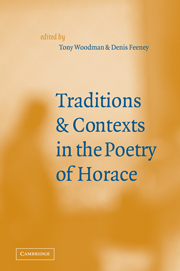
Traditions and Contexts in the Poetry of Horace
This book explores the whole range of the output of an exceptionally versatile and innovative poet, from the Epodes to the literary-critical Epistles. Distinguished scholars of diverse background and interests introduce readers to a variety of critical approaches to Horace and to Latin poetry. Close attention is paid throughout to the actual text of Horace, with many of the chapters focusing on reading a single poem. These close readings are then situated in a number of different political, philosophical and historical contexts. The book sheds light not only on Horace but on the general problems confronting Latinists in the study of Augustan poetry, and it will be of value to a wide range of upper-level Latin students and scholars.
eBook

Troubling Nationhood in U.S. Latina Literature
This book examines the ways in which recent U.S. Latina literature challenges popular definitions of nationhood and national identity. It explores a group of feminist texts that are representative of the U.S. Latina literary boom of the 1980s, 1990s, and 2000s, when an emerging group of writers gained prominence in mainstream and academic circles. Through close readings of select contemporary Mexican American, Puerto Rican, and Cuban American works, Maya Socolovsky argues that these narratives are \"remapping\" the United States so that it is fully integrated within a larger, hemispheric Americas.Looking at such concerns as nation, place, trauma, and storytelling, writers Denise Chavez, Sandra Cisneros, Esmeralda Santiago, Ana Castillo, Himilce Novas, and Judith Ortiz Cofer challenge popular views of Latino cultural \"unbelonging\" and make strong cases for the legitimate presence of Latinas/os within the United States. In this way, they also counter much of today's anti-immigration rhetoric.Imagining the U.S. as part of a broader \"Americas,\" these writings trouble imperialist notions of nationhood, in which political borders and a long history of intervention and colonization beyond those borders have come to shape and determine the dominant culture's writing and the defining of all Latinos as \"other\" to the nation.
eBook

Disenchanting Citizenship
Central to contemporary debates in the United States on migration and migrant policy is the idea of citizenship, and—as apparent in the continued debate over Arizona’s immigration law SB 1070—this issue remains a focal point of contention, with a key concern being whether there should be a path to citizenship for “undocumented” migrants. In Disenchanting Citizenship, Luis F. B. Plascencia examines two interrelated issues: U.S. citizenship and the Mexican migrants’ position in the United States. The book explores the meaning of U.S. citizenship through the experience of a unique group of Mexican migrants who were granted Temporary Status under the “legalization” provisions of the 1986 IRCA, attained Lawful Permanent Residency, and later became U.S. citizens. Plascencia integrates an extensive and multifaceted collection of interviews, ethnographic fieldwork, ethno-historical research, and public policy analysis in examining efforts that promote the acquisition of citizenship, the teaching of citizenship classes, and naturalization ceremonies. Ultimately, he unearths citizenship’s root as a Janus-faced construct that encompasses a simultaneous process of inclusion and exclusion. This notion of citizenship is mapped on to the migrant experience, arguing that the acquisition of citizenship can lead to disenchantment with the very status desired. In the end, Plascencia expands our understanding of the dynamics of U.S. citizenship as a form of membership and belonging.
eBook