
Catalogue Search | MBRL


Are you sure you want to remove the book from the shelf?

{{itemTitle}}
116
result(s) for
"legal materiality"
Sort by:

Diffuse subjects and dispersed power: New materialist insights and cautionary lessons for international law
This article sets out the major tenets of new materialism and maps out its implications for international law. It considers what new materialism might offer for those of us working within international law in the way of new insights, resources, practices or politics. It first sets the contours of new materialism within the broader material turn. It then elaborates three main tenets of new materialism’s methodology, theory, and ontology: its attention to matter in its physicality; the embedded and entangled subject; and the vitality or agency of objects. The article focuses on how new materialist work might help us to understand, first, subjectivity and second, power and accountability in international law. It concludes that new materialist approaches offer important and compelling insights, working against entrenched categories and structures that continue to perpetuate or excuse violence and harm in international law’s doctrines and practices. These insights provide resources for rethinking power and subjectivity, and the role these play in international law. However, those of us working to consider how we can respond to pressing crises of justice and coexistence within international law may find new materialism most powerful when brought into relation, and deep conversation, with more structural methodologies. Notably ‘older’ (Marxist or historical) materialisms grasp embedded power relations and deep-rooted systemic harms in more concrete ways. This is, the article concludes, a conversation that international law scholars are well placed to contribute to, deepening both ‘old’ and ‘new’ materialist insights for international law.
Journal Article
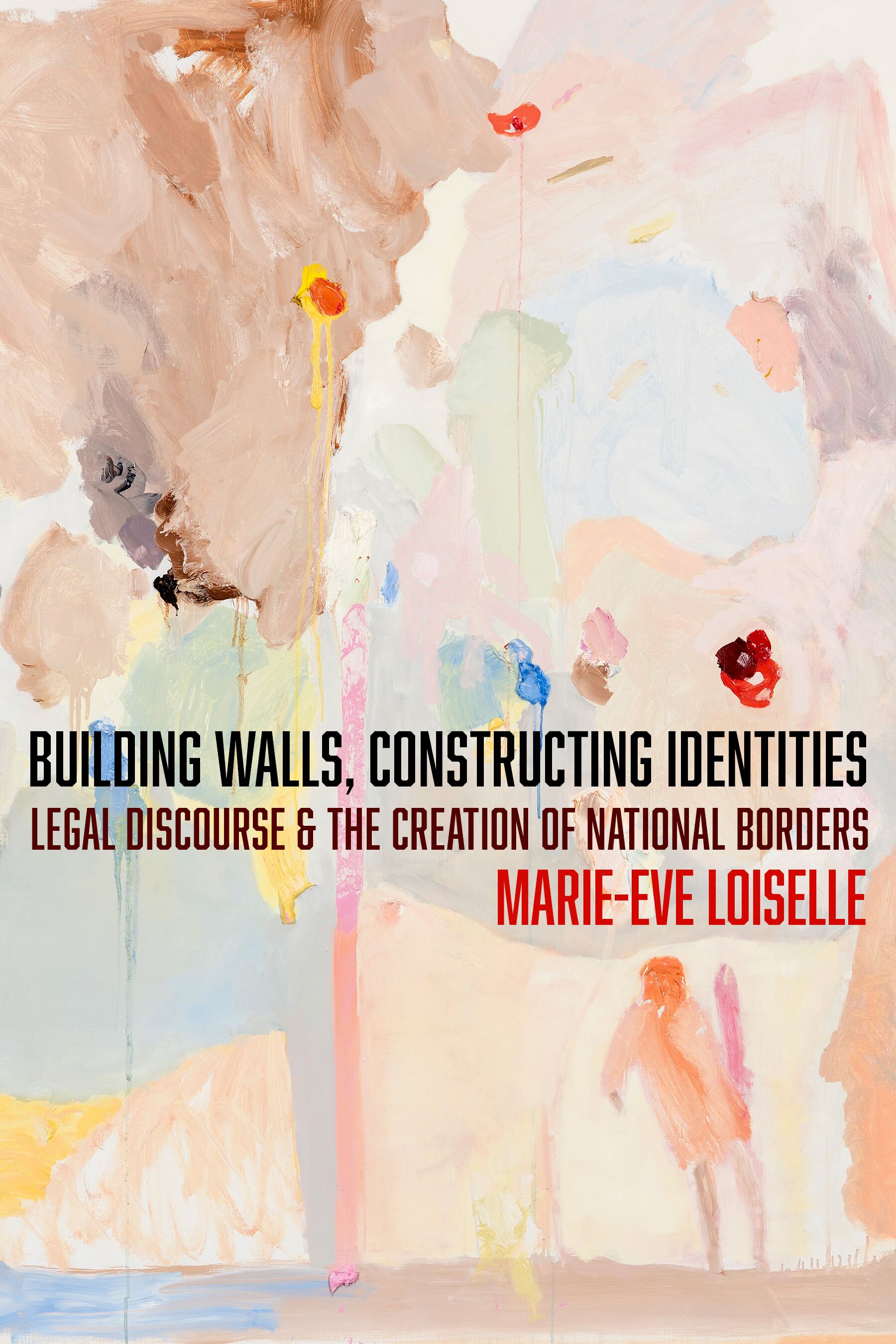
Building Walls, Constructing Identities
States are erecting walls at their borders at a pace unmatched in history, and the wall between the United States and Mexico stands as an icon among these dividing structures. Much has been said about the US-Mexico border wall in the last few decades, yet American walling projects have a much longer history, dating back almost a century. Building Walls, Constructing Identities offers a rich account of this legal history, informed by two episodes of wall-building—the Act of August 19, 1935, and the Secure Fence Act of 2006. These two legislative periods illustrate that today's wall imprints onto the landscape a grammar of racial inequality underpinned by a settler colonial rationality. Marie-Eve Loiselle argues in favor of an account of the law that considers its material translation into space and identifies discursive processes by which the law and the wall come together to communicate legal knowledge about territory and identity.
eBook

Transparency materialised: how registers can regulate access to documents?
Proactive transparency in the form of electronic provision of documents is required by law in the EU. It has long been acknowledged in law and technology studies that digital technology can have legal consequences when implemented to perform a legal function. Consequently, the technological design of document registers has the ability to limit as well as enhance access to documents. When technology can have such regulatory powers, incorporating it into a legal function requires closer attention as to how or why it is so. This article will provide a close analysis of the European Commission’s main Register of Documents (RegDoc) to study the implications of technological design for access to documents. Transparency is approached through a procedural view, highlighting its mechanisms. The article uses a HCI based walkthrough method for the case-study artefact critique of the RegDoc. The main findings suggest that there are two specific affordances of the RegDoc that limit access, especially for users who do not have pre-existing knowledge of the documents they are searching for. These affordances are, first, the scope of the dataset and, second, searchability. Overall, designing technology for legally relevant functions should take into account the wider legal framework that the technology aims to cater for. Attention should be paid to the affordances that can make a legal difference in a technology created to perform a legally relevant task.
Journal Article
Designing for international law: The architecture of international organizations 1922–1952
Situating itself in current debates over the international legal archive, this article delves into the material and conceptual implications of architecture for international law. To do so I trace the architectural developments of international law’s organizational and administrative spaces during the early to mid twentieth century. These architectural endeavours unfolded in three main stages: the years 1922–1926, during which the International Labour Organization (ILO) building, the first building exclusively designed for an international organization was constructed; the years 1927–1937 which saw the great polemic between modernist and classical architects over the building of the Palace of Nations; and the years 1947–1952, with the triumph of modernism, represented by the UN Headquarters in New York. These events provide an illuminating allegorical insight into the physical manifestation, modes of self-expression, and transformation of international law during this era, particularly the relationship between international law and the function and role of international organizations.
Journal Article
Endroits of Planetary Ordering: Violence, Law, Space, & Capital in the Diplomatic History of 19th Century Europe
If Derrida once praised English for the richness of the expression “to enforce the law,” in this article I return the favor and embrace the ambiguity of the French word endroit. While it means nothing more than place, I suggest one could draw from Benjamin’s work on dwelling to ponder on the meaning of being within the spaces of 19th century (counter) revolutionary internationalism. In this vein, I read Benjamin’s unfinished Arcades Project—and, in particular, its analysis of the rise of iron & glass architecture that accompanied the conquering bourgeois and the persistent aristocracy—to analyze the new built environments of the fin de siècle North Atlantic diplomacy. Despite the growing interest in the history of global governance, for historians and critical legal scholars alike, the spatial dimension of “the international” have been a largely unexplored affair. Conversely, I suggest Benjamin’s insistence on the materiality of architecture reminds us that international law’s castles were not built solely in the air. In this vein, I suggest one can trace a material history of the spaces in which revolutionary and counterrevolutionary internationalisms struggled to fashion a shell for themselves during Europe’s turbulent 19th century.
Journal Article

Inscribing the State: Constitution Drafting Manuals as Textual Technologies
The production of states is often regarded as matter of power: of drawing together political elites, proxies for external interests, and sentiments that tap into what is figured as the \"popular will.\" In a more critical vein, the production of states is read in relation to postcolonial inheritances that continue to haunt contemporary state structures. Statebuilding technologies have evolved into technocratic exercises in ensuring that rights are protected, internal forms of state power are separated and subjected to checks and balances, and principles of fairness and constraint are enshrined in legislation. Many of these objectives appear as legal problems to be addressed through the drafting of a written constitution, an emblem of modern political statehood. Yet these projects appear to be increasingly delegated to technocratic \"experts\" who are thought to have harnessed the formulae for producing viable states. Constitutional production has expanded beyond a process of political deliberation into an industry of expert knowledge. The rise of expert knowledge in constitutional matters marks a turn toward \"constitutional technicity,\" where constitution drafting is regarded as a domain of technical expertise inhabited by neutral and politically divested actors.1 This essay considers the emergence of the constitution drafting manual or handbook in the post-Cold War period as a genre in which technical expertise seeks to confront and regulate the political. Produced by and circulated within a diverse network of actors, these documents consolidate a view of what constitutes \"best practice\" in the production of contemporary state identity. Yet, in claiming that they merely reflect what they present as an existing consensus of state construction, these manuals also act into the field of state-building, naturalizing particular understandings of the ontology of the state that reflect liberal legalist norms. This essay takes up and interrogates these texts to consider their underlying presumptions, revealing the active role of textual practices in the production of contemporary state forms. The provision of information is not only a matter of recording and presenting an account of what exists, but also a way of acting into the world through forms of inscription.2 The state is increasingly inscribed not only through the constitution itself, but also by what precedes its emergence: expert consultations; trainings in legislative drafting; and the content of constitution-drafting reports, manuals, and handbooks that influence the texts of state constitutions. In this sense, the constitution- drafting manual forms part of a broader dispositif, an assemblage of multiple elements such as \"discourses, institutions, architectural forms, regulatory decisions, laws, administrative measures, scientific statements, philosophical, moral and philanthropic propositions\" and the \"system of relations\" between elements that enable the tracing of power beyond its most apparent locations.3 It has become a familiar feature of the more avowedly political practice of constitution drafting: a technocratic accompaniment that seeks to shape and inform the discursive terrain on which terms and phrases are translated into foundational legal authority.
Journal Article

Double materiality and the shift from non-financial to European sustainability reporting: review, outlook and implications
PurposeThis paper outlines the development of the principle of materiality in the European accounting framework, from the Modernization Directive (2003/51/EC) to the NFI Directive (2014/95/EU) and on to the proposals for a Corporate Sustainability Reporting (CSR) Directive (2021/0104 (COD)). The authors highlight how the requirements for corporate reporting in terms of sustainability matters have changed, underlining the main issues that require further attention by practitioners, researchers and legislators.Design/methodology/approachThis paper is based upon a historic analysis of European Union (EU) regulations in the field of non-financial and sustainability reporting and how these have changed over time. A conceptual comparison of different reporting concepts is presented, and changes in their relevance to the EU accounting framework are discussed as part of the historic analysis. Implications from corporate practice are derived from previous empirical findings from the EU Commission's consultations.FindingsThe proposed change from non-financial to sustainability reporting within the EU affects more than simply the terminology used. It implies that a different understanding is needed of both the purposes of company reporting on sustainability matters and the aims of carrying out such reporting. This change was driven by the need and desire to appropriately interpret the principle of materiality set forth in the NFI Directive. However, the recent redefinition in the shift within the EU Commission's proposals presents considerable challenges–and costs–in practice.Research limitations/implicationsFuture research on the conceptualization and operationalization of ecological and social materiality, as well as on the use of this information by different stakeholder groups, is necessary in order to (a) help companies that are applying the reporting requirements in practice, (b) support the increased harmonization of the reports published by these companies and (c) fully assess the costs and benefits associated with the increase in reporting requirements for these companies.Practical implicationsCompanies have to establish relevant reporting processes, systems and formats to fulfil the increasing number of reporting requirements.Originality/valueThis paper outlines the historic development of the principle of materiality regarding mandatory non-financial or sustainability reporting within the EU. It outlines a shift in rationales and political priorities as well as in implications for European companies that need to fulfil the reporting requirements. In consequence, it describes appropriate interpretations of this principle of materiality under current and upcoming legislation, enabling users to apply this principle more effectively.
Journal Article

Legal pluralisms, justice and spatial conflicts: New directions in legal geography
Critical legal pluralism acknowledges both the multiple sources and forms of law, and their dynamic interaction, within singular geographical spaces at whatever scales they are defined. Challenging conventional constructs of law and jurisdiction, the articles in this themed section draw on the ideas of legal pluralism, justice and spatial conflict to explore the experience, interaction, impact and possibilities of the plurality of laws in particular and diverse geographical contexts. Encompassing a wide‐ranging geographical scope and pluralistic approach to the idea of law, these articles present fresh analyses and novel case studies from Australia, UK, Cambodia, Indonesia, USA, Thailand and Aotearoa New Zealand, which collectively reflect the richly textured and diversely oriented work of legal geographers. They raise important and challenging questions about law as a living materiality and about place as a legal agent.
Journal Article

Transformative Impact of the Internet on the Boundaries for the Physician Profession: Why Materiality Matters
Over the last 25 years, the health care sector has undergone a digital transformation; health issues and medical conditions are increasingly managed with the support of digital health technology. The internet has transformed the boundaries around physicians’ work, which raises questions about how technological artifacts are transforming the boundaries that have traditionally existed between the health care professions and patients regarding information and knowledge. This viewpoint paper analyzes how digital health technologies can transform the boundaries of physicians’ work by examining 3 examples of technology aimed at patients or citizens: Open Notes, PatientsLikeMe, and Apple Watch. Traditionally, the physician profession drew the boundaries that separated it from other professions and patients to define and protect its jurisdiction and professional knowledge. However, in the 3 artifacts analyzed, technology changes the boundaries between laypeople and physicians. Therefore, health technologies aimed at citizens impact health care and its professions, and the materiality of artifacts can change the boundaries between physicians and citizens. Thus, the initiators and developers of technology aimed at patients or citizens may have the power to transform the field of knowledge in health care.
Journal Article

Anticipating emergencies: Technologies of preparedness and the matter of security
In this article, we examine contemporary 'resilience' through UK preparedness – an apparatus of security enacted under the legal and organizational principles of UK Civil Contingencies and civil protection legislation and practices. By examining the design, practices and technologies that constitute the exercises performed within Civil Contingencies, the article first suggests that the manner in which exercises have been mobilized as examples of preparedness and apocalyptical imaginations of the 'unthinkable' should be understood within the highly specific societal and political contexts that shape them. More substantially, the article then provides a nuanced understanding of the life of the security assemblage through an in-depth analysis of the exercise and its design, materials, play and contingent relations. Seeking to deepen and widen concerns for what matters in security studies, animated by concern for objects, bodily affects, contingencies and excess, the article contends for a more serious concern with how security and its practices can surprise, shock, enthral and disrupt in a manner that need not only be associated with failure.
Journal Article