
Catalogue Search | MBRL


Are you sure you want to remove the book from the shelf?

{{itemTitle}}
663
result(s) for
"liberal capitalism"
Sort by:

THE IDEOLOGY OF ECONOMIC LIBERALISM AND THE POLITICS OF HOUSING IN ROMANIA
The privatization of housing (linked to the privatization of means of production), respectively the creation of a new private housing fund, have been crucial for the emergence of capitalist property regime and market economy in Romania. The state withdrew from its position as a developer (of housing stock, but not only), however it did not remain passive, contrary, it assumed a central role in the creation of the (housing) market through modifying legislation and creating new institutions that administered this process. The article is addressing how the ideology of economic liberalism is working through housing politics as a core medium of the transformation of really existing socialism into neoliberal capitalism. In particular, it describes how – through privatization – this ideology creates material effects in the housing sector, i.e. accumulation on the one side and dispossession on the other side of the class structure. Moreover, the article insists that the housing stock’s privatization after 1990 happened in relation with the housing politics of state socialism, which allowed the existence of three types of property on housing. The creation of a new private housing fund was tied to post-socialist primitive accumulation resulted from the privatization of state enterprises and from the investment of profit obtained in the due process into real estate businesses. After some introductory ideas about ideologies and housing politics, the article discusses the privatization of housing and the creation of the private housing stock as central pillars of capitalist political economy. The description of some features of housing production and personal ownership of dwellings in state socialism is followed by an account on the promotion of privatization after 1990 by local-national-transnational actors using the example of the city of Cluj. The last chapter of the article concludes on the process of transformation of state socialism into neoliberal capitalism through the politics of housing sustained by the ideology of economic liberalism.
Journal Article

Social, cultural and institutional forces in corporate and patrimonial states and their relations with corporate governance: a North–South contrast
Purpose
This study aims to examine two questions that contribute to understanding the organizational corporate governance forms of the so-called New World: What have been the social and cultural forces that gave rise to the institutional features of the Anglo-Saxon corporate states and the Hispanic patrimonial states? And how have these traits influenced the governance forms of North American and Latin American firms?
Design/methodology/approach
A comparative historical analysis methodology that dates back to the colonial foundations of the New World was used. Analysis categories were derived to allow us to reflect on the phenomenon studied and support the hypotheses while deriving observations that explain the historical relationships of the state types and their capitalisms with contemporary corporate governance. The research also considered case analysis in context, presented as specific empirical evidence.
Findings
The paper maintains that the historical social and cultural forces that were configured in the New World shaped the institutional features of the Anglo-Saxon corporate states with liberal capitalism and the Hispanic patrimonial states with hierarchical capitalism, and that these features are related to the predominant organizational corporate governance forms in North American and Latin American firms, respectively.
Originality/value
This paper provides insights into the social, cultural and institutional factors that gave rise to corporate and patrimonial states and their relationships with the different types of organizational corporate governance. It introduces a categorization into the literature with three types of organizational corporate governance (e.g. corporatist, patrimonial and hybrid). This allows progress in linking corporate governance theories with a managerial focus and governance perspectives oriented to economic and social development.
Journal Article

Mental Health Challenges Related to Neoliberal Capitalism in the United States
Rates of mental illness have increased dramatically over the past 15 years in the United States [Products—Data Briefs—Number 283—August 2017. Centers for Disease Control and Prevention.
https://www.cdc.gov/nchs/products/databriefs/db283.htm
. Published August 15, 2017]. Additionally, life expectancy has fallen over the past several years due to increases in death from suicide, opioid overdose, and alcoholic liver cirrhosis as reported by Case and Deaton [Deaths of despair and the future of capitalism. Princeton University Press, 2020]. Over the last decade some have questioned whether these changes are due to neoliberal capitalist policies and ideologies. Neoliberal capitalism incorporates theories of eliminating all restrictions on the market and decreasing government assistance programs as reported by Harvey [A brief history of neoliberalism, Oxford University Press, 2005]. Since then these policies have led to income inequality, disempowerment of workers, outsourcing of manufacturing jobs, inadequate social services, mass incarceration and an expensive and ineffective healthcare system as reported by Case and Deaton [Deaths of despair and the future of capitalism. Princeton University Press, 2020] and Nkansah-Amankra et al. [International Journal of Health Services 43(2):217-240, 2013]. Studies have shown that the consequences of these policies and ideologies likely have a role in increasing rates of mental illness. This paper will discuss how these factors increase mental distress and postulate ways that mental health professionals can advocate for change.
Journal Article

Belonging, Indigeneity, Land and Nature in Southern Africa under Neoliberal Capitalism: An Overview
The political dynamics of land and belonging cannot be seen apart from the rise of neoliberal capitalism in recent decades, which has thrived in the region, with market logic superseding the social justice orientations of post-colonial ideologies and ever larger inequalities being created. Thus, against the background of these increasing inequalities, the question of who the land belongs to – and, equally important, who belongs to the land – is more relevant than ever in independent, post-apartheid southern Africa. In this introductory article, we begin by outlining the particularities of neoliberal capitalism vis-à-vis land and nature in southern Africa, with a focus on the two countries featured in this special issue: South Africa and Namibia.
Journal Article
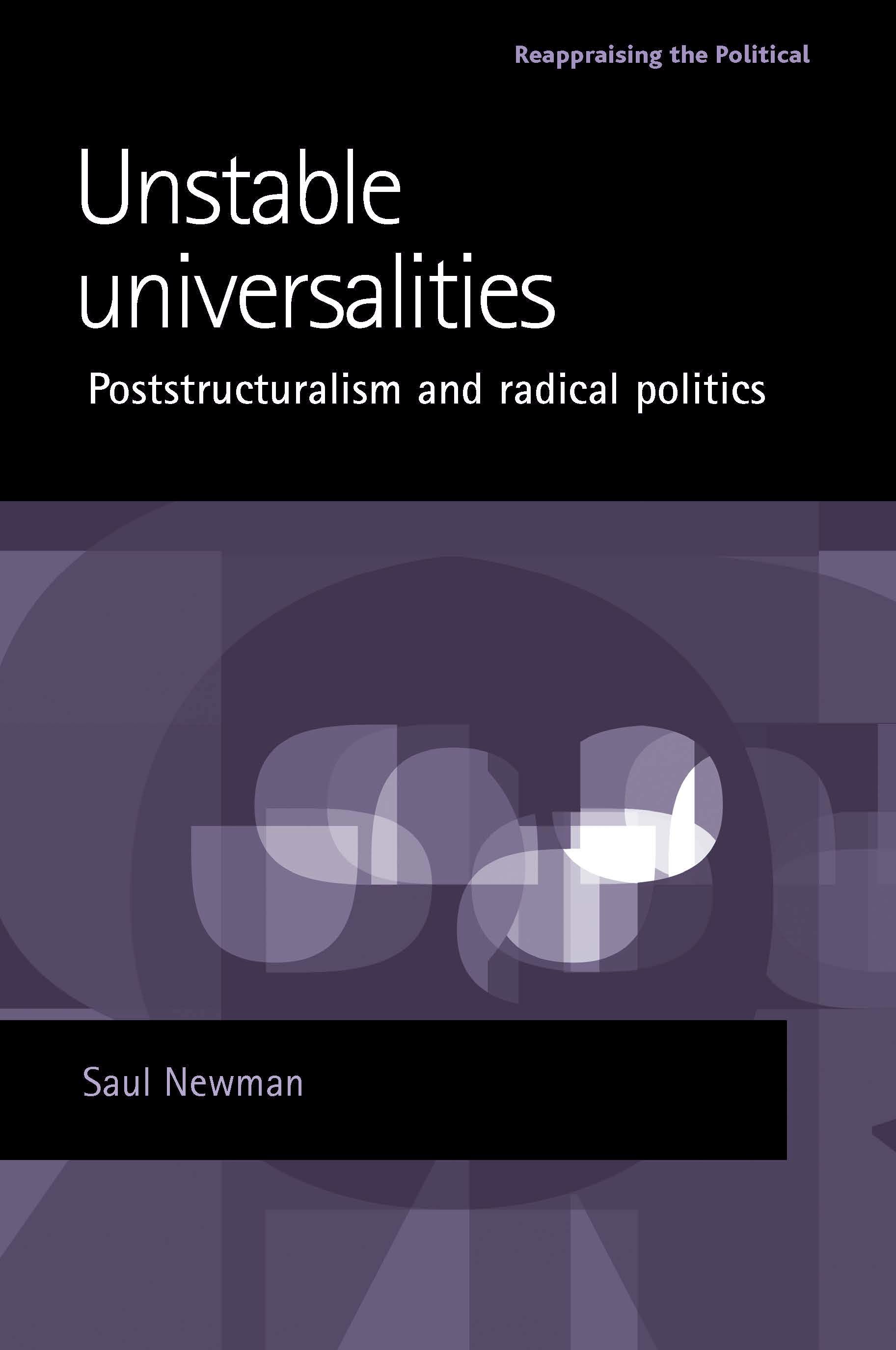
Unstable universalities
Unstable universalities, available for the first time in paperback, examines the theme of universality and its place in radical political theory. Saul Newman argues that both Marxist politics of class struggle and the postmodern politics of difference have reached their historical and political limits, and that what is needed is a new approach to universality, a new way of thinking about collective politics. By exploring various themes and ideas within poststructuralist and post-Marxist theory, the book develops a new and original approach to universality – one that has important implications for politics today, particularly on questions of power, subjectivity, ethics and democracy. In so doing, it engages in debates with thinkers such as Laclau, Žižek, Badiou and Rancière over the future of radical politics. It also applies important theoretical insights to contemporary events such as the emergence of the anti-globalisation movement, the ‘war on terrorism’, the rise of anti-immigrant racism, and the nihilistic violence which lurks at the margins of the political.
eBook

How to save politics in a post-truth era
The rise of populism, Donald Trump's election and the result of the EU referendum in the UK have been widely interpreted as a rejection of the post-war liberal order – the manifestation of a desire to undermine the political system that people feel has let them down. Yet mainstream politicians and analysts have been slow to grasp the changing situation, instead relying on a rhetoric of ‘hard data’ and narrow economic arguments while failing to properly engage with the politics of identity. This book argues that the relationship between methodology and politics is now more important than ever – that politics, if it is anything, is about engaging with people’s interpretations and narratives of the world in which they find themselves. Politics in this new ‘post-truth’ era will require an appreciation of the fact we live in an uncertain world of endless diversity and potential for change. This thoughtful book addresses how we might think about and do politics in these strange new times.
eBook

Protesting Precarity: South Korean Workers and the Labor of Refusal
This essay examines the crisis of solidarity affecting workers who protest labor precarity under South Korea's capitalist democracy. Once considered foundational to the struggle for national democratization, the dramatic protests of aggrieved workers are frequently depicted as out of place and out of sync. Drawing upon ethnographic research on workers’ protest repertoires, this essay challenges prevailing explanations and instead argues that heightened forms of drama, ritual, and suffering in workers’ protests enact a willful politics of refusal. Moving beyond resistance as an all-encompassing frame, the labor of refusal foregrounds ways of being and becoming that are not rooted in the contractual fallacies of liberal capitalist democracy, but in the spaces of solidarity produced by social movement networks and grassroots communities of care. The labor of refusal may not always generate robust solidarity, but it challenges the structures of organized abandonment that treat workers as disposable under neoliberal capitalist rule.
Journal Article
Ekhayeni
South Africa continues to experience high rates of rural–urban migration. Despite long-term residence in urban areas, many migrants do not consider the city to be home. This article presents a multi-sited study of Xhosa-speaking migrants who journey between Centane in the former Transkei homeland and Cape Town. The study aimed to explore the relationship that migrants have with their family home (ekhayeni). We interpret migrants’ narratives of life in the city and returning home in terms of processes of ‘place attachment’ (sensory, narrative, historical, spiritual, ideological, commodifying and material dependence) and factors that influence ‘place belonging’ (autobiographical, relational, cultural, economic and legal). We found that the landscape of home remains central to migrants’ cultural identity, belonging and well-being. Childhood experiences in nature and activities that continue to take rural inhabitants into these landscapes remain key to this relationship. Our case material contributes to understanding people’s motivation for ongoing visits to and investment in the rural areas, notably the emotional and spiritual dimensions of home and belonging, and the sensory and spiritual attachment to the natural environment. This complements and extends other recent work on rural–urban migration, which has focused on the rural areas as sites of asserting citizenship, social change and changing forms of investment that are to a large extent driven by the lack of opportunity to do so meaningfully in the informal settlements migrants inhabit in the city.
Journal Article

Threatening Happiness: \No One Can Compel Me to Be Happy Their Way\
Starting from classical philosophical suggestions about the status of happiness recipes that suggest the optimal ways to reach it, I will soon illustrate the fundamental Kantian suggestion: “No one can coerce me to be happy in his way”, that is, an individual has the right to choose their own kind of happiness “provided he does not infringe upon that freedom of others to strive for a like end which can coexist with the freedom of everyone”. I will conclude that happiness (and even its very possibility) is constrained in a relational interplay in a collective of human beings. Thanks to the events that took place during the notorious “enclosures”, which violently expropriated peasants by destroying their homes and cottages during the so-called primitive accumulation of capitalism, I will provide a very clear example of the relational nature of happiness and even its potential to be jeopardized. The idea of a “moral bubble” will be proposed as an explanation for why some people fail to recognize the harm they create when they jeopardize the happiness of other humans. A study of the current predatory neoliberal capitalism’s peculiar propensity to make the majority of people unhappy will be the focus of the last section. The article interdisciplinarily aims at bridging philosophy, economics, sociology, and political theory, enriching the philosophical analysis with historical and contemporary contexts, and also providing the following critical engagement: the analysis of how dominant narratives and economic frameworks serve to mask violence, thus challenging readers at least to reconsider accepted truths about progress and prosperity.
Journal Article

Sylvia J. Wynter's Concept of the Over-Representation of Man and Its Relevance to Gender and Global Development in the 21st Century
This essay critically examines Sylvia J. Wynter's (2003) concept of the \"overrepresentation of Man\" (p. 263) and its profound implications for gender and global development in the 21st century. I examine Wynter's critique of \"Man\" as the universal subject of knowledge and power through a Caribbean-transnational, decolonial, and intersectional feminist lens. My reflection challenges the historical reduction of the human experience to a singular, patriarchal notion and highlights the voices and contributions of previously excluded marginalized voices and women scholar-activists. In the context of global development, the overrepresentation of Man undergirds the continued dominance of Western, patriarchal ideologies that shape international economic, political, social, and environmental practices and discourses. This dominance not only reinforces gender inequities in public and private institutions, but it also perpetuates the marginalization of non-Western knowledge systems, particularly in development strategies that fail to account for the realities of all women. By drawing on Wynter's work, I argue for the necessity of integrating decolonial, intersectional feminist perspectives into global development discourses and policies. This integration is critical to shift the dominant paradigm toward more equitable and culturally responsive development practices that honor diverse identities and knowledge systems. Finally, I emphasize the urgent need for a transformative approach that promotes justice and change for marginalized communities in gender and global development discourse and practice.
Journal Article