
Catalogue Search | MBRL


Are you sure you want to remove the book from the shelf?

{{itemTitle}}
3,518
result(s) for
"linguistic typology"
Sort by:

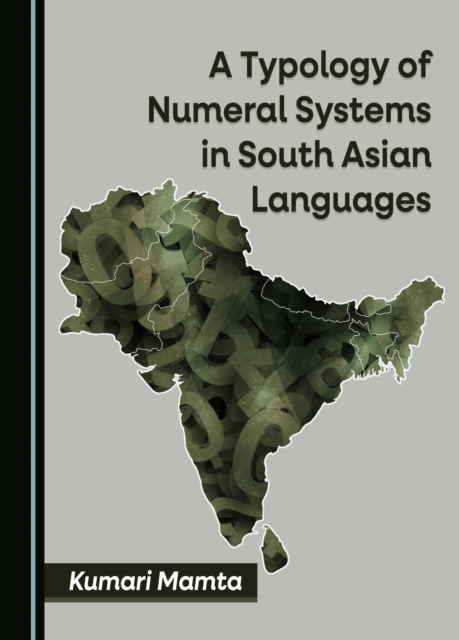
A Typology of Numeral Systems in South Asian Languages
This book takes a journey into the fascinating world of numerical systems in South Asian languages, offering a unique exploration of the intricate patterns, cultural nuances, and historical significance embedded within the numerical frameworks of the given languages. It blends the discovery of new facts with the reinterpretation of existing ones, while developing a methodology for investigating number systems that can be applied to languages around the world.It is a groundbreaking study that unveils the complex linguistic patterns and socio-cultural significance of numerical systems in South Asian languages, offering valuable insights for researchers, linguists, anthropologists, and language enthusiasts alike. By bridging the gap between linguistics, anthropology, cultural studies, and mathematics, this book encourages interdisciplinary dialogue and collaboration by examining numeral systems from multiple angles.
eBook
Granularity in the verbalization of events and objects : a cross-linguistic study
The study departs from the observation that in expressing ideas, some languages encode more details than others. This book was awarded the prestigious André Martinet Award 2024 from the Societas Linguistica Europaea!.
eBook
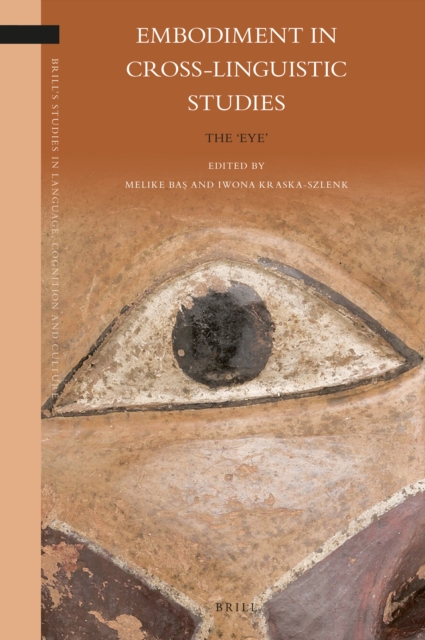
Embodiment in Cross-Linguistic Studies: The 'Eye'
The volume explores the body part 'eye' as a source domain in conceptualization and a vehicle of embodied cognition. It includes in-depth case studies of languages situated in different cultural contexts in Europe, Asia, Africa, America, and Oceania. It also provides insights into cross-linguistic comparison of conceptualization patterns and semantic extension of the term 'eye' on various target domains. The contributions in the volume present a range of cultural models associated with the visual organ which take into account socio-cultural factors and language usage practices. The book offers new material and novel analyses within the subject of polysemy of body part terms. It also adds to studies on metaphor, metonymy and cultural conceptualizations within a cognitive linguistic paradigm.
eBook
Usage-based and Typological Approaches to Linguistic Units
The chapters in this volume focus on how we might understand the concept of 'unit' in human languages. It is an analytical notion that has been widely adopted by linguists of various theoretical and applied orientations but has recently been critically examined by both typologically oriented and interactional linguistics.
eBook
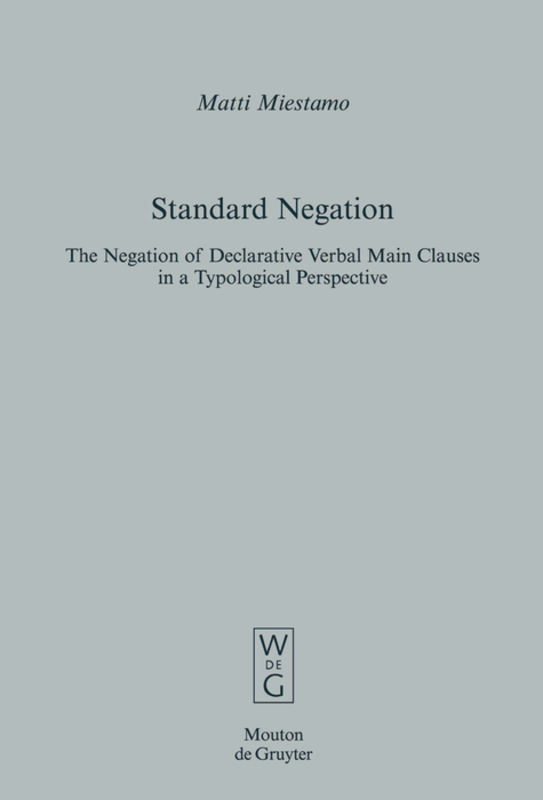
Standard Negation
This book is the first cross-linguistic study of clausal negation based on an extensive and systematic language sample. Methodological issues, especially sampling, are discussed at length. Standard negation – the basic structural means languages have for negating declarative verbal main clauses – is typologized from a new perspective, paying attention to structural differences between affirmatives and negatives. In symmetric negation affirmative and negative structures show no differences except for the presence of the negative marker(s), whereas in asymmetric negation there are further structural differences, i.e. asymmetries. A distinction is made between constructional and paradigmatic asymmetry; in the former the addition of the negative marker(s) is accompanied by further structural differences in comparison to the corresponding affirmative, and in the latter the correspondences between the members of (verbal etc.) paradigms used in affirmatives and negatives are not one-to-one. Cross-cutting the constructional-paradigmatic distinction, asymmetric negation can be further divided into subtypes according to the nature of the asymmetry. Standard negation structures found in the 297 sample languages are exemplified and discussed in detail. The frequencies of the different types and some typological correlations are also examined. Functional motivations are proposed for the structural types – symmetric negatives are language-internally analogous to the linguistic structure of the affirmative and asymmetric negatives are language-externally analogous to different asymmetries between affirmation and negation on the functional level. Relevant diachronic issues are also discussed. The book is of interest to language typologists, descriptive linguists and to all linguists interested in negation.
eBook

Revisiting population size vs. phoneme inventory size
In this discussion note we argue against the findings presented in Hay & Bauer 2007, which show a positive correlation between population size and phoneme inventory size. We argue that the positive correlation is an artifact of the authors' statistical technique and biased data set. Using a hierarchical mixed model to account for genealogical relatedness of languages, and a much larger and more diverse sample of the world's languages, we find little support for population size as an explanatory predictor of phoneme inventory size once the genealogical relatedness of languages is accounted for.*
Journal Article

Chinese Word Order in the Comparative Sino-Tibetan and Sociotypological Contexts
The present study discusses typology and variation of word order patterns in nominal and verb structures across 20 Chinese languages and compares them with another 43 languages from the Sino-Tibetan family. The methods employed are internal and external historical reconstruction and correlation studies from linguistic typology and sociolinguistics. The results show that the head-final tendency is a baseline across the family, but individual languages differ by the degree of head-initial structures allowed in a language, leading to a hybrid word order profile. On the one hand, Chinese languages consistently manifest the head-final noun phrase structures, whereas head-initial deviants can be explained either internally through reanalysis or externally through contact. On the other hand, Chinese verb phrases have varied toward head-initial structures due to contact with verb-medial languages of Mainland Southeast Asia, before reinstalling the head-final structures as a consequence of contact with verb-final languages in North Asia. When extralinguistic factors are considered, the typological north-south divide of Chinese appears to be geographically consistent and gradable by the latitude of individual Chinese language communities, confirming the validity of a broader typological cline from north to south in Eastern Eurasia.
Journal Article
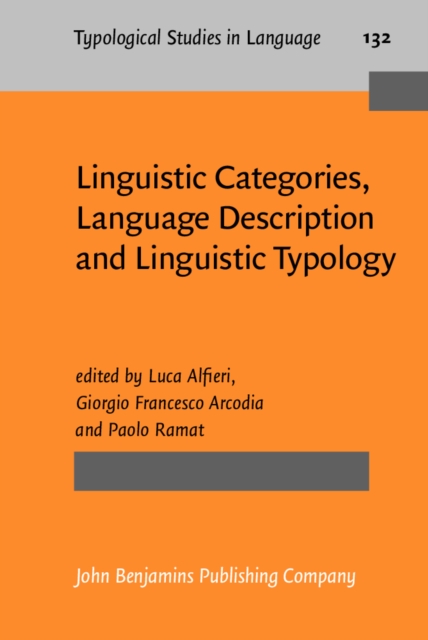
Linguistic categories, language description and linguistic typology
Few issues in the history of the language sciences have been an object of as much discussion and controversy as linguistic categories. The eleven articles included in this volume tackle the issue of categories from a wide range of perspectives and with different foci, in the context of the current debate on the nature and methodology of the research on comparative concepts - particularly, the relation between the categories needed to describe languages and those needed to compare languages. While the first six papers deal with general theoretical questions, the following five confront specific issues in the domain of language analysis arising from the application of categories. The volume will appeal to a very broad readership: advanced students and scholars in any field of linguistics, but also specialists in the philosophy of language, and scholars interested in the cognitive aspects of language from different subfields (neurolinguistics, cognitive sciences, psycholinguistics, anthropology).
eBook

Linguistic Realization of Evidentiality in European Languages
This book presents a selection of contributions to the workshop \"Linguistic realization of evidentiality in European languages\", held at the 30th Annual Convention of the German Society of Linguistics in Bamberg (February 27-29, 2008), and additional papers, which have been especially commissioned for this volume. Its main focus lies on providing further empirical evidence about languages that have various - lexical as well as grammatical - evidential expressions. The papers in this volume will offer a cross-linguistic perspective on this topic as they deal with a number of different language families and languages: Romance languages (French, Spanish, Italian), Germanic languages (Dutch, German, English, Icelandic), Baltic and Slavic languages, Greek, Basque, and Turkish.
eBook