
Catalogue Search | MBRL


Are you sure you want to remove the book from the shelf?

{{itemTitle}}
175
result(s) for
"literary combat"
Sort by:
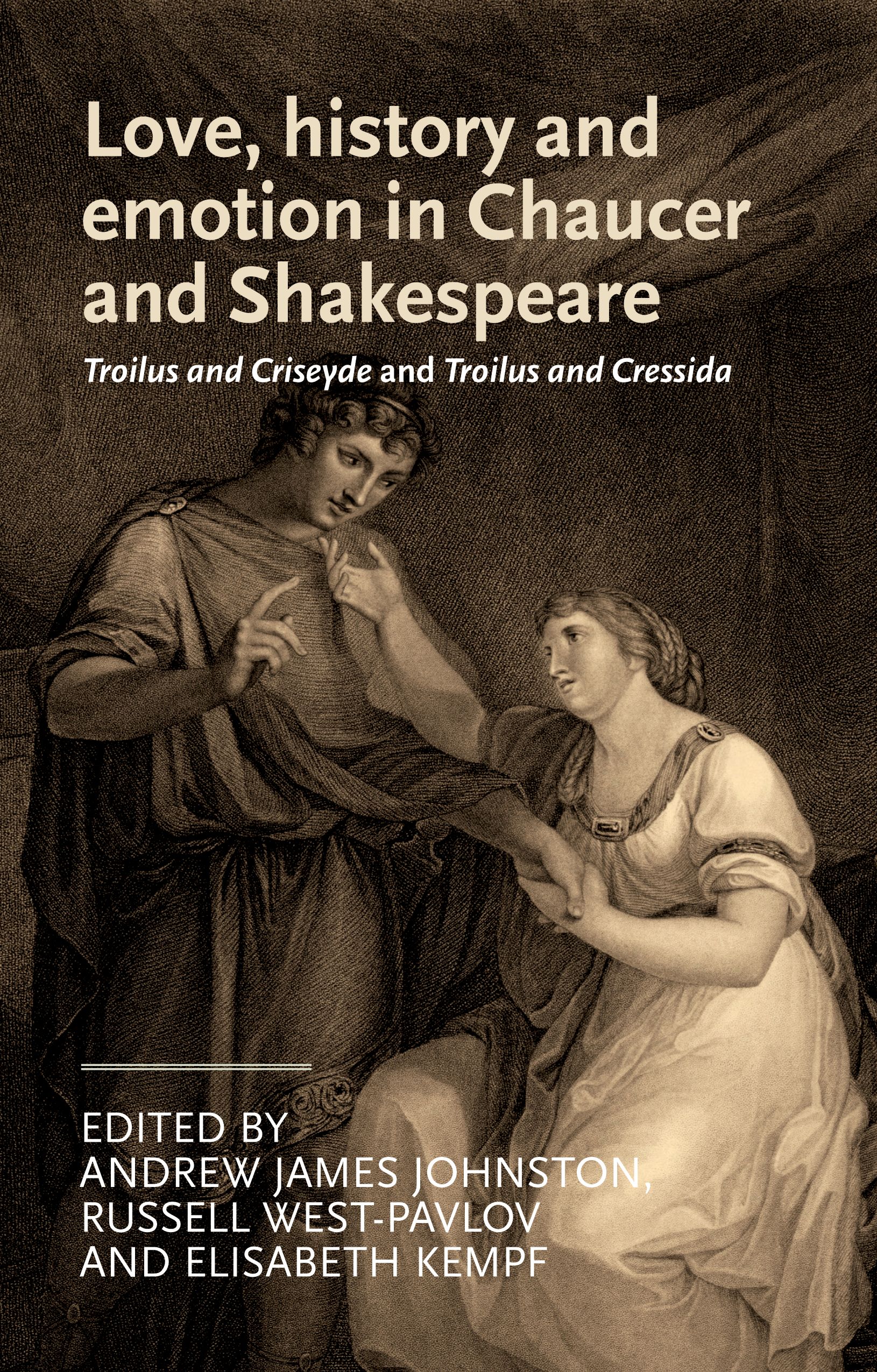
Love, history and emotion in Chaucer and Shakespeare
This collection of essays explores medieval and early modern Troilus-texts from Chaucer to Shakespeare. The contributions show how medieval and early modern fictions of Troy use love and other emotions as a means of approaching the problem of tradition. As these texts reflect on their own traditionality, they highlight both the affective nature of temporality and the role of affect in scrutinising tradition itself. Focusing on a specific textual lineage that bridges the conventional period boundaries, the collection participates in an exchange between medievalists and early modernists that seeks to generate a dialogic encounter between the periods with the aim of further dismantling the rigid notions of chronology and periodisation that have kept medieval and early modern scholarship apart.
eBook
Love, history and emotion in Chaucer and Shakespeare
This collection of essays explores medieval and early modern Troilus-texts from Chaucer to Shakespeare. The contributions show how medieval and early modern fictions of Troy use love and other emotions as a means of approaching the problem of tradition. As these texts reflect on their own traditionality, they highlight both the affective nature of temporality and the role of affect in scrutinising tradition itself. Focusing on a specific textual lineage that bridges the conventional period boundaries, the collection participates in an exchange between medievalists and early modernists that seeks to generate a dialogic encounter between the periods with the aim of further dismantling the rigid notions of chronology and periodisation that have kept medieval and early modern scholarship apart.
eBook

The Routledge Companion to Health Humanities
The health humanities is a rapidly rising field, advancing an inclusive, democratizing, activist, applied, critical, and culturally diverse approach to delivering health and well-being through the arts and humanities. It has generated new kinds of interdisciplinary research, knowledge, and communities of practice globally. It has also acted to bring greater coherence and political force to contributions across a range of related disciplines and traditions.
In this volume, a formidable set of authors explore the history, current state, and future of the health humanities, in particular how its vision of the arts and humanities:
Promotes creative public health.
Opens new routes to health and well-being.
Informs and drives better health care.
Interrogates relationships between ill health and social equality.
Develops humanist theory in relation to health and social care practice.
Foregrounds cultural difference as a resource for positive change in society.
Tests the humanity of an increasingly globalized health-care system.
Looks to overcome structural and process obstacles to cross-disciplinary ventures.
Champions co-construction, co-design, and mutuality in solving health and well-being challenges.
Showcases less familiar, prominent, or celebrated creative practices.
Includes multiple perspectives on the value and health benefits of the arts and humanities not limited to or dominated by medicine.
Divided into two main sections, the Companion looks at \"Reflections and Critical Perspectives,\" offering current thinking and definitions within health humanities, and \"Applications,\" comprising a wide selection of applied arts and humanities practices from comedy, writing, and dancing to yoga, cooking, and horticultural display.
eBook

Military Deployments and Suicide: A Critical Examination
Deployment to a combat zone is a fundamental mission for most military forces, but prior research suggests that there is a complex and nuanced association between deployment and related risk factors for suicide. Deployment and combat experiences vary greatly among military personnel and can affect a variety of protective and risk factors for suicide. This article offers a critical examination of the association among modern U.S. military deployments, suicide attempts, and death while considering the context of a prominent theory of suicide. Although previous work has demonstrated that deployment is not associated with suicide overall in this population, there is growing evidence that risk may be elevated shortly after deployment, and for some subgroups. Specific aspects of combat exposure, including the experience of killing or witnessing death in combat, may be important contributing factors. An analysis of the literature illustrates that deployment-related risk factors for suicide are complex. The limitations of the literature are discussed, and future directions are suggested.
Journal Article

Silence in the Land of Logos
In ancient Greece, the spoken word connoted power, whether in the free speech accorded to citizens or in the voice of the poet, whose song was thought to know no earthly bounds. But how did silence fit into the mental framework of a society that valued speech so highly? Here Silvia Montiglio provides the first comprehensive investigation into silence as a distinctive and meaningful phenomenon in archaic and classical Greece. Arguing that the notion of silence is not a universal given but is rather situated in a complex network of associations and values, Montiglio seeks to establish general principles for understanding silence through analyses of cultural practices, including religion, literature, and law.
Unlike the silence of a Christian before an ineffable God, which signifies the uselessness of words, silence in Greek religion paradoxically expresses the power of logos--for example, during prayer and sacrifice, it serves as a shield against words that could offend the gods. Montiglio goes on to explore silence in the world of the epic hero, where words are equated with action and their absence signals paralysis or tension in power relationships. Her other examples include oratory, a practice in which citizens must balance their words with silence in very complex ways in order to show that they do not abuse their right to speak. Inquiries into lyric poetry, drama, medical writings, and historiography round out this unprecedented study, revealing silence as a force in its own right.
eBook

“Medicinable Literature”: Bibliotherapy, Literary Caregiving, and the First World War
Histories of bibliotherapy often emphasize the importance of the First World War in stimulating the development of bibliotherapeutic theory and practice. The word itself was used in a 1916 article by the American author Samuel McChord Crothers, while histories of bibliotherapy in the United Kingdom often foreground H. F. Brett-Smith's so-called \"fever chart\" of therapeutic books for treating shell-shocked soldiers. Despite this, however, we argue that a full account of wartime bibliotherapy (particularly the importance of British hospital libraries in its development) has yet to be told. This article draws on the papers of British military hospital personnel to describe the range of \"literary caregiving\" supporting the treatment of sick and wounded soldiers during the conflict. It traces the social and professional networks underlying these schemes. Finally, it shows how British volunteer librarians helped develop a specifically medicalized language of caregiving through books, thereby contributing to the early development of bibliotherapy.
Journal Article

Elizabethan Revenge Tragedy, 1587-1642
A most thorough study of the Elizabethan Tragedy of Revenge, its origins, development, the ethical influence affecting it and the inter-relations of the plays.
Originally published in 1966.
The Princeton Legacy Library uses the latest print-on-demand technology to again make available previously out-of-print books from the distinguished backlist of Princeton University Press. These editions preserve the original texts of these important books while presenting them in durable paperback and hardcover editions. The goal of the Princeton Legacy Library is to vastly increase access to the rich scholarly heritage found in the thousands of books published by Princeton University Press since its founding in 1905.
eBook

Shell Shock and the Modernist Imagination
Looking closely at both case histories of shell shock and Modernist novels by Ford Madox Ford, Rebecca West, and Virginia Woolf, Wyatt Bonikowski shows how the figure of the shell-shocked soldier and the symptoms of war trauma were transformed by the literary imagination. Situating his study with respect to Freud’s concept of the death drive, Bonikowski reads the repetitive symptoms of shell-shocked soldiers as a resistance to representation and narrative. In making this resistance part of their narratives, Ford, West, and Woolf broaden our understanding of the traumatic effects of war, exploring the possibility of a connection between the trauma of war and the trauma of sexuality. Parade’s End, The Return of the Soldier, and Mrs. Dalloway are all structured around the relationship between the soldier who returns from war and the women who receive him, but these novels offer no prospect for the healing effects of the union between men and women. Instead, the novels underscore the divisions within the home and the self, drawing on the traumatic effects of shell shock to explore the link between the public events of history and the intimate traumas of the relations between self and other.
eBook

Motivational factors for practicing Brazilian Jiu-jitsu
Background: Martial arts have historically played a significant role in the development of societies, serving purposes such as self-defense and warfare. However, the motivations behind practicing martial arts have evolved over time, encompassing social, educational, psychological, health, and competitive aspects. Purpose: This study aims to assess the factors that drive individuals to engage in Brazilian Jiu-jitsu (BJJ), with a specific focus on comparing competitors and non-competitors. Methods: The analysis included a total of forty-seven male BJJ practitioners aged between 18 and 50 years. The participants were divided into two groups for data analysis: competitors (n = 31) and non-competitors (n = 16). To measure exercise motivation, the Exercise Motivation Inventory (EMI-2) questionnaire, validated for use in the Brazilian population, was administered. Descriptive statistics were used for data analysis, followed by an independent samples t-test, with a significance level set at p ≤ 0.05. Results: The motivational dimensions that had the greatest influence on BJJ practice were Psychological and Physical Condition (index = 4 and 3.5, respectively). They were closely followed by Interpersonal (index = 2.7) and Health and Aesthetics (index = 2.6 for both). However, in the group analysis, the Interpersonal dimension exhibited less relevance among non-competitive practitioners (non-competitors = 2.3 ± 0.73; competitors = 2.9 ± 0.98; p = 0.038). Competitors placed greater importance on factors such as Competition and Social Recognition compared to non-competitors [Competition: competitors = 3.3 ± 1.3; non-competitors = 2 ± 1.2; p = 0.001; Social Recognition: competitors = 2 ± 1.4; non-competitors = 1.1 ± 1.1; p = 0.037]. Moreover, for non-competitive practitioners, the psychological dimension exerted a significantly stronger influence on BJJ practice (non-competitors = 4.4 ± 0.6; competitors = 3.8 ± 1.1; p = 0.009), with stress control being an important contributing factor (non-competitors = 4.4 ± 0.7; competitors = 3.5 ± 1.6; p = 0.013). Conclusion: The factors driving the practice of BJJ can vary between competitors and non-competitors. These findings should be taken into account when designing training programs aimed at fostering motivation for continued participation in sports activities.
Journal Article

A World Elsewhere
Abstract Documentaries about the use of Shakespeare in applied theatre publicise and endorse the work of practitioners to scholars as well as the general public, and have influenced the growth of academic interest in what this article terms Social Shakespeare: practices in which Shakespeare and social work interact with each other to bring about change. However, in the quest for touching and uplifting individual stories, such media treatments risk ignoring the actual values and strategies governing the work in favour of narratives that normalise social differences through emphasis on the transformative power of Shakespearean theatre, viewed as a sanctified space. Documentaries about three different constituencies – prisoners, young people with learning disabilities, and combat veterans – are examined to determine how far they locate the need for change in society rather than in the individual.
Journal Article