
Catalogue Search | MBRL


Are you sure you want to remove the book from the shelf?

{{itemTitle}}
46
result(s) for
"literatura cinematográfica"
Sort by:

Literatura como mitología infraurbana del mal. Sábato: “Informe sobre ciegos” , en Sobre héroes y tumbas (1961-1993)
El artículo plantea la pregunta por el alcance del Informe sobre ciegos, capítulo central de Sobre héroes y tumbas, como un acercamiento fenoménico, poético y mitológico a la pregunta por el mal. La primera parte se ocupa de rastrear los motivos personales, morales y estéticos que llevan a Sábato a la formulación del mito de la Secta de los ciegos como una hipótesis plausible sobre la inteligibilidad del mal. La segunda, explora los recursos pictóricos, cinematográficos y de puesta en escena que Sábato utiliza para entrar al mundo de abajo, al reino del mal. La última parte intenta situar el texto de Sábato en el conjunto de su vida y de su obra como un recurso para examinar el alcance metafísico, político y moral de su pensamiento.
Journal Article

A companion to literature and film
A Companion to Literature in Film provides state-of-the-art research on world literature, film, and the complex theoretical relationship between them.25 essays by international experts cover the most important topics in the study of literature and film adaptations.
eBook

Trauma Culture
It may be said that every trauma is two traumas or ten thousand-depending on the number of people involved. How one experiences and reacts to an event is unique and depends largely on one's direct or indirect positioning, personal psychic history, and individual memories. But equally important to the experience of trauma are the broader political and cultural contexts within which a catastrophe takes place and how it is \"managed\" by institutional forces, including the media.In Trauma Culture, E. Ann Kaplan explores the relationship between the impact of trauma on individuals and on entire cultures and nations. Arguing that humans possess a compelling need to draw meaning from personal experience and to communicate what happens to others, she examines the artistic, literary, and cinematic forms that are often used to bridge the individual and collective experience. A number of case studies, including Sigmund Freud's Moses and Monotheism, Marguerite Duras' La Douleur, Sarah Kofman's Rue Ordener, Rue Labat, Alfred Hitchcock's Spellbound, and Tracey Moffatt's Night Cries, reveal how empathy can be fostered without the sensationalistic element that typifies the media.From World War II to 9/11, this passionate study eloquently navigates the contentious debates surrounding trauma theory and persuasively advocates the responsible sharing and translating of catastrophe.
eBook

Spatial Turns
The phrase \"spatial turns\" signals the growing importance of space as an analytical as well as representational category for culture. The volume addresses such emerging modes of inquiry by bringing together, for the first time, essays that engage with spatial turns, spatiality, and the theoretical implications of both in the context of German culture, history, and theory. Migrating from fields like geography, urban studies, and architecture, the new centrality of space has transformed social-science fields as diverse as sociology, philosophy, and psychology. In cultural studies, productive analyses of space increasingly cut across the studies of literature, film, popular culture, and the visual arts. Spatial Turns brings together essays that apply a spatial analysis to German literature and other media and engages with specifically German theorizations of space by such figures as Siegfried Kracauer and Walter Benjamin. The volume is organized in four sections: \"Mapping Spaces\" addresses cartography in all forms and in its intersection with culture; \"Spaces of the Urban\" takes up one of the key sites of spatial studies, the city; \"Spaces of Encounter\" considers how Germany has become a contact zone for multiple ethnicities; and \"Visualized Spaces\" concerns the theorization of space in film and new media studies.
eBook
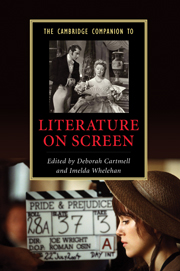
The Cambridge Companion to Literature on Screen
This Companion offers a multi-disciplinary approach to literature on film and television. Writers are drawn from different backgrounds to consider broad topics, such as the issue of adaptation from novels and plays to the screen, canonical and popular literature, fantasy, genre and adaptations for children. There are also case studies, such as Shakespeare, Jane Austen, the nineteenth-century novel and modernism, which allow the reader to place adaptations of the work of writers within a wider context. An interview with Andrew Davies, whose work includes Pride and Prejudice (1995) and Bleak House (2005), reveals the practical choices and challenges that face the professional writer and adaptor. The Companion as a whole provides an extensive survey of an increasingly popular field of study.
eBook
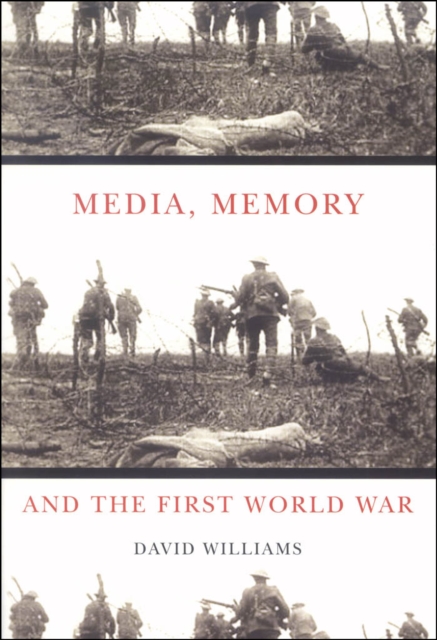
Media, Memory, and the First World War
Of interest to historians, classicists, media and digital theorists, literary scholars, museologists, and archivists, Media, Memory, and the First World War is a comparative study that shows how the dominant mode of communication in a popular culture - from oral traditions to digital media - shapes the structure of memory within that culture.
eBook

The Adaptation Industry
Adaptation constitutes the driving force of contemporary culture, with stories adapted across an array of media formats. However, adaptation studies has been concerned almost exclusively with textual analysis, in particular with compare-and-contrast studies of individual novel and film pairings. This has left almost completely unexamined crucial questions of how adaptations come to be made, what are the industries with the greatest stake in making them, and who the decision-makers are in the adaptation process. The Adaptation Industry re-imagines adaptation not as an abstract process, but as a material industry. It presents the adaptation industry as a cultural economy of six interlocking institutions, stakeholders and decision-makers all engaged in the actual business of adapting texts: authors; agents; publishers; book prize committees; scriptwriters; and screen producers and distributors. Through trading in intellectual property rights to cultural works, these six nodal points in the adaptation network are tightly interlinked, with success for one party potentially auguring for success in other spheres. But marked rivalries between these institutional forces also exist, with competition characterizing every aspect of the adaptation process. This book constructs an overdue sociology of contemporary literary adaptation, never losing sight of the material and institutional dimensions of this powerful process.
eBook

The final victim of the blacklist
Before he attained notoriety as Dean of the Hollywood Ten—the blacklisted screenwriters and directors persecuted because of their varying ties to the Communist Party—John Howard Lawson had become one of the most brilliant, successful, and intellectual screenwriters on the Hollywood scene in the 1930s and 1940s, with several hits to his credit including Blockade, Sahara, and Action in the North Atlantic. After his infamous, almost violent, 1947 hearing before the House Un-American Activities Committee, Lawson spent time in prison and his lucrative career was effectively over. Studded with anecdotes and based on previously untapped archives, this first biography of Lawson brings alive his era and features many of his prominent friends and associates, including John Dos Passos, Theodore Dreiser, F. Scott Fitzgerald, Charles Chaplin, Gene Kelly, Edmund Wilson, Ernest Hemingway, Humphrey Bogart, Dalton Trumbo, Ring Lardner, Jr., and many others. Lawson's life becomes a prism through which we gain a clearer perspective on the evolution and machinations of McCarthyism and anti-Semitism in the United States, on the influence of the left on Hollywood, and on a fascinating man whose radicalism served as a foil for launching the political careers of two Presidents: Richard Nixon and Ronald Reagan. In vivid, marvelously detailed prose, Final Victim of the Blacklist restores this major figure to his rightful place in history as it recounts one of the most captivating episodes in twentieth century cinema and politics.
eBook

It reminded me of Poe’s story»: Edgar Allan Poe’s legacy, the ghost story and the American gothic in Richard Matheson’s A Stir of Echoes
Even if A Stir of Echoes (1958) has often been overshadowed by Richard Matheson’s most well-known novels I am Legend (1954) and The Shrinking Man (1956), it should be given the credit it deserves as a novel that functions both as a reflection as well as a source of intertextuality. A Stir of Echoes is rooted in the tradition of the ghost story and the American gothic, but above all, it comprises motifs, characters and twists in the plot that are significantly remindful of some of Poe’s most representative tales. Likewise, being the novel that came to light immediately prior to his films adaptations of Poe’s tales, Richard Matheson must have had A Stir of Echoes in mind in order to expand and transform some of Poe’s stories for his screenplays. This article aims to analyse A Stir of Echoes regarding its intertextuality with Poe’s tales, especially with those that Matheson would later on adapt to the screen.
Pese a que la novela El último escalón (1958) a menudo ha sido eclipsada por otros títulos más conocidos de Richard Matheson tales como Soy leyenda (1954) o El increíble hombre menguante (1956), debería otorgársele la importancia que merece como reflejo a la par que como fuente de intertextualidad. El último escalón se enmarca en la tradición del relato de fantasmas y del gótico americano, pero ante todo, amalgama imágenes, personajes y giros argumentales que evocan, de forma significativa, algunos de los relatos más representativos de Poe. Asimismo, por tratarse de la novela que vio la luz con inmediata anterioridad a las adaptaciones cinematográficas de los relatos de Poe, es harto probable que Richard Matheson tuviera en mente su novela El último escalón a la hora de desarrollar y transformar algunos de los relatos de Poe para sus guiones cinematográficos. Este artículo tiene el objetivo de analizar la novela El último escalón en relación a su intertextualidad con los relatos de Poe, especialmente con aquellos que Matheson adaptaría poco después a la gran pantalla.
Journal Article

Cine en Bogotá: Estrenos de la semana (1954-1955): Crítica cinematográfica y cinefilia en Gabriel García Márquez
Este análisis se centra en la columna de crítica cinematográfica Cine en Bogotá: Estrenos de la semana, escrita por García Márquez y publicada en El Espectador (1954-1955). La columna, redactada durante la formación temprana del autor, refleja su creciente interés por el cine como arte, industria y entretenimiento. Aunque presenta limitaciones estéticas y enfrenta problemas con empresarios, la columna busca fortalecer el criterio del público, contribuyendo al surgimiento de una cultura cinematográfica en Colombia. Este periodo marca las bases de la literatura posterior de García Márquez, revelando su evolución y conexión con el mundo cinematográfico.
Journal Article