
Catalogue Search | MBRL


Are you sure you want to remove the book from the shelf?

{{itemTitle}}
88
result(s) for
"mainstream history"
Sort by:

HISTORY AS PHILOSOPHY
Historians have taken a beating in recent times from an array of critics troubled by our persistent unwillingness to properly theorize our work. This essay contends that their criticisms have generally failed to make headway among mainstream historians owing to a little noticed cognitive byproduct of our work that I call history as philosophy. In so doing I offer a novel defense of professional history as it has been understood and practiced in the Anglophone world over the last half‐century or so while suggesting, in conclusion, that historians could not do other than they do without serious psychic and societal loss.
Journal Article

On Borderlands
A new generation of borderlands historians has reoriented American history by delving more deeply into indigenous history, traveling across the borders of empire, and extending these border crossings forward in time - as empires yield to nations and nations seek to dominate in new ways the oftenautonomous realms of indigenous and immigrant America. The challenge is to respect the very real power of empires and nations without missing the field's central insight: that history pivoted not only on a succession of state-centered polities but also on other turning points anchored in vast stretches of America where the visions of empires and nations often foundered and the future was far from certain.3 Beginnings Borderlands history has a complex root system that reaches deep into the twentieth century.
Journal Article
Race, Surveillance, and Indian Anticolonialism in the Transnational Western U.S.-Canadian Borderlands
Rather, I argue that Indian anticolonialiste organizing in the western U. S. -Canadian borderlands played a unique role in the federal governments antiradical imagination before World War I. Much of the analysis of antiradicalism in early twentieth-century U.S. history has been based in the World War I period, with a particular focus on how President Woodrow Wilsons administration justified politically repressive acts as wartime measures.6 Yet, as this essay illustrates, U.S.\\n Referring to Taraknath Das as a figure of \"infamy and treachery,\" Preston argued that there was no \"greater criminal\" nor a \"greater enemy\" to the peace and welfare of the United States and detailed Das's activities over the past decade to suggest that the United States needed to be vigilant about guarding its borders against foreign agitators organizing on U.S. soil.36 The \"Hindu conspiracy\" trial lasted five months and cost the United States $450,000 and England $2.5 million, making it the longest and most expensive state trial in U.S. history at that point.
Journal Article
Borderlands in a World at Sea: Concow Indians, Native Hawaiians, and South Chinese in Indigenous, Global, and National Spaces
[...]a nation-state focus in borderlands history risks obscuring the histories of indigenous peoples whose lands had been colonized or were at risk of colonization, such as nineteenth-century American Indians and Kanaka Maoli (one of the principal Hawaiianlanguage terms for indigenous Hawaiian people). For all the differences between Indian reservations and Chinese exclusion, the enforcement of reservation borders reveals that the process by which the United States transformed itself into a \"gatekeeper nation\" was rooted in the history of American settler colonialism and the containment of American Indian people.1 The notion of borderlands argues against a border line between two Western-style nation-states (the United States and Canada) and the idea of a Turnerian frontier \"between savagery and civilization\" (American Indians and the United States).
Journal Article
Before the Railroad: From Slavery to Freedom in the Canadian-American Borderland
When Detroit passed from British to American rule in 1796, in accordance with the Jay Treaty, several slaveholders relocated to the new setdements of Amherstburg and Sandwich (now Windsor) on the Canadian side of the river, taking their human property with them. Because the Northwest Ordinance of 1787 and the 1793 Act against Slavery in Upper Canada forbade the introduction of new slaves into their respective territories, enslaved people on both sides of the border soon learned that they could seize their freedom merely by crossing the river.5 Investigating the institution of slavery and the development of the Canadian-American border in concert allows us to recast our understanding of both subjects, revealing the extent to which each shaped the other. [...]enslaved people in the Detroit borderland acquired their freedom long before those held elsewhere in Upper Canada and Michigan - jurisdictions where slavery persisted until the mid- 1830s.46 By virtue of its situation adjacent to the border, the Michigan territorial court established in 1805 was better placed to resolve the problem of runaway slaves than the distant Canadian civil authorities at York and Quebec.
Journal Article
Borderlands of Modernity and Abandonment: The Lines within Ambos Nogales and the Tohono O'odham Nation
Post- World War II ideas about modernity and abandonment - the state-sponsored aesthetics examined here - put in sharp relief U.S. and Mexican histories of capitalist development, border regulation, and citizenship based on national belonging; support of state projects and ideologies; and access to services. [...]during the late twentieth century, even though the appearances of these borderlands remained different, perceptions of them converged as many increasingly saw the entire border as a zone of criminality.3 The contrast between these two border spaces during the postwar era demonstrates a paradox made visible by the historian Samuel Truett: state visions of a uniform border were at odds with the reality of a border that national governments invested in, developed, and tightly policed in certain areas, while leaving others comparatively unattended.
Journal Article
The Cosmic Race in Texas: Racial Fusion, White Supremacy, and Civil Rights Politics
The Lone Star State was home to the United States' largest Mexican-descent community until the 1950s, when it was surpassed by California. Because they lived in the only state with both a large ethnic Mexican population and a formal Jim Crow system, lulac's leaders and members faced particularly stark consequences if they fell outside the legal rights accorded to those the state considered white. [...]scholarship emphasizing the allure of whiteness for Mexican Americans has focused on Texas in this period, so the different racial ideologies unearthed here speak directly to the literature on the trajectory of whiteness and Latino racial formations.4 The Mexican American Civil Rights Movement in Texas The origins of the Mexican American civil rights movement lie in Texas in the 1920s, when politically active Texas Mexicans began concertedly organizing themselves on the basis of American citizenship rights. [...]for the author, the key phrase in lulac's constitution was the one that declared \"emphatically that we accept the ideas and customs of this country 'only to the extent that there is good in them. In \"March Onward Lulac Soldiers,\" for example, F. Valencia included \"the negro Estevanico\" (a member of an early Spanish expedition into what became the U.S. Southwest) in his description of the founding of Mexico and its people. [...]the lulac leaders most likely to claim indigenous heritage explicitly, such as José de la Luz Saenz, a south Texas schoolteacher, longtime civil rights activist, and coauthor of lulac's constitution, were also the most unequivocal in their denunciation of racial discrimination and segregation per se.
Journal Article
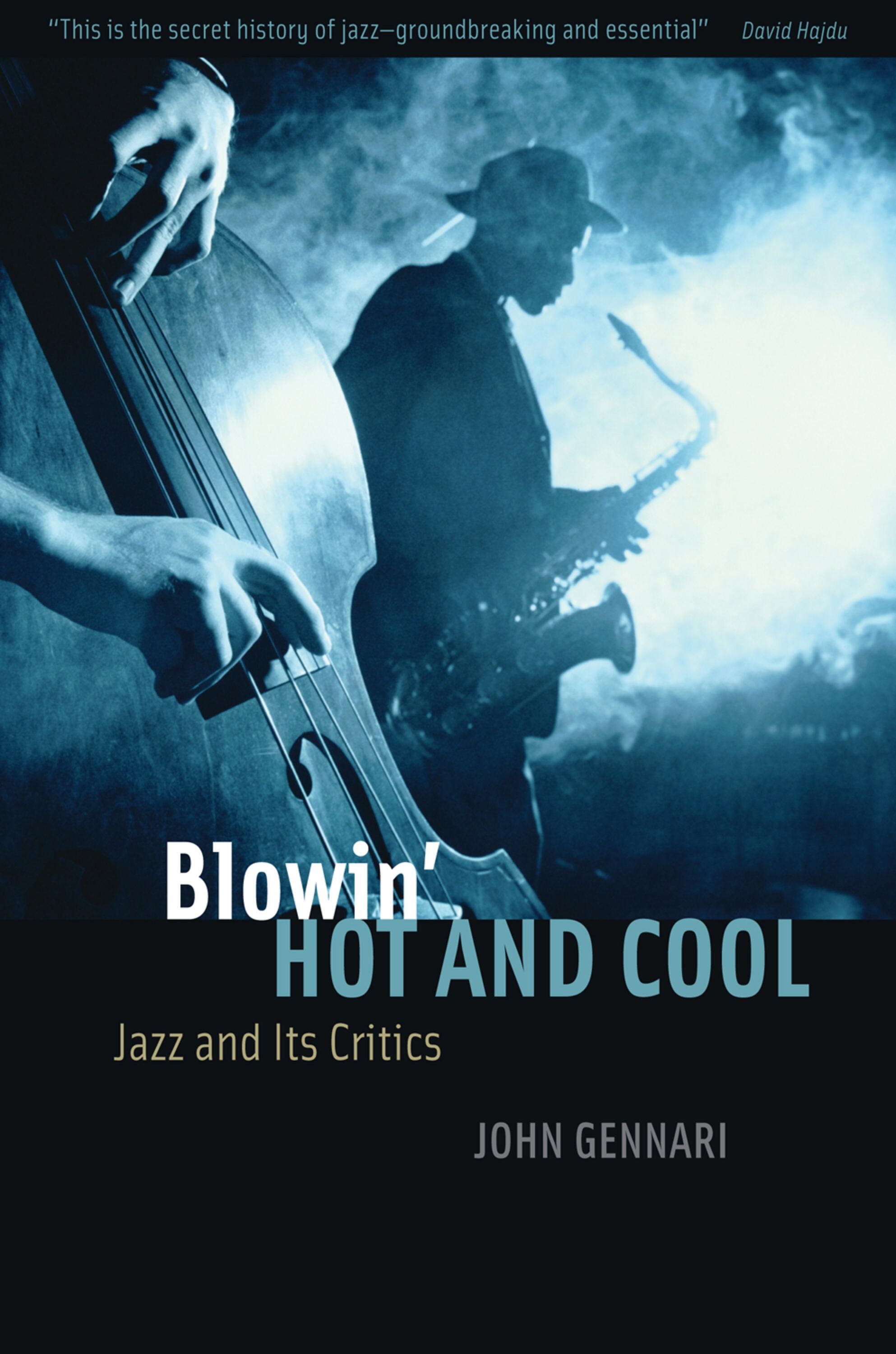
Blowin' hot and cool
In the illustrious and richly documented history of American jazz, no figure has been more controversial than the jazz critic. Jazz critics can be revered or reviled—often both—but they should not be ignored. And while the tradition of jazz has been covered from seemingly every angle, nobody has ever turned the pen back on itself to chronicle the many writers who have helped define how we listen to and how we understand jazz. That is, of course, until now. In Blowin’ Hot and Cool, John Gennari provides a definitive history of jazz criticism from the 1920s to the present. The music itself is prominent in his account, as are the musicians—from Louis Armstrong and Duke Ellington to Charlie Parker, John Coltrane, Roscoe Mitchell, and beyond. But the work takes its shape from fascinating stories of the tradition’s key critics—Leonard Feather, Martin Williams, Whitney Balliett, Dan Morgenstern, Gary Giddins, and Stanley Crouch, among many others. Gennari is the first to show the many ways these critics have mediated the relationship between the musicians and the audience—not merely as writers, but in many cases as producers, broadcasters, concert organizers, and public intellectuals as well. For Gennari, the jazz tradition is not so much a collection of recordings and performances as it is a rancorous debate—the dissonant noise clamoring in response to the sounds of jazz. Against the backdrop of racial strife, class and gender issues, war, and protest that has defined the past seventy-five years in America, Blowin’ Hot and Cool brings to the fore jazz’s most vital critics and the role they have played not only in defining the history of jazz but also in shaping jazz’s significance in American culture and life.
eBook