
Catalogue Search | MBRL


Are you sure you want to remove the book from the shelf?

{{itemTitle}}
166,245
result(s) for
"management areas"
Sort by:

Protected Area Governance and Management
Protected Area Governance and Management presents a compendium of original text, case studies and examples from across the world, by drawing on the literature, and on the knowledge and experience of those involved in protected areas. The book synthesises current knowledge and cutting-edge thinking from the diverse branches of practice and learning relevant to protected area governance and management. It is intended as an investment in the skills and competencies of people and consequently, the effective governance and management of protected areas for which they are responsible, now and into the future. The global success of the protected area concept lies in its shared vision to protect natural and cultural heritage for the long term, and organisations such as International Union for the Conservation of Nature are a unifying force in this regard. Nonetheless, protected areas are a socio-political phenomenon and the ways that nations understand, govern and manage them is always open to contest and debate. The book aims to enlighten, educate and above all to challenge readers to think deeply about protected areas—their future and their past, as well as their present. The book has been compiled by 169 authors and deals with all aspects of protected area governance and management. It provides information to support capacity development training of protected area field officers, managers in charge and executive level managers.
eBook

World Heritage : concepts, management and conservation
\"World Heritage Sites: Concepts, Management and Conservation presents an insight into discussions and debates surrounding the UNESCO World Heritage List, and the properties on it. This book will be of pivotal interest to students and scholars in the fields of tourism, heritage, archaeology, natural resource management and development studies\"-- Provided by publisher.
BOOK

Riparia : ecology, conservation, and management of streamside communities
This book describes the underlying water conditions and geologies that support viable riparia, illustrates the ecological characteristics of riparia, and discusses how riparia are used by human cultures as well as how riparia can be used to sustain environmental quality.
eBook

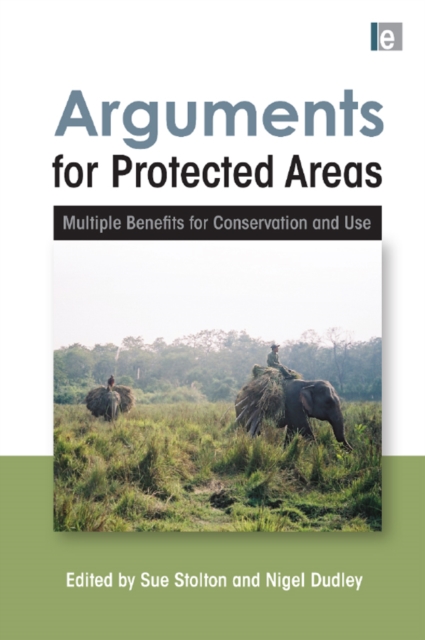
Arguments for Protected Areas
Most protected areas (e.g.national parks and nature reserves) have been created to protect wildlife and land- and seascape values. They currently cover over 13% of the world's land surface, around 12% of marine coastal areas and 4% of the marine shelf. Retaining and expanding these areas in the future will depend on showing their wider benefits for society.
This book provides a concise and persuasive overview of the values of protected areas. Contributing authors from over fifty countries examine a wide range of values that are maintained in protected areas, including food, water and materials; health; tourism; cultural and spiritual values; and buffering capacity against climate change and natural disasters. The book also considers the role of protected areas in poverty reduction strategies, their relationship with traditional and indigenous people and in fostering conflict resolution through peace parks initiatives.
The chapters draw on a series of authoritative reports published by WWF over recent years under the 'Arguments for Protection' banner, in association with various partners, and on additional research carried out especially for the volume. It analyses the opportunities and limitations of protected areas for supplying the various values along with practical advice for planners and managers about maximising benefits. It provides an important contribution to the debate about the role of protected areas in conservation and other aspects of natural resource management and human livelihoods.
Published with WWF
eBook


Do occupancy or detection rates from camera traps reflect deer density?
Camera trapping is a powerful tool for studying mammal populations over large spatial scales. Density estimation using camera-trap data is a commonly desired outcome, but most approaches only work for species that can be individually recognized, and researchers studying most mammals are typically constrained to measures of site occupancy or detection rate. These 2 metrics are often used as measures of relative abundance and presumed to be related directly to animal density. To test this relationship, we estimated density, occupancy, and detection rate of male white-tailed deer (Odocoileus virginianus) using camera-trap data collected from 1,199 cameras across 20 study sites. Detection rate and density exhibited stronger positive linear correlation (r2 = 0.80) than occupancy and density (r2 = 0.27). When hunted and unhunted paired areas were compared, detection rate and density showed the same trend between paired sites 62.5% of the time compared to 87.5% for occupancy and density. In particular, agreement between estimates was lowest for pairs of sites that had the largest differences in surrounding housing density. Although it is clear occupancy and detection rate contain some information about density, models suggested different ecological relationships associated with the metrics. Using occupancy or detection rate as proxies for density may be particularly problematic when comparing between areas where animals might to move or behave differently, such as urban–wild interfaces. In such cases, alternate methods of density approximation are recommended.
Journal Article


Effectiveness of management zoning designed for flagship species in protecting sympatric species
Flagship species have been used widely as umbrella species (i.e., species with large home range whose protection often provides protection for sympatric species) in the management of China’s nature reserves. This conflation of flagship and umbrella species is best represented by the giant panda (Ailuropoda melanoleuca) and other large, endangered mammals designated as conservation targets in site selection and planning of reserves. Few empirical studies have tested the effectiveness of flagship species as surrogates for a broader range of sympatric species. Using extensive camera-trap data, we examined the effectiveness of management zones designated to protect flagship (target) species in conserving sympatric species in 4 wildlife reserves (Gutianshan, Changqing, Laohegou, and Wolong). We tested whether the progression from peripheral to core zones was associated with an increasing habitat association for both target and sympatric species. The distribution patterns of the study species across the zones in each reserve indicated a disparity between management zones and the species’ habitat requirements. Management zone was included in the final model for all target species, and most of them had higher occurrence in core zones relative to less-protected zones, but zone was not a predictor for most of the sympatric species. When management zone was associated with the occurrence of sympatric species, threatened species generally had higher detections in core zones, whereas common species had higher detections outside of the core zone. Our results suggested that reserve planning based on flagship species does not adequately protect sympatric species due to their specialized habitat requirements. We recommend re-examining the effectiveness of management zoning and urge a multispecies and reserve-wide monitoring plan to improve protection of China’s wildlife.
Las especies bandera se han utilizado ampliamente como especies paraguas (es decir, especies con una extensa distribución cuya protección frecuentemente proporciona protección para especies simpátricas) en el manejo de las reservas naturales de China. Esta combinación de especie bandera y especie paraguas tiene su mejor representación en el panda gigante (Ailuropoda melanoleuca) y otros grandes mamíferos en peligro de extinción designados como objetivos de conservación en la selección de sitio y la planeación de reservas. Pocos estudios empíricos han probado la efectividad de las especies bandera como sustitutas de una especie simpátrica con una distribución más amplia. Con datos numerosos de cámaras trampa, examinamos la efectividad de las zonas de manejo designadas para proteger a las especies bandera (objetivo) en la conservación de especies simpátricas dentro de cuatro reservas de fauna (Gutianshan, Changqing, Laohegou y Wolong). Probamos si la progresión de las zonas periféricas hacia las zonas núcleo estaba relacionada con asociaciones crecientes de hábitat tanto para las especies objetivo como para las simpátricas. Los patrones de distribución del estudio de especies a lo largo de las zonas en cada reserva indicaron una disparidad entre las zonas de manejo y los requerimientos de hábitat de las especies. La zona de manejo se incluyó dentro del modelo final para todas las especies objetivo y la mayoría de ellas tuvo una presencia más alta en las zonas núcleo en relación con las zonas de menor protección. Cuando la zona de manejo se asoció a la presencia de especies simpátricas, las especies amenazadas generalmente tuvieron un mayor número de detecciones en la zona núcleo, mientras que las especies comunes tuvieron un número más elevado de detecciones fuera de la zona núcleo. Nuestros resultados sugieren que la planeación de reservas basada en las especies bandera no protege adecuadamente a las especies simpátricas debido a sus requerimientos especializados de hábitat. Recomendamos una reexaminación de la efectividad del manejo de zonación y urgimos que se genere un plan de monitoreo multiespecífico en toda la reserva para mejorar la protección de la fauna en China.
旗舰物种被广泛地作为伞护物种 (指活动范围广、对其投人的保护措施能够同时有益于其它同域分布物 种的物种) 用于中国自然保护区的管理。旗舰种和伞护种概念的混淆最为突出地体现在, 选择以大熊猫为代表 的大型濒危兽类作为主要保护对象来确定保护区的选址和规划。很少有实证性的研究来检验伞护种是否能有效 代表同域分布物种的保护需求。我们基于大数据量的红外相机调查, 评估了中国 4 个野生动物保护区 (古田山、 长青、老河沟和卧龙) 针对旗舰物种 ( 即主要保护对象) 划定的管理分区对同域分布物种保护的有效性。我们分 析了从保护区实验区向缓冲区、核心区过渡的过程中, 主要保护对象和其它同域分布物种是否均表现出更强的 选择性。多个物种在保护区各个分区内的分布格局显示, 管理分区和物种的栖息地需求并不一致。分区是影响 主要保护对象分布的因素之一。相比实验区和缓冲区, 多数保护对象更多地出现在核心区。然而, 分区对绝大多 数同域分布物种而言, 并不是一个影响其分布的显著因素。对于部分分布受分区影响的同域分布物种而言, 受 威胁物种通常偏好核心区内的生境, 而常见种则偏好实验区内的生境。我们的研究结果表明, 旗舰物种通常有 特化的栖息地需求, 将它们作为同域分布物种的代表以指导保护区规划, 并不能有效保护其它同域分布物种。 我们建议保护区应重新评估管理分区的有效性, 并采用基于多物种的、覆盖保护区全境的监测方案, 以促进对 中国野生动物的有效保护。
Journal Article