
Catalogue Search | MBRL


Are you sure you want to remove the book from the shelf?

{{itemTitle}}
58
result(s) for
"manliness"
Sort by:

Globalizing the Beautiful Body
In the late nineteenth century, bodybuilding was seen as a new way of shaping a manly, muscular, and beautiful body. Eugen Sandow, sometimes hailed as the “father of modern bodybuilding,” emerged as a global icon. Historians have usually understood his travels around the world as the origin of bodybuilding’s global career. This article argues, by contrast, that the cross-border trajectory of the ideal and practice of the muscular male body was not the simple result of the diffusion of Western norms, but rather the effect of a global conjuncture. At the turn of the twentieth century, the uneven process of global integration generated debates at the interplay of masculinity, strength, beauty, health, and nationalism and helped establish a new body regime that was employed as a response to the challenges of the modern world in many places.
Journal Article

The Erotic Whitman
In this provocative analysis of Whitman's exemplary quest for happiness, Vivian Pollak skillfully explores the intimate relationships that contributed to his portrayal of masculinity in crisis. She maintains that in representing himself as a characteristic nineteenth-century American and in proposing to heal national ills, Whitman was trying to temper his own inner conflicts as well. The poet's expansive vision of natural eroticism and of unfettered comradeship between democratic equals was, however, only part of the story. As Whitman waged a conscious campaign to challenge misogynistic and homophobic literary codes, he promoted a raceless, classless ideal of sexual democracy that theoretically equalized all varieties of desire and resisted none. Pollak suggests that this goal remains imperfectly achieved in his writings, which liberates some forbidden voices and silences others. Integrating biography and criticism, Pollak employs a loosely chronological organization to describe the poet's multifaceted \"faith in sex.\" Drawing on his early fiction, journalism, poetry, and self-reviews, as well as letters and notebook entries, she shows how in spite of his personal ambivalence about sustained erotic intimacy, Whitman came to imagine himself as \"the phallic choice of America.\"
eBook

Manliness in Britain, 1760–1900
This book offers an innovative account of manliness in Britain between 1760 and 1900. Using diverse textual, visual and material culture sources, it shows that masculinities were produced and disseminated through men’s bodies –often working-class ones – and the emotions and material culture associated with them. The book analyses idealised men who stimulated desire and admiration, including virile boxers, soldiers, sailors and blacksmiths, brave firemen and noble industrial workers. It also investigates unmanly men, such as drunkards, wife-beaters and masturbators, who elicited disgust and aversion. Unusually, Manliness in Britain runs from the eras of feeling, revolution and reform to those of militarism, imperialism, representative democracy and mass media, periods often dealt with separately by historians of masculinities.
eBook

Ancient Trees and Aged Peasants
This article takes as its starting point Jacob George Strutt’s description, in his Sylva Britannica (1826) of the Cowthorpe Oak, an ancient oak tree, as being ‘like some aged peasant, whose toil-worn limbs still give evidence of the strength which enabled him to acquit himself of the labors of his youth’. Strutt’s etching of the tree may be compared with Thomas Barker of Bath’s painting, Man Holding a Staff. Both works compare the life cycle of a tree to that of a human being, and specifically a male peasant, who has spent his working life in the open air, battered by the weather. Symbols of British history and greatness, from the rites of the Druids to the naval victories of the Napoleonic Wars, ancient oaks could stand for stoicism, steadfastness, independence, and peaceful reform. Depictions of aged peasants, in art and literature, served a similar purpose. They appealed to those who felt nostalgic for the idea of a more settled, rural past, and emotionally attached to paternalistic values.
Journal Article

Leading with the Chin
Leading with the Chin is a fascinating examination of
the changing representations of twentieth-century masculinity in
Esquire , America's oldest men's interest magazine.
eBook

Leading with the Chin
Leading with the Chin focuses on the Esquire writings of James Baldwin, Truman Capote, Raymond Carver, Don DeLillo, Norman Mailer, and Tim O’Brien to examine how these authors negotiated important shifts in American masculinity. Using the works of these six authors as case studies, Leading with the Chin argues that Esquire permitted writers to confront national fantasies of American masculinity as they were impacted by the rise of neoliberalism, civil rights and gay rights, and the cultural dominance of the professional-managerial class.
Applying the methodologies of periodical studies and the theoretical concerns of masculinity studies, this book recontextualizes the prose and fiction of these authors by analyzing them in the material context of the magazine. Relating each author’s articulation of masculinity to the advertisements, editorials, and articles published in each issue, Leading with the Chin shows that Esquire reflected and helped to shape the forces that structured American masculinity in the twentieth century.
eBook
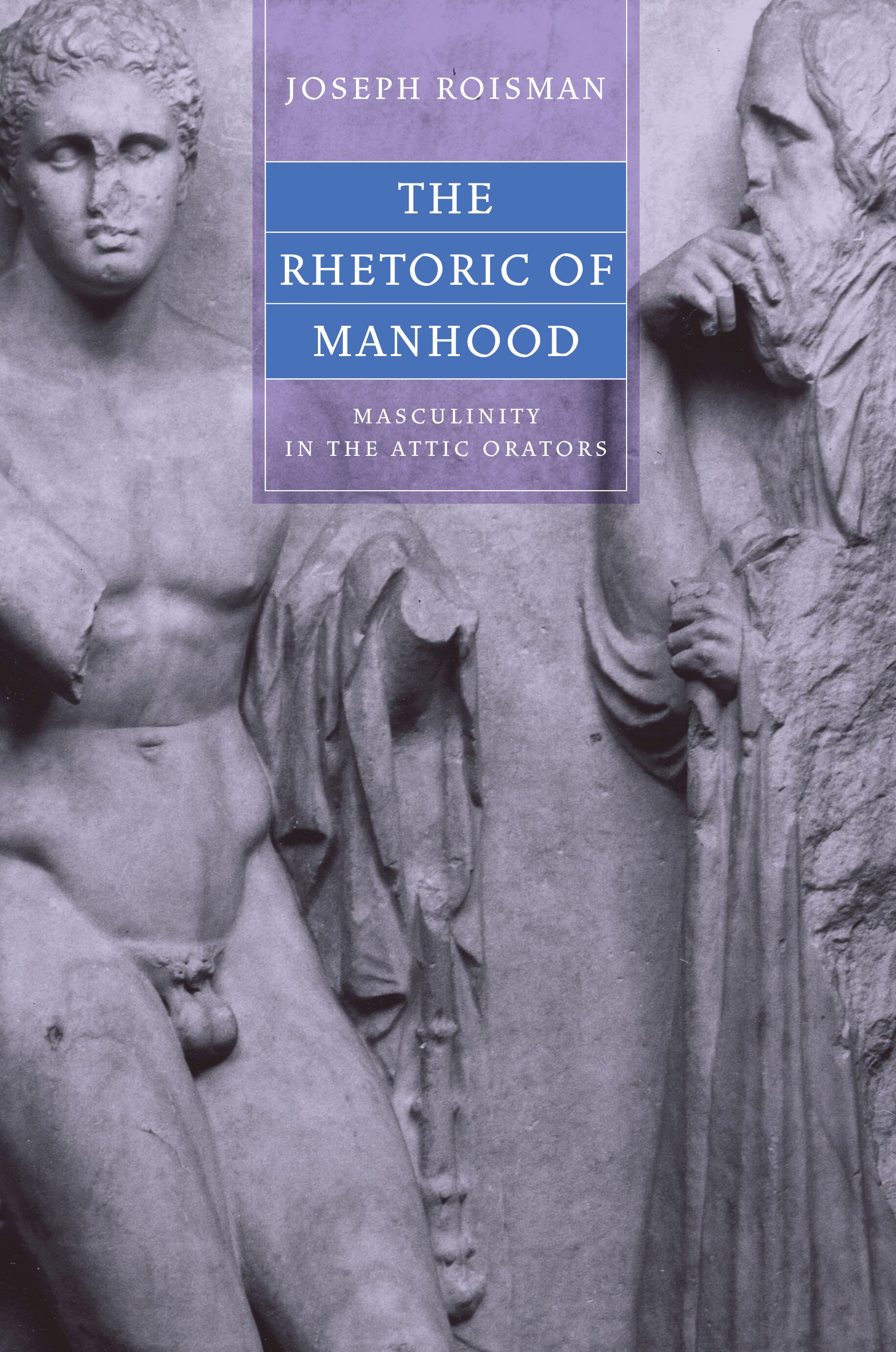
The Rhetoric of Manhood
The concept of manhood was immensely important in ancient Athens, shaping its political, social, legal, and ethical systems. This book, a groundbreaking study of manhood in fourth-century Athens, is the first to provide a comprehensive examination of notions about masculinity found in the Attic orators, who represent one of the most important sources for understanding the social history of this period. While previous studies have assumed a uniform ideology about manhood, Joseph Roisman finds that Athenians had quite varied opinions about what constituted manly values and conduct. He situates the evidence for ideas about manhood found in the Attic orators in its historical, ideological, and theoretical contexts to explore various manifestations of Athenian masculinity as well as the rhetoric that both articulated and questioned it. Roisman focuses on topics such as the nexus between manhood and age; on Athenian men in their roles as family members, friends, and lovers; on the concept of masculine shame; on relations between social and economic status and manhood; on manhood in the military and politics; on the manly virtue of self-control; and on what men feared.
eBook

Des hommes forts mais dociles ? La salarisation du secteur de la sécurité locale comme révélateur de la hiérarchisation des masculinités à Lagos (Nigéria)
Le secteur de la sécurité locale à Lagos fait figure de « cas-limite » pour penser les dynamiques de salarisation des services et remettre en cause les définitions normatives du salariat. En tâchant de ne pas amalgamer trop vite virilité et masculinité, cette contribution s’attache à décrire les pratiques de hiérarchisation des masculinités à l’œuvre dans le travail de sécurité à l’échelle locale. Si les expressions viriles et la force physique sont valorisées par les notables qui emploient des travailleurs de sécurité, elles justifient aussi l’assignation de certains hommes à une position subalterne. D’autres, en connotant leurs pratiques de travail d’une valeur morale et en les assimilant à la possession d’un savoir, obtiennent une meilleure rémunération. Enfin, la hiérarchisation des masculinités a des conséquences sur les recompositions du foyer des travailleurs de sécurité. The local security sector in Lagos represents a “limiting case” for thinking about the dynamics of salarization and for questioning the normative definitions of wage-earning labor. While trying to differentiate virility and masculinity, this article attempts to describe the hierarchical practices of masculinities at stake in security work at the local scale. While virile expressions and physical force are valued by the local patrons, they also justify assigning some security workers to subaltern positions. By giving their work practices a moral value and associating them with the possession of knowledge, others obtain better remuneration. Finally, the hierarchization of masculinities has consequences for the security workers’ household recomposition.
Journal Article

Jiu-Jitsuing Uncle Sam
The emergence of Japan as a major world power in the early twentieth century generated anxiety over America’s place in the world. Fears of race suicide combined with a fear of the feminizing effects of over-civilization further exacerbated these tensions. Japanese jiu-jitsu came to symbolize these debates. As a physical example of the yellow peril, Japanese martial arts posed a threat to western martial arts of boxing and wrestling. The efficiency and effectiveness of Japanese jiu-jitsu, as introduced to Americans in the early twentieth century, challenged preconceived notions of the superiority of western martial arts and therefore American constructions of race and masculinity. As Theodore Roosevelt and the U.S. nation wrestled with the Japanese and jiu-jitsu, they responded in various ways to this new menace. The jiu-jitsu threat was ultimately subjugated by simultaneously exoticizing, feminizing, and appropriating aspects of it in order to reassert the dominance of western martial arts, the white race and American masculinity.
Journal Article

Love among the ruins
Classical Athenian literature often speaks of democratic politics in sexual terms. Citizens are urged to become lovers of the polis, and politicians claim to be lovers of the people. Victoria Wohl argues that this was no dead metaphor. Exploring the intersection between eros and politics in democratic Athens, Wohl traces the private desires aroused by public ideology and the political consequences of citizens' most intimate longings. Love among the Ruins analyzes the civic fantasies that lay beneath (but not necessarily parallel to) Athens's political ideology. It shows how desire can disrupt politics and provides a deeper--at times disturbing--insight into the democratic unconscious of ancient Athens. The Athenians imagined the perfect citizen as a noble and manly lover. But this icon conceals a multitude of other possible figures: sexy tyrants, potent pathics, and seductive perverts. Through critical re-readings of canonical texts, Wohl investigates these fantasies, which seem so antithetical to Athens's manifest ideals. She examines the interrelation of patriotism and narcissism, the trope of politics as prostitution, the elite suspicion of political pleasure, and the status of perversion within Athens's sexual and political norms. She also discusses the morbid drive that propelled Athenian imperialism, as well as democratic Athens's paradoxical fascination with the joys of tyranny.
eBook