
Catalogue Search | MBRL


Are you sure you want to remove the book from the shelf?

{{itemTitle}}
534
result(s) for
"mary pickford"
Sort by:
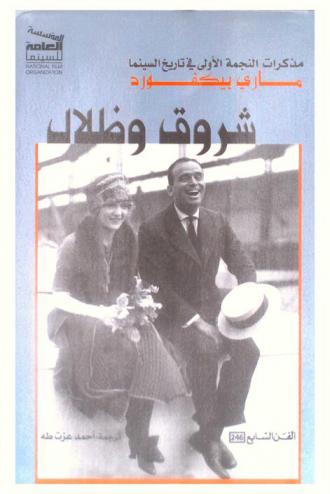
شروق وظلال : مذكرات النجمة الأولى في تاريخ السينما
يسرد الكتاب الذي تولى ترجمته أحمد عزت طه بلغة بسيطة يستطيع القارئ العادي أن يفهمها حياة النجمة بيكفورد منذ وفاة والدها وهي في سنين عمرها الأولى والمعاناة التي مرت بها العائلة من فقر وتنقل. وتصف النجمة الكندية الأصل خلال فصول الكتاب بدقة مراحل دقيقة من حياتها وأختها وأخوها الأطفال الصغار مع أم شابة ترملت في سن العشرين ووهبت حياتها لتربية أطفالها الثلاثة وتأمين مورد لمعيشتهم. وذكرت أن بدايتها مع المسرح كانت عبر مدير مسرح شركة كامينكر ستوك في تورنتو بكندا الذي استأجر غرفة في منزل العائلة وعرض بعد فترة من سكنه على والدتها أن تشارك وشقيقتها في مسرحية بعنوان الملك الفضي وقبل أن ترفض الطلب دعاها لتكون مع المجموعة المسرحية في الكواليس ليؤكد لها أن الفنانين لا يختلفون عن الناس الآخرين وفعلا لبت أمها الدعوة وكانت النتيجة أنها بدأت واختها لوتي العمل المسرحي. وعبر سنوات من المعاناة خلال العمل المسرحي إلى أن أصبحت نجمة بهذه المكانة الفنية العالية.
BOOK

Un otro lugar para la subjetividad femenina: la caída cómica en las películas de Frances Marion y Mary Pickford
Mary Pickford contrató a Frances Marion en 1915 para que escribiera los guiones de sus películas, éxitos de taquilla que afianzaron su estrellato en la década de los diez del siglo veinte. En un marco social convulso, marcado por la Primera Guerra Mundial y los cambios que las mujeres sufrieron en el paso de una sociedad decimonónica a una moderna, los personajes de Mary Pickford fueron un modelo de optimismo para las audiencias. La estrella representó una figuración tradicional, pero a través de la comicidad ofreció nuevos comportamientos femeninos. El artículo estudiará la comicidad de los personajes de la estrella para exponer que en su gestualidad cómica se vislumbra una autónoma subjetividad femenina. A partir del análisis del gag de la caída cómica que se encuentra en todas las películas de Frances Marion y Mary Pickford se demostrará que la guionista y la estrella desarrollaron un discurso alternativo a la visión falocéntrica del sujeto. A través de los Star Studies y las teorías filosóficas feministas de Teresa De Lauretis y Rosi Braidotti se demostrará que en la caída cómica Mary Pickford reveló una subjetividad “excéntrica”, capaz de crear un “otro lugar” de resistencia al logos decimonónico y patriarcal.
Journal Article

Un otro lugar para la subjetividad femenina: la caída cómica en las películas de Frances Marion y Mary Pickford /An-Other Place for Female Subjectivity: the Comic Pratfall in the Films of Frances Marion and Mary Pickford
Mary Pickford contrató a Frances Marion en 1915 para que escribiera los guiones de sus películas, éxitos de taquilla que afianzaron su estrellato en la década de los diez del siglo veinte. En un marco social convulso, marcado por la Primera Guerra Mundial y los cambios que las mujeres sufrieron en el paso de una sociedad decimonónica a una moderna, los personajes de Mary Pickford fueron un modelo de optimismo para las audiencias. La estrella representó una figuración tradicional, pero a través de la comicidad ofreció nuevos comportamientos femeninos. El artículo estudiará la comicidad de los personajes de la estrella para exponer que en su gestualidad cómica se vislumbra una autónoma subjetividad femenina. A partir del análisis del gag de la caída cómica que se encuentra en todas las películas de Frances Marion y Mary Pickford se demostrará que la guionista y la estrella desarrollaron un discurso que transgredía la visión falocéntrica del sujeto. A través de los Star Studies y las teorías filosóficas feministas de Teresa De Lauretis y Rosi Braidotti se demostrará que en la caída cómica Mary Pickford reveló una subjetividad \"excéntrica\", capaz de crear un \"otro lugar\" de resistencia al logos decimonónico y patriarcal.
Journal Article

American Cinema of the 1920s
During the 1920s, sound revolutionized the motion picture industry and cinema continued as one of the most significant and popular forms of mass entertainment in the world. Film studios were transformed into major corporations, hiring a host of craftsmen and technicians including cinematographers, editors, screenwriters, and set designers. The birth of the star system supported the meteoric rise and celebrity status of actors including Charlie Chaplin, Mary Pickford, Joan Crawford, Greta Garbo, and Rudolph Valentino while black performers (relegated to \"race films\") appeared infrequently in mainstream movies. The classic Hollywood film style was perfected and significant film genres were established: the melodrama, western, historical epic, and romantic comedy, along with slapstick, science fiction, and fantasy.
In ten original essays,American Cinema of the 1920sexamines the film industry's continued growth and prosperity while focusing on important themes of the era.
eBook
Promoting and Containing New Womanhood in the Pages of Photoplay: The Case Of \Little Mary\ Pickford and Her Mediated Alter Egos on the Cusp of the Roaring Twenties
Actress Mary Pickford is perhaps best remembered for her silent-screen persona “Little Mary.” But there was another important aspect to her Hollywood career that is frequently overlooked today: Pickford’s rise to power and fame corresponded with the era of the “New Woman” in U.S. society. This article explores the mediated construction of new womanhood as communicated through the coverage of Pickford’s career between 1918 and 1921 in the pages of the fan magazine Photoplay. It demonstrates how Photoplay used coverage of Pickford to promote the ideal of new womanhood until 1919, when she became the most powerful woman in American moviemaking by co-founding United Artists with three men. After that, at the start of the Roaring Twenties, the magazine sought to contain new womanhood by presenting Pickford almost exclusively as a child, without continuing to acknowledge her abilities as a savvy movie mogul and grown woman as it had regularly done in the past—until significant changes in her personal life required another noteworthy shift in the magazine’s coverage patterns of this star.
Journal Article

In Behalf of the Feminine Side of the Commercial Stage: The Institute of the Woman's Theatre and Stagestruck Girls
By Mabel Rowland's public accounting, the Institute of the Woman's Theatre helped hundreds of so-called stagestruck girls realize their ambitions by providing a safety net for the pitfalls of the commercial theatre. The organization, officially established in 1926 and in operation until roughly 1930, was said to have begun years earlier, “the outgrowth of a group which was formed in 1910 and used to meet in the Fitzgerald Building.” As president, Rowland—a press agent, well-known comedic monologist, and all-around theatre factotum—was supported by society women and a cadre of famous female writers and performers, including Florence Reed, who served as Vice President, and charter members Julia Arthur, Irene Castle, Rachel Crothers, Helen Hayes, Violet Heming, Elsie Janis, Anita Loos, Mary Pickford, and Mary Shaw, plus about a dozen more. At the time of its official founding, the institute announced that it would undertake three activities. First, it sought to establish a professional Broadway theatre as exclusively a women's operation, employing female playwrights, designers, directors, managers, producers, box-office staff, and so forth: “The only men who will be connected with the enterprise … are the actors and stagehands.” Second and third, the institute would give “aid and advice to girls from out of town who think they have something to offer the theater, read scripts and give opinions thereon, and in other ways labor in behalf of the feminine side of the stage.” The institute's goal of a theatre in tandem with discovering talented women looked to create a meaningful shift in women's inclusion and power within commercial theatre.
Journal Article

The Conditions of Fame: Literary Celebrity in Australia between the Wars
Modern celebrity is typically associated with metropolitan centers and with the new media of radio and cinema. But Australian cultural institutions and markets were thoroughly engaged in the transnational networks of modernity. New forms of authorial fame emerged alongside the star systems of radio and cinema, largely through the operations of the commercial periodical press. Australian magazines of the 1920s and 1930s register the impact of modernity and celebrity. Personality and celebrity become dominant there, and artists and writers are among those featured. Yet Australia's “provincial” relations to Britain and the US meant that attaching celebrity to Australian authors remained problematic, despite editorial investments in representing local books and writing as aspects of a modern life or personality.
Journal Article

Shirley Temple and the Performance of Girlhood
In the 1930s, Shirley Temple was heralded as \"America's sweetheart,\" and she remains the icon of wholesome American girlhood, but Temple's films strike many modern viewers as perverse.Shirley Temple and the Performance of Girlhoodexamines her early career in the context of the history of girlhood and considers how Temple's star image emerged out of the Victorian cult of the child.
Beginning her career in \"Baby Burlesks,\" short films where she played vamps and harlots, her biggest hits were marketed as romances between Temple and her adult male costars. Kristen Hatch helps modern audiences make sense of the erotic undercurrents that seem to run through these movies. Placing Temple's films in their historical context and reading them alongside earlier representations of girlhood in Victorian theater and silent film, Hatch shows how Shirley Temple emerged at the very moment that long standing beliefs about childhood innocence and sexuality were starting to change. Where we might now see a wholesome child in danger of adult corruption, earlier audiences saw Temple's films as demonstrations of the purifying power of childhood innocence.
Hatch examines the cultural history of the time to view Temple's performances in terms of sexuality, but in relation to changing views about gender, class, and race. Filled with new archival research,Shirley Temple and the Performance of Girlhoodenables us to appreciate the \"simpler times\" of Temple's stardom in all its thorny complexity.
eBook

Mary Pickford and the American \Growing Girl\
\"I always study a part very carefully and try to get into the spirit of the child I am to portray,\" commented twenty-six-year-old Mary Pickford (1892-1979) in a July 1918 interview in Motion Picture Classic. \"The costume, dressing the character, means a lot. You know, when I'm dressed as a child, I never walk. I always skip or run. Funny how one feels a character when ... dressed for the part. You just naturally lose your own identity\" (McKelvie).
During the years 1917-20 Mary Pickford achieved international celebrity appearing in screen adaptations of several classic children's novels and stories, including Eleanor Gates's The Poor Little Rich Girl (1912), Kate Douglas Wiggin's Rebecca of Sunny-brook Farm (1903), Frances Hodgson Burnett's A Little Princess (1903), William J. Locke's Stella Maris (1913), Belle K. Maniates's Amarilly of Clothes-Line Alley (1915), Bret Harte's \"M7apos;liss\" (1868), Jean Webster's Daddy-Long-Legs (1912), and Eleanor H. Porter's Pollyanna (1913). These \"growing girl\" films, as I shall call them, instantly eclipsed the popularity of her earlier films, most of which had featured her in adult roles.
1
Audiences, if not all the critics, notes biographer Robert Windeler, were delighted to discover the \"Little Mary\" of the long, backlighted blonde curls, \"in Tattered-Tom clothes, a sometimes smudged face, and with no visible breasts\" (96). Now, at the zenith of her career, Pickford's little-girl roles established her indisputably as the highest paid, most recognized, most idolized, and most powerful female in the entertainment business. She had forged an image, says commentator Arlene Croce with a touch of sarcasm, that \"had become the nearest thing to a universally recognized holy icon\" (132).
Journal Article