
Catalogue Search | MBRL


Are you sure you want to remove the book from the shelf?

{{itemTitle}}
323
result(s) for
"mathematical learning difficulties"
Sort by:

Number Line Strategies of Students with Mathematical Learning Difficulties and Students with General Learning Difficulties: Findings Through Eye Tracking
In many countries, the number line (NL) is an important tool in mathematics education to develop an understanding of numbers. However, students may have difficulties using the NL. To provide students showing NL difficulties with appropriate support, more research is needed on how these students interact with NLs. In this study, we investigated how three different groups of students located numbers on an NL: 20 fifth-grade students with general learning difficulties (LD) from a special school, and 60 fifth-grade students with mathematical learning difficulties (MD) from a school of general education, compared to 55 fifth-grade students without MD/LD. We analyzed students’ strategies based on qualitative analysis of eye-tracking videos and students’ error rates. We found that all students were generally able to solve the tasks correctly. Analyses of students’ strategies showed that the types of strategies used for locating numbers on an NL did not differ between students with LD, with MD, and without MD/LD. Differences were found in the frequency with which certain strategies were used, particularly for numbers between the midpoint and endpoint of the NL—indicating differences in the mathematical development regarding the flexible use of NL strategies between students with LD, with MD, and without MD/LD.
Journal Article

The Effects of Visual Cueing on Students with and without Math Learning Difficulties in Online Problem Solving: Evidence from Eye Movement
This study investigated the impact of visual cueing on attention guidance, deep-thinking promotion, and performance optimization in arithmetic word problem solving for students with mathematical learning difficulties (MLD). The participants included eight students with MLD and twenty students without MLD who attempted to solve mathematical word problems with and without visual cueing. Eye movements were recorded during the tasks. A repeated-measure design and nonparametric tests were applied to enhance the statistical power of the study. The data analysis results indicated that visual cueing effectively guided and sustained the attention of students with MLD, reducing their off-task duration. However, it showed limited influence in facilitating deep thinking and performance improvement for these students. There were no significant attention-guidance or performance-improvement effects observed in the problem-solving processes of students without MLD, who initially demonstrated better concentration levels and performance. The potential explanations for these findings are further discussed in this paper.
Journal Article

Parental awareness, diagnostic processes, and support needs regarding mathematical learning difficulties
This study examines the awareness levels, diagnostic experiences, and support needs of parents of children diagnosed with Specific Learning Disability (SLD) displaying Mathematical Learning Difficulties (MLDs) through the lens of Ecological Systems Theory (EST). Adopting a phenomenological design, the study involved seventeen parents selected via maximum variation sampling to represent diverse socioeconomic backgrounds in Van, Türkiye. Data were collected through semi-structured interviews and analyzed using content analysis. The findings indicate that the early signs of MLD are typically recognized by teachers during the early primary years (
chronosystem
). Teacher guidance within the
microsystem
proves decisive in facilitating parental acceptance and initiating the multi-staged diagnostic process involving Guidance and Research Centers (GRC) and medical evaluations. While school-based individualized interventions are perceived as beneficial, the study reveals critical disconnects within the
mesosystem
(e.g., weak coordination between school, family, and rehabilitation services) and significant barriers arising from the
exosystem
(e.g., financial constraints, limited access to specialized support). Although parents attempt to mitigate these gaps through home-based support strategies using concrete and digital tools, their efforts are often constrained by low pedagogical literacy and societal stigma (
macrosystem
). The study emphasizes the necessity of institutionalizing school-based interdisciplinary support teams, integrating practical MLD modules into teacher education, and fostering equitable access to instructional resources to bridge the gap between policy and practice.
Journal Article

Assistance of students with mathematical learning difficulties : how can research support practice?
When looking at teaching and learning processes in mathematics education students with mathematical learning difficulties or disabilities are of great interest. To approach the question of how research can support practice to assist these students one has to clarify the group or groups of students that we are talking about. The following contribution firstly concentrates on the problem of labelling the group of students having mathematical difficulties as there does not exist a single definition. This problem might be put down to the different roots of mathematics education on the one hand and special education on the other hand. Research results with respect to concepts and models for instruction are multifaceted based on the specific content and mathematical topics as well as the underlying view of mathematics. Taking into account inclusive education, a closer orientation to mathematical education can be identified and the potential of selected teaching and learning concepts can be illustrated. Beyond this, the role of the teacher, their attitudes and beliefs and the corresponding teacher education programs are discussed. [Author abstract]
Journal Article

Mathematical learning difficulties subtypes classification
The literature refers to two preverbal or non-symbolic systems for processing quantities: (1) the object tracking system (OTS) that is precise, limited by its absolute set size, and that creates an object file with concrete information for each objects observed simultaneously (Brannon and Roitman, 2003; Xu, 2003; Fayol and Seron, 2005; van Herwegen et al., 2008; Cordes and Brannon, 2009; Cantlon et al., 2010; Piazza, 2010); (2) the approximate number system (ANS) that is extensible to very large quantities, operates on continuous dimensions, and yields and approximate evaluation in accordance with Weber's law (Xu and Spelke, 2000; Mix et al., 2002; Halberda and Feigenson, 2008; Piazza, 2010). Together with the existing hypotheses of domain specific deficits in number processing that we have presented in section Hypotheses for Difficulties in the Learning of Numbers, we support an additional hypothesis of a domain general cognitive deficit underlying MLD (Geary, 2004; Geary and Hoard, 2005), which emanates from converging evidence showing that such cognitive functions are involved in mathematical performance in both adults and children (Fuchs et al., 2005; Andersson, 2007, 2008; Swanson et al., 2008). [...]we believe, that in general intervention should focus mostly on the students' strengths, because this can have positive effects on motivation, while attempts to address students' weaknesses directly are likely to contribute to de-motivation and further failures. [...]educators, from researchers to teachers, can use the model to easily create tasks for working with their students. [...]the suggested classification model of MLD is expected to be clinically useful, as has been observed during a first study of its validity, the results of which will be soon submitted for publication.
Journal Article

Enhancing Time Reading and Recording Skills in First-Grade Children with Learning Difficulties Using the “Clock Motor Game”
This study aimed to explore the effect of the motor game, “Clock Motor Games”, on the improvement of “Reading and Recording of Time” (RRT) in children with Grade 1 mathematical learning difficulties (MLDs). A within-school cluster-randomized intervention study was conducted with 232 children (aged 6–7 years) with limited physical education experience (0.7 ± 0.3 years). The participants were divided into two groups: a control group, which received conventional teaching on time without any additional motor activities, and an experimental group, which incorporated the concept of time with the “Clock Motor Game”, for 3 weeks. The Clock-Reading Test was administered before the intervention (T0), immediately after each session (T1), and five weeks after the intervention (T2) in both groups. The results demonstrated that the experimental group exhibited significantly greater improvements in RRT performance compared to the control group (U = 4416.5; p < 0.001; r = 0.3; medium effect). Additionally, the experimental group was more likely to show progress and less likely to experience regression or stagnation compared to the control group (25% vs. 38.4%). The findings suggest that practicing “Clock Motor Games” can positively contribute to the RRT ability in children with Grade 1 MLD.
Journal Article

Predicting Mathematical Learning Difficulties Status: The Role of Domain-Specific and Domain-General Skills
This study investigated which domain-specific and domain-general skills measured at grade 1 predict mathematical learning difficulties (MLD) status at grade 3. We used different cut-off criteria and measures of mathematics performance for defining the MLD status. Norwegian children’s (N = 206) numeracy, cognitive, and language skills were measured at grade 1 and arithmetic fluency and curriculum-based mathematics (CBM) at grade 3. Logistic regression analyses showed that symbolic numerical magnitude processing, verbal counting, and rapid automatized naming predicted MLD25 status (performance ≤ 25th percentile) based on arithmetic fluency, whereas verbal counting skills and nonverbal reasoning predicted the status based on CBM. The same predictors were found for MLD10 status (performance ≤ 10th percentile), and in addition, rapid automatized naming also predicted the status based on CBM. Only symbolic numerical magnitude processing and verbal counting predicted LOW status (performance between 11–25th percentile) based on arithmetic fluency, whereas nonverbal reasoning and working memory predicted LOW status based on CBM. Different cut-off scores and mathematics measures used for the definition of MLD status are important to acknowledge, as these seem to lead to relatively significant variation in which students are identified as having MLD and which factors contribute to the MLD status. This study investigated which domain-specific and domain-general skills measured at grade 1 predict mathematical learning difficulties (MLD) status at grade 3. We used different cut-off criteria and measures of mathematics performance for defining the MLD status. Norwegian children’s (N = 206) numeracy, cognitive, and language skills were measured at grade 1 and arithmetic fluency and curriculum-based mathematics (CBM) at grade 3. Logistic regression analyses showed that symbolic numerical magnitude processing, verbal counting, and rapid automatized naming predicted MLD25 status (performance ≤ 25th percentile) based on arithmetic fluency, whereas verbal counting skills and nonverbal reasoning predicted the status based on CBM. The same predictors were found for MLD10 status (performance ≤ 10th percentile), and in addition, rapid automatized naming also predicted the status based on CBM. Only symbolic numerical magnitude processing and verbal counting predicted LOW status (performance between 11–25th percentile) based on arithmetic fluency, whereas nonverbal reasoning and working memory predicted LOW status based on CBM. Different cut-off scores and mathematics measures used for the definition of MLD status are important to acknowledge, as these seem to lead to relatively significant variation in which students are identified as having MLD and which factors contribute to the MLD status.
Journal Article

CAN INFOGRAPHICS FACILITATE THE LEARNING OF INDIVIDUALS WITH MATHEMATICAL LEARNING DIFFICULTIES?
Visualization of data has recently gained great importance in education and use of infographics is regarded as an important tool in teaching mathematics since it presents information in a clear and abstract way. Therefore, use of infographics for helping individuals with mathematical learning difficulties has become an important research question. This study aims to provide an overview on the use of infographics in teaching mathematics to individuals with mathematical learning difficulties. This is a qualitative study in which document analysis was used the collect the data. Results provided information about the definition of infographics, effectiveness of using infographics in education and facilitative role of infographics in enhancing learning of individuals with mathematical learning difficulties, namely dyscalculia. Results were discussed with relevant literature and recommendations for further research and practices were also presented.
Journal Article
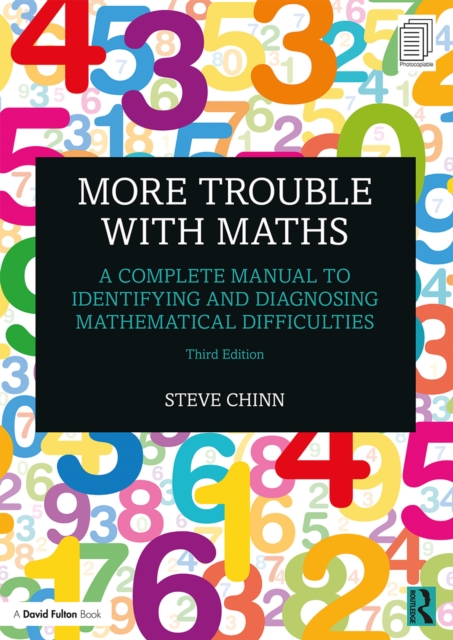
More Trouble with Maths
Now in an updated third edition, this invaluable resource takes a practical and accessible approach to identifying and diagnosing many of the factors that contribute to mathematical learning difficulties and dyscalculia. Using a combination of formative and summative approaches, it provides a range of norm-referenced, standardised tests and diagnostic activities, each designed to reveal common error patterns and misconceptions in order to form a basis for intervention. Revised to reflect developments in the understanding of learning difficulties in mathematics, the book gives a diagnostic overview of a range of challenges to mathematical learning, including difficulties in grasping and retaining facts, problems with mathematics vocabulary and maths anxiety.
Key features of this book include:
Photocopiable tests and activities designed to be presented in a low-stress way
Guidance on the interpretation of data, allowing diagnosis and assessment to become integrated into everyday teaching
Sample reports, showing the diagnostic tests in practice
Drawing on tried and tested methods, as well as the author’s extensive experience and expertise, this book is written in an engaging and user-friendly style. It is a vital resource for anyone who wants to accurately identify the depth and nature of mathematical learning difficulties and dyscalculia.
eBook
Mathematical Profile Test: A Preliminary Evaluation of an Online Assessment for Mathematics Skills of Children in Grades 1–6
The domain of numerical cognition still lacks an assessment tool that is theoretically driven and that covers a wide range of key numerical processes with the aim of identifying the learning profiles of children with difficulties in mathematics (MD) or dyscalculia. This paper is the first presentation of an online collectively administered tool developed to meet these goals. The Mathematical Profile Test (MathPro Test) includes 18 subtests that assess numerical skills related to the core number domain or to the visual-spatial, memory or reasoning domains. The specific aim of this paper is to present the preliminary evaluation both of the sensitivity and the psychometric characteristics of the individual measures of the MathPro Test, which was administered to 622 primary school children (grades 1–6) in Belgium. Performance on the subtests increased across all grades and varied along the level of difficulty of the items, supporting the sensitivity of the test. The MathPro Test also showed satisfactory internal consistency and significant and stable correlation with a standardized test in mathematics across all grades. In particular, the achievement in mathematics was strongly associated with the performance on the subtests assessing the reasoning and the visuospatial domains throughout all school grades, whereas associations with the core number and memory tasks were found mainly in the younger children. MD children performed significantly lower than their peers; these differences in performance on the MathPro subtests also varied according to the school grades, informing us about the developmental changes of the weaknesses of children with MD. These results suggest that the MathPro Test is a very promising tool for conducting large scale research and for clinicians to sketch out the mathematical profile of children with MD or dyscalculia.
Journal Article