
Catalogue Search | MBRL


Are you sure you want to remove the book from the shelf?

{{itemTitle}}
38
result(s) for
"maximus confessor"
Sort by:


The Whole Mystery of Christ
A thoroughgoing examination of Maximus Confessor's
singular theological vision through the prism of Christ's cosmic
and historical Incarnation.
Jordan Daniel Wood changes the trajectory of patristic
scholarship with this comprehensive historical and systematic study
of one of the most creative and profound thinkers of the patristic
era: Maximus Confessor (560-662 CE). Wood's panoramic vantage on
Maximus's thought emulates the theological depth of Hans Urs von
Balthasar's Cosmic Liturgy while also serving as a
corrective to that classic text.
Maximus's theological vision may be summed up in his enigmatic
assertion that \"the Word of God, very God, wills always and in all
things to actualize the mystery of his Incarnation.\" The Whole
Mystery of Christ sets out to explicate this claim. Attentive
to the various contexts in which Maximus thought and
wrote-including the wisdom of earlier church fathers, conciliar
developments in Christological and Trinitarian doctrine, monastic
and ascetic ways of life, and prominent contemporary philosophical
traditions-the book explores the relations between God's act of
creation and the Word's historical Incarnation, between the analogy
of being and Christology, and between history and the Fall, in
addition to treating such topics as grace, deification, theological
predication, and the ontology of nature versus personhood. Perhaps
uniquely among Christian thinkers, Wood argues, Maximus envisions
creatio ex nihilo as creatio ex Deo in the event
of the Word's kenosis: the mystery of Christ is the revealed
identity of the Word's historical and cosmic Incarnation. This book
will be of interest to scholars and students of patristics,
historical theology, systematic theology, and Byzantine
studies.
eBook
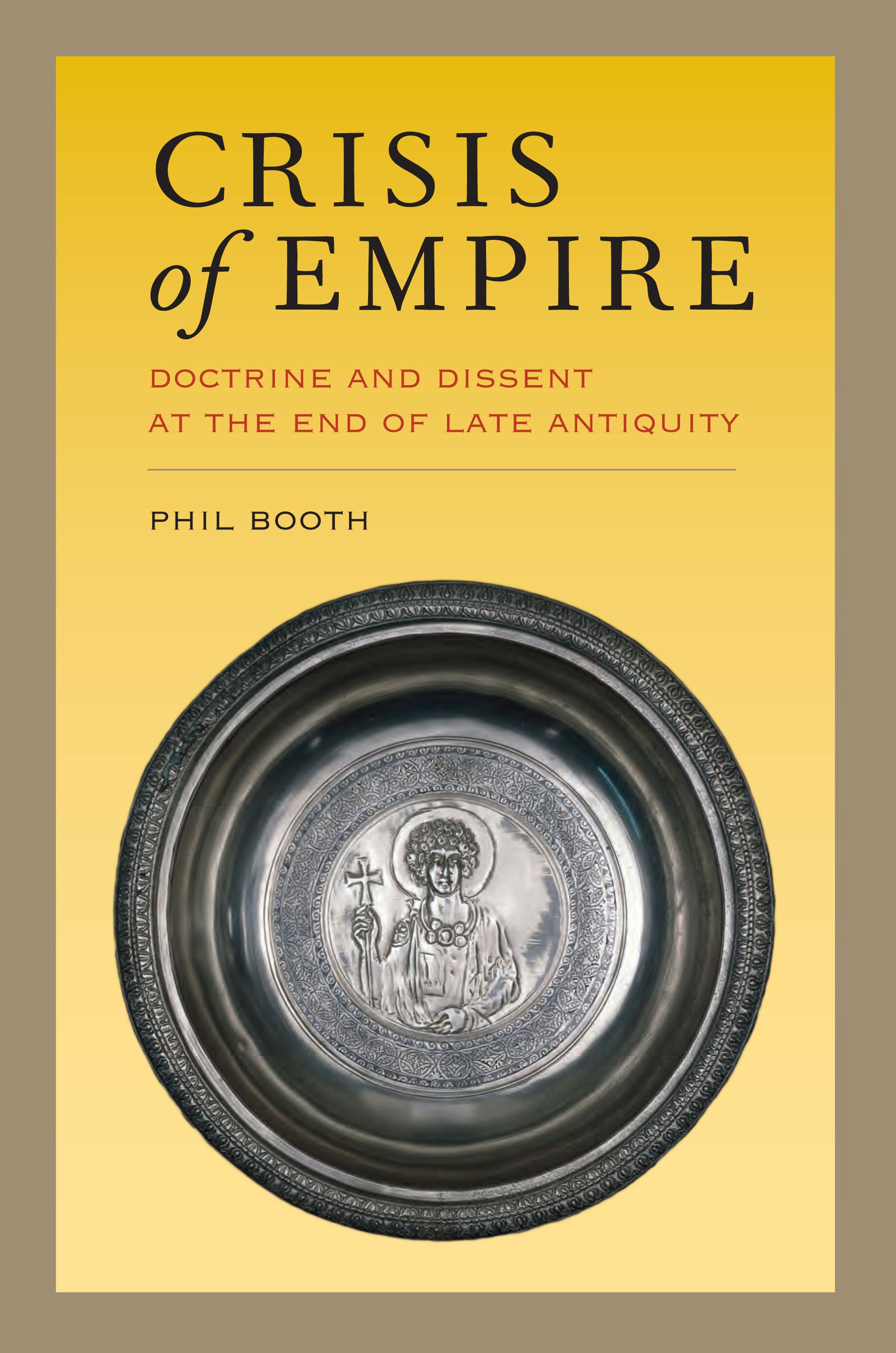
Crisis of empire
This book focuses on the attempts of three ascetics—John Moschus, Sophronius of Jerusalem, and Maximus Confessor—to determine the Church’s power and place during a period of profound crisis, as the eastern Roman empire suffered serious reversals in the face of Persian and then Islamic expansion. By asserting visions which reconciled long-standing intellectual tensions between asceticism and Church, these authors established the framework for their subsequent emergence as Constantinople's most vociferous religious critics, their alliance with the Roman popes, and their radical rejection of imperial interference in matters of the faith. Situated within the broader religious currents of the fourth to seventh centuries, this book throws new light on the nature not only of the holy man in late antiquity, but also of the Byzantine Orthodoxy that would emerge in the Middle Ages, and which is still central to the churches of Greece and Eastern Europe.
eBook

A Patristic Synthesis of the Word Enfleshed: The Christology of Maximus the Confessor
St. Maximus the Confessor (580–662) stands out among the Church Fathers as one of the last Christological martyrs. Maximus possessed one of the greatest minds of the Church’s first millennium. The greatest strength of Maximus’s Christology is that he presents a synthesis of all Christological contributions known to him while developing his own Christology of union in distinction. In order to flesh out his system of Christology, this essay works primarily with select works of Maximus’s, namely, the Small Theological and Polemical Works (Opuscula), the Ambigua, the Questions to Thalassius, and the Mystagogy. It will demonstrate that Maximus’s Christology bears the following four predominant signatures: it is patristic, Incarnational, composite, and cosmic. All four features are interrelated, particularly in Maximus’s theory of the λόγοι (logology), and all four hold significant sway over the whole of his doctrine. The essay concludes with a brief consideration of how the Ressourcement movement has benefitted Maximian studies.
Journal Article
Typologie Spatio-Temporelle de l'Ecclesia Byzantine
This study addresses the philosophical context of the Mystagogy of Maximus the Confessor. It examines how the Byzantine monk integrates Neoplatonist topics when exposing one of the most important feature of his religious conception of the physical world or cosmology. It provides many important new perspectives for reading the works of Maximus the Confessor, especially the Mystagogy, not only for theologians, but also for scholars interested in late Antique and Byzantine philosophy.
eBook
“Signore, Ti Amo” (John 21:17): The Christology of Pope Benedict XVI/Joseph Ratzinger
With 1600 titles Joseph Ratzinger/Pope Benedict XVI. is the most academically published pope in Church history. His stature as a theologian is only comparable to that of Leo the Great or Gregory the Great. In an age that has lost an appreciation for the human being as a person, the peritus Ratzinger introduced at the Second Vatican Council the notion that divine revelation is ultimately identical with the Godman Jesus Christ. In his view, Jesus Christ, as a divine person with both divine and human natures, redeems the postmodern human being from solipsistic self-preoccupation and existentialist despair. Such is the result of a positivistic and rationalistic approach to the figure of Jesus Christ. At the beginning of the 21st century, Pope Benedict XVI inaugurated an epochal, personalist, and Christocentric shift by penning the Jesus of Nazareth trilogy, taking serious Kant’s critiques and writing thus the first “post-critical” Christology presented to postmodernity. Nowhere else does Ratzinger write so extensively on “the man from Nazareth”.
Journal Article

Logostalgia: Eschatology and the Sixth Extinction
What would it mean to give a theological account of mass extinction events? Taking into consideration new developments in extinction studies alongside the Greek tradition’s vocabulary for the created order, this article argues that an eschatology centered on the excessive Logoi of creaturely existence can allow anthropogenic mass extinction to register as a call for contemplative acknowledgment. The eschatology builds critically on the deep incarnation thesis of Niels Henrik Gregersen and the work of Christopher Southgate, arguing for an anthropocentricism that participates in the excessive redemptive work of the incarnate Logos.
Journal Article
CBT (Cognitive Behavioural Therapy) and Spiritual Exegesis (πνευματικὴ ἐξήγησις) in the Writings of Saint Maximus the Confessor: A Study in the Modality of the Psychology of Religion
This title and theme of this study will be preoccupied with the discipline of the psychology of religion. It aims at bringing closer the psychology of religion and the writings of the St Maximus the Confessor in an interdisciplinary perspective. Its objective will be focused on illustrating elements of spirituality as a psychological trend under modern psychological endeavours, such as those associated with cognitive behavioural therapy (CBT), and in terms of identifying mental disorders, like anxiety and depression, and therapeutic interventions of change on them. In addition, it will present and discuss St. Maximus the Confessor’s psychological aspects on man that relate to fallenness, intrapsychic upheaval, and therapeutic suggestions. This topic will be presented as an empirical study, based on an inventory (PIPR—Philautia Inventory for the Psychology of Religion) that I have developed, which outlines items from St. Maximus the Confessor’s Christian Orthodox Psychology that are relevant to the spiritual anthropology and exegetical paradigm of that father’s interpretation of the condition of man. This is the second time that I have employed this inventory, for I have constructed it to be pilot-studied, and then to use it in a main study in the future. The items of the PIPR are validated through this pilot study (the present paper). The discussion which will derive from such a pilot empirical study will look into the interdisciplinary elements of spirituality according to a psychology of religion perspective, and the convergence and divergence between the psychology of religion and St. Maximus the Confessor’s writings. This empirical study will concentrate on the inventory I have suggested based on the pilot study that was conducted on each of its items. Last, but not least, I will also discuss and suggest how, by studying the writings of St. Maximus the Confessor, the psychology of religion can benefit, in view to presenting, discussing, and studying the human condition as a psychosomatic endeavour, and not simply as a psychological edifice, and connecting to how the faculties of the human mind operate and function.
Journal Article

Whole God and whole man: Deification as incarnation in Maximus the Confessor
Maximus the Confessor says that the Word of God wills to be embodied always and in all things. Against many who wish to render this ‘universal incarnation’ metaphorical, I attempt a literal reading. When Maximus speaks of the Word's universal incarnation, he refers to the deification of human beings, which constitutes a single reality with the Word's incarnation. For Maximus, deification perfectly realises and completes the very logic of the Word's incarnational descent: just as God became whole man while remaining whole God, human beings will become whole God while remaining wholly human. Herein all things become enhypostasised into the Word – rendered one by grace with Christ himself, through his humanity – and so the Word becomes embodied in all things.
Journal Article

PEACOCKE PRIZE ESSAY—TOWARDS AN EASTERN ORTHODOX CONTEMPLATION OF EVOLUTION: MAXIMUS THE CONFESSOR'S VISION OF THE PHYLOGENETIC LOGOI
In recent years, several scholars have hinted at a resemblance between Maximus the Confessor's logoi cosmology and evolutionary biology. In this article, I develop these suggestions further and claim that the logoi (divine ideas or wills) do indeed behave in an evolutionary fashion, diverging hierarchically and interactively from the Logos. However, there the similarity ends, for the logoi are also purposeful, inviolable, and good, unlike evolution which is said to be random, ever‐changing, and cruel. But rather than abandon the logoi–evolution congruity, I argue that, by harnessing theological resources from across the Eastern tradition, one can integrate Maximus’ logoi vision more fully, resulting in an “incarnationally panentheistic” model of God's action and presence in evolution. More speculatively, within canonical Darwinism, the underlying (good) evolutionary motion of the logoi might be discernible in variation and adaptation, with the “evil” of competition and natural selection being “garments of skin” conceded by God as part of a simultaneous creation and cosmic fall.
Journal Article